The plain version
You are buying hours of searching. The risk in buying hours of searching is that you spend them and end up exactly where you started, holding an invoice and still not knowing where the water is going. No find, no fee moves that risk off you and onto us.
It is one promise, and it is narrow on purpose: if we do not find the leak, you do not pay for the time we spent looking. Everything else about the job is priced normally, at £150 per hour.
What it covers and what it does not
| Covered by the guarantee | Not covered |
|---|
| The hours spent tracing a leak we do not locate | The hours spent tracing a leak we do locate |
| An unsuccessful search regardless of how long it took | The repair itself, once the leak has been found |
| Method escalation that does not produce an answer | Reinstatement: flooring, screed, plaster, tiling, decoration |
| A job where there turns out to be no leak, but the cause is found |
That last row is the one worth dwelling on. A meter that turns with everything off is sometimes a passing toilet valve, a garden tap left cracked open, or a neighbour on a shared supply. Diagnosing that is a find. You have your answer, the search worked, and the time is chargeable. The guarantee is against failure, not against being told something you did not expect.
It is not the same thing as free
"Free leak detection" and "no find, no fee" are different offers, and the first one is almost always attached to something. A free survey is usually a sales visit for a repair, a free detection is usually free only if you then accept the repair quote, and a free call-out generally means the attendance cost has been folded into an hourly rate you have not been shown yet.
No find, no fee makes no claim to be free. It says the successful outcome is chargeable and the unsuccessful one is not. If somebody offers you both free and no find, no fee in the same sentence, ask which one they mean.
The five questions that tell you whether a guarantee is real
- Is it in writing, before the visit? A guarantee described on a phone call and absent from the booking confirmation is not a guarantee.
- Does it include the call-out fee? Plenty of "no find, no fee" offers waive the hourly labour and keep the attendance charge. That can be most of the bill on a short visit, given that Checkatrade puts emergency call-out fees at £100 to £120.
- Who decides whether the leak was found? If the answer is "the engineer, on the day, verbally", the wording is doing nothing. A written report that states what was tested, what was excluded and what was located is what makes the promise checkable.
- Does it survive a second visit? Some guarantees quietly expire if the job needs the flat above, or a drained circuit, or a return when the weather is different.
- Is there a time cap? "No find, no fee up to two hours" is a two-hour guarantee, and the third hour is yours whatever happens.
Why a lower hourly rate can cost you more
Take the market rates as published: Checkatrade puts a standard plumber at £40 to £60 an hour. Suppose an engineer at the top of that range spends three hours in your house and does not find the leak. You pay £180 for three hours of labour, plus any call-out fee, and you still have the problem. Book again next week and the meter starts at zero for the second attempt.
Now run the same three unsuccessful hours under a no find, no fee guarantee. The cost of those hours is nothing. Not discounted, not credited against a future visit. Nothing.
The rate you compare on a price list is the cost of a good outcome. The number that actually varies between firms is the cost of a bad one, and that is the number nobody advertises. A guarantee is the only thing that makes a higher rate cheaper on average, because it prices the failures into the successes instead of billing them to whoever happened to have the hardest leak.
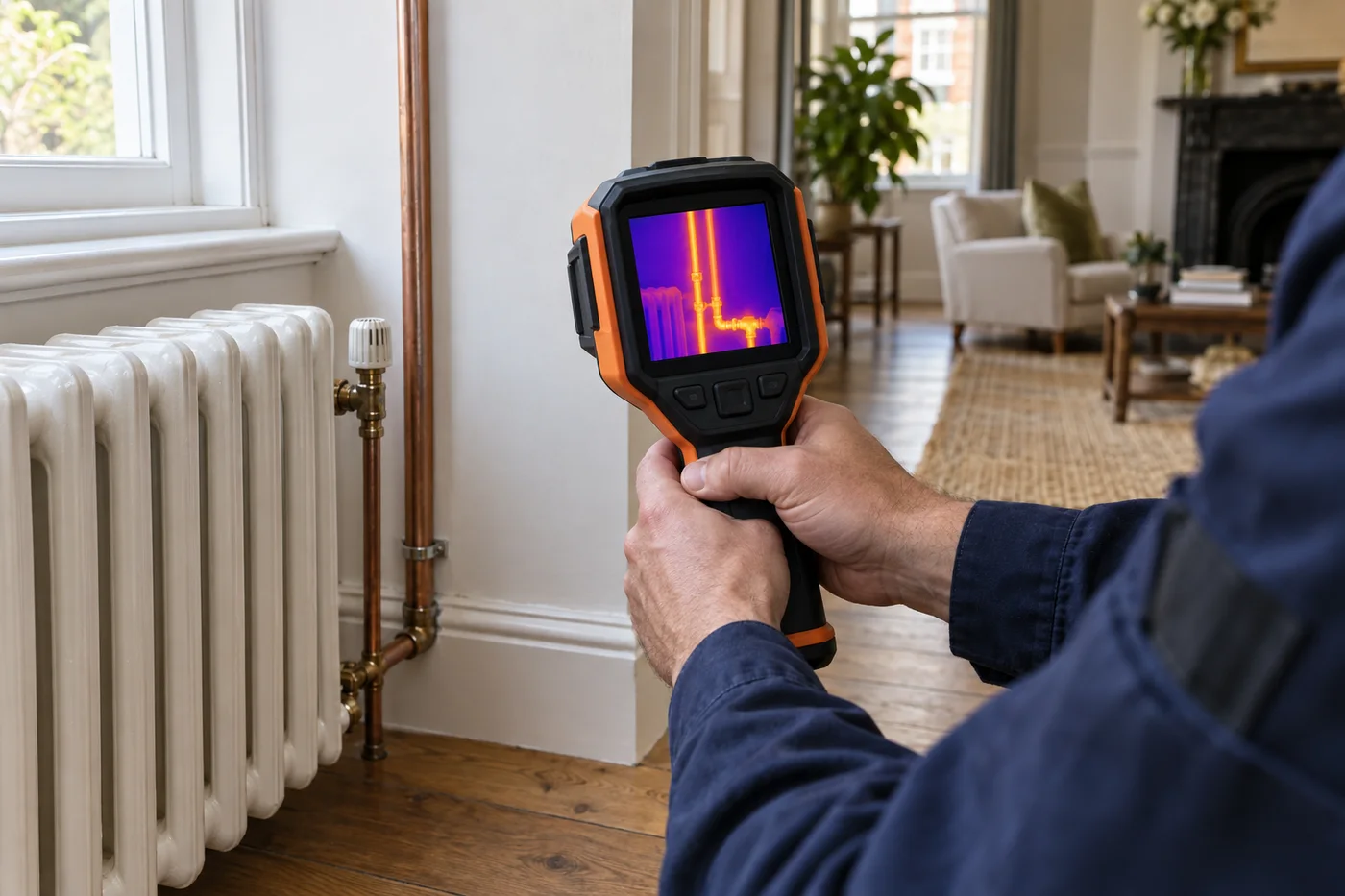
It also changes the incentives on the day, which matters more than the arithmetic. An engineer paid by the hour with no guarantee is not punished for a slow, inconclusive afternoon. An engineer who only gets paid for finding it has every reason to run the pressure test properly at the start rather than waving a thermal camera about for an hour first.
What counts as found
A location specific enough to open one place and repair it. A room, a wall and a height. A pipe run and a point on it. "Somewhere under the kitchen floor" is not a find, and we do not treat it as one.
The evidence goes in a written report: what was tested, what was ruled out, which method located the leak and where it is. That is also the document your insurer wants if you are claiming trace and access, which is set out in insurance claims and trace and access.
When you should not book a detection visit at all
- The leak is visible. A guarantee about finding something you can already see is worth nothing. Go straight to the repair.
- You have not proved there is a leak. Do the meter test first. If the meter does not move with everything off, the water is coming from somewhere other than the pressurised supply, and detection is the wrong tool.
- The water is coming from the flat above. Their leak, their insurer, their engineer.
- Your insurer has appointed a contractor. Instructing your own in parallel can cut across the claim. Ask them first.
For what the hours themselves cost and why the bill is structured that way, see why leak detection is charged by the hour and the published market figures in leak detection cost.