Pressure testing
- Finds
- Whether there is a leak at all, and how big
- Will not find
- Where it is — this sizes the problem, it does not place it

Emergency leak repair, water leak detection and the making good afterwards. We trace the leak with acoustic, thermal and non-invasive tracer gas, repair the pipework, and put the floor, wall or ceiling back. One team, one rate, across London.
No find, no fee · £150 per hour · no call-out fee 01 / 06
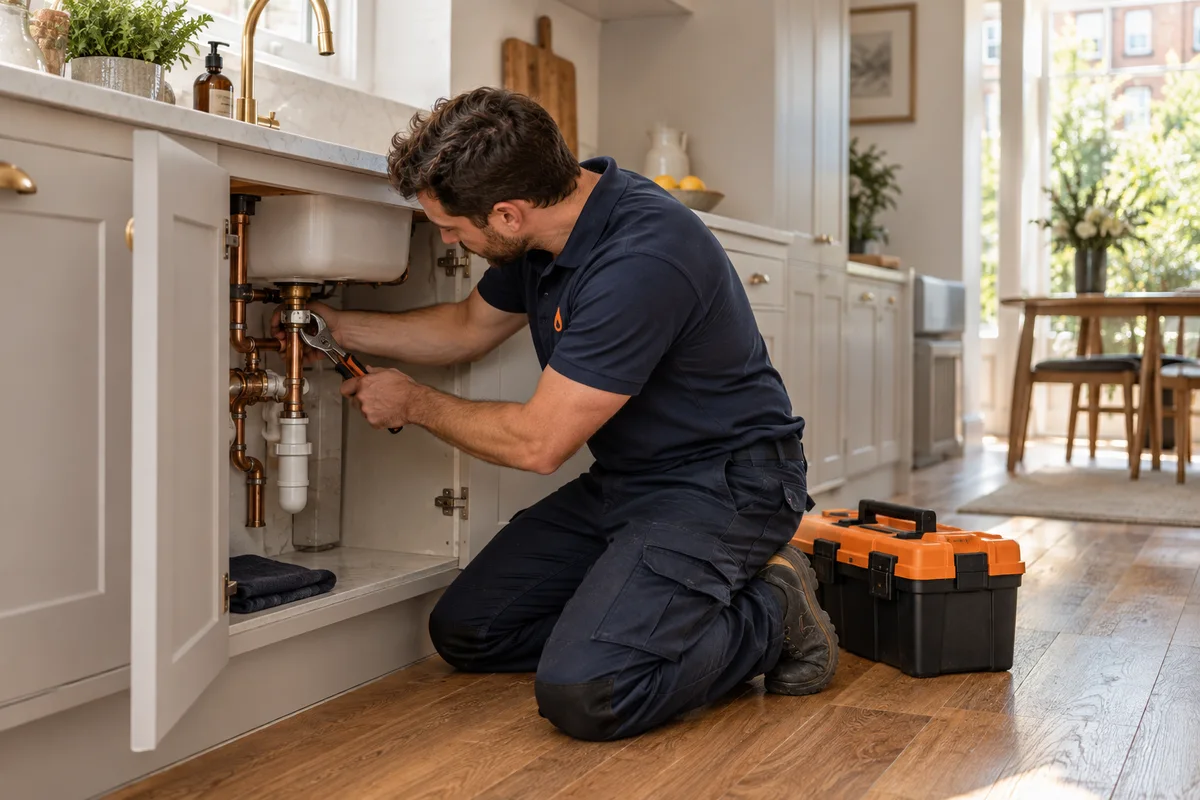
Once we find the leak, we deal with the pipework. From a failed joint to a damaged section, we explain the repair before we start.
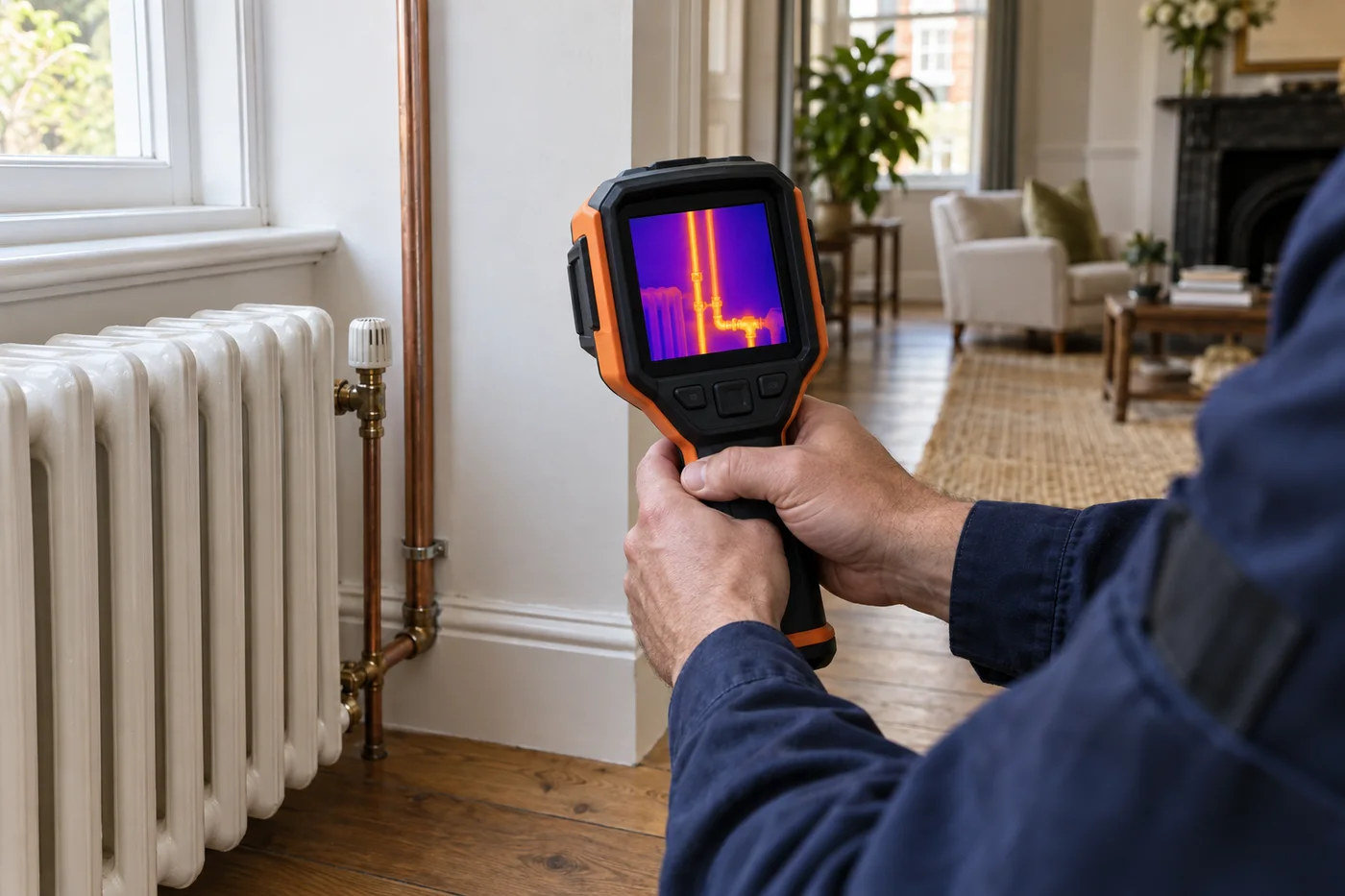
A stain tells you where water has ended up. We use specialist detection methods to work back to where it started.
 THE RIGHT METHOD
 BACK TO FEELING LIKE HOME
Our in-house handymen and builders take care of what comes after the leak.
Leaks don’t stop at the front door. We help landlords, managing agents and businesses find the fault, organise the repair and document the work.

Practical answers for the moment you notice a leak — and the decisions that follow.
All advice & guidesThe first ten minutes, step by step.
Understand the hourly rate and what you pay for.
The methods, the equipment and their limits.
DETECTION, REPAIR AND REINSTATEMENT
Most leak companies in London detect only. They find the leak, give you a report and leave you to arrange a plumber, and then a plasterer, and then a tiler. We carry all three, so the job finishes with us rather than starting again with somebody else.
Step One
Pressure testing to prove the loss is real and size it, then acoustic, thermal and non-invasive tracer gas to place it. The floor is opened once, where the leak is.
Step Two
Copper, plastic, lead and heating pipework, cylinders, valves and joints. Most domestic leaks are repaired on the same visit they are found.
Step Three
Our own handymen and builders close the floor, screed, plaster, ceiling or tiling we opened. You are not left holding a hole and a list of other trades to ring.
£150 per hour across all three. No find, no fee. No call-out fee and no out-of-hours uplift.
Everything we coverSTART WITH WHAT YOU CAN SEE
You do not need to know what is leaking. Pick the thing you can actually see and we will tell you what it usually turns out to be, what you can check yourself, and when it is genuinely not us you need.
All 29 problemsWHAT ACTUALLY HAPPENS
The worry before booking is usually not the price. It is whether someone is about to pull your floor up looking for something. Here is the order we work in, and why it means fewer holes.
How leaks are actually foundBefore anything is opened, the supply or the heating circuit is isolated and pressure-tested. That confirms the loss is real, and tells us roughly how big it is. It is also the step that rules out the leaks that turn out not to be leaks.
Acoustic listening, thermal imaging and moisture mapping narrow the area. On a drained circuit, non-invasive tracer gas finds what the other three cannot — leaks under screed and concrete, and on plastic pipe that is too quiet to hear.
The point of the first two steps is that the floor or wall comes up once, where the leak actually is. We will tell you what we are opening and why before we do it.
The pipework is repaired, re-run or replaced. Then our own handymen and builders make the opening good — screed, floor, plaster, ceiling, tiling and decoration. Most leak specialists in London stop at the report.
You’re not just finding a leak — you’re getting your home back.
We bring detection, repair and reinstatement together, with one team to take care of the whole job.
Found. Fixed. Made good.
Finding the source is only the beginning. Once we’ve located the leak, we explain the repair, put the pipework right and arrange the work needed to restore the space around it.
One team, from start to finishHidden leaks on hot and cold pipework, traced to their source and repaired properly.
Find out why your heating pressure keeps dropping, and get the leaking pipework fixed.
Acoustic, thermal and tracer gas techniques help pinpoint the leak beneath the surface.
From a damaged joint to a faulty pipe run, we repair or replace the source of the leak.
Floors, walls and ceilings made good by our in-house handymen and builders.
Back to feeling like home.More than a detection visit. A clear route from the hidden leak to the final repair.
FOUR METHODS, IN SEQUENCE
No single method finds every leak, and anyone who tells you otherwise is selling the one piece of equipment they own. These run in order, cheapest and least invasive first, and most jobs stop long before the last one.
Every visit ends with a written report prepared to support a trace and access claim — method, findings, thermal images, moisture readings and pressure results, dated. Your insurer decides what your policy covers. How trace and access works
NO QUOTE ON THE DOORSTEP
Most London leak companies will not give you a price until an engineer is standing in your hallway. Ours is on the website, and it is the same at eight in the morning and eight at night.
A fixed hourly rate is not a fixed total. The rate cannot rise for a difficult property or an awkward access; the total depends on how long the job takes. Most domestic leaks are located inside two hours.
What is and is not includedCLEAR ANSWERS BEFORE YOU BOOK
Finding the leak is only the beginning. Here’s how we take care of the repair, the paperwork and what happens next.
Talk about your leakOur fixed hourly rate is £150 per hour, agreed before we attend. It does not rise for a difficult property, an awkward access or an evening visit. The total depends on how long the job takes; most domestic leaks are located inside two hours.
If we do not find the leak, you do not pay for the time we spent looking. Repair and reinstatement work is charged separately once you have agreed it.
Yes. Our in-house handymen and builders carry out flooring, screed, plaster, ceilings, tiling and decoration after the leak is repaired. Most London leak specialists detect only and hand you a report and a hole.
Your leak detection visit includes a written report prepared to support a trace and access claim — method, findings, thermal images, moisture readings and pressure test results, dated. Your insurer decides what your policy covers.
Four methods in sequence. A pressure test confirms the loss is real and sizes it, acoustic listening and thermal imaging narrow the area, and non-invasive tracer gas finds what those cannot — leaks under screed and concrete, and on plastic pipe. The floor is opened once, where the leak is.
Usually, yes. A sealed heating system is closed and should not lose water. If you are topping it up more than about twice a year, it is going somewhere — commonly a pinhole under a floor, a weeping valve inside a wall, or a failed expansion vessel. Those are three different fixes and one test apart.
We work across London. We also publish a small number of pages about the places where the housing stock changes the job — lead supply pipes under Victorian terraces, communal risers in mansion blocks, liquid screed over underfloor heating in new builds.
Because the business is new and has not earned them. We will publish ratings when they come from a verified profile, and not before. In the meantime we publish our rate, our methods and what we do when we cannot find a leak.
WHO WE WORK FOR
The engineering is the same. What changes is what has to come out of it — a repair, an answer about liability, a document an insurer will accept, or a block kept running while the work happens.
A ceiling coming through on a Sunday, or a water bill that has doubled with nothing visible. One rate, and the damage put back afterwards.
Emergency leak repairA leak between two flats where nobody yet knows whose pipe it is. We establish that first, in writing, because the answer decides who pays.
Leaks between flatsTrace and access cover pays to find the leak and to put right what was opened. The report is written for that, with the evidence an insurer asks for.
Trace and accessRisers, plant rooms, communal supplies and secondary hot water loops, where the leak is rarely in the flat that reported it.
Commercial leak repairACROSS LONDON
A lead supply pipe under a Victorian terrace, a communal riser in a mansion block and liquid screed over underfloor heating in a new build are three different jobs, and knowing which one you have before arriving is most of the work. We cover London; these are the places where the housing stock changes the approach.
All areasWRITTEN DOWN PROPERLY
Who pays when the leak is upstairs. What trace and access actually covers, and what it does not. Why a boiler that needs topping up every week is costing you a floor. 179 pages, each one sourced and dated, written because someone asked us on a job.
One team to trace the source, repair the leak and make the damage good. A clear route from the first visit to the finished job.
If we do not find the leak, you do not pay for the time we spent looking.
Targeted investigation helps us reach the problem while keeping unnecessary disruption to your home to a minimum.
An insurer-ready report is included, so you have a written record of the leak, the findings and the work carried out.
£150 per hour, with the hourly rate agreed before we attend. Your total depends on the time the job takes.
Across LondonFrom period homes to modern apartments.
Tell us what you’ve noticed and where you are. We’ll help you take the next step.
Book an engineer No find, no fee · Report included