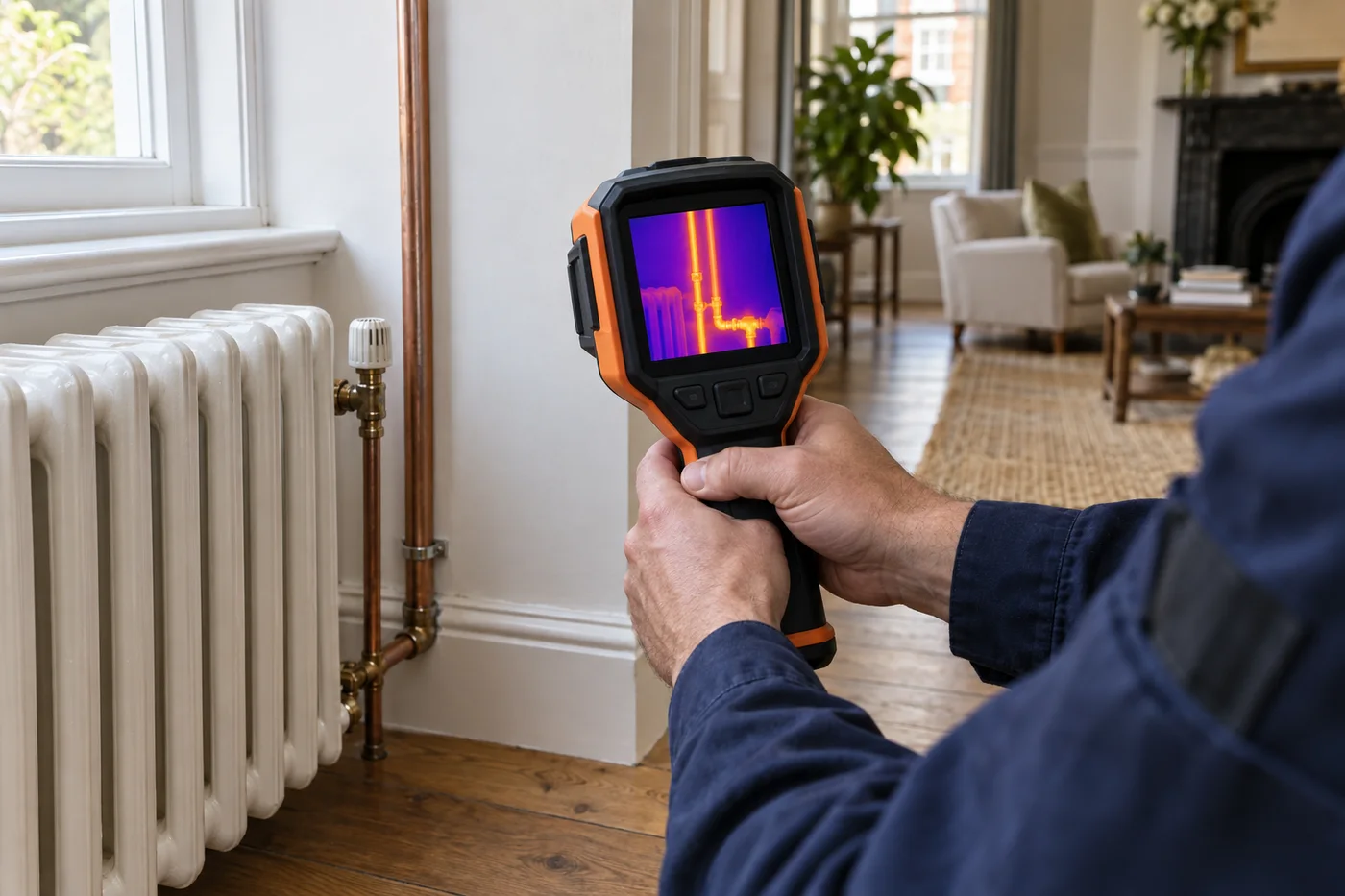
What the engineer is listening to
When water is forced through a small opening under pressure it becomes turbulent, and turbulence makes noise. The noise is broadband, it is continuous rather than intermittent, and it travels two ways: along the pipe wall as structure-borne sound, and out through the surrounding soil, screed or plaster as ground-borne sound.
Both routes are useful and they give different information. Structure-borne sound travels a long way but tells you only that there is a leak somewhere on that run. Ground-borne sound travels a short way but tells you where. A survey usually uses the first to find the run and the second to find the spot.
The three pieces of kit
The contact microphone, or listening stick
A sensor placed on something metal that touches the water: a stopcock, a radiator valve, a pipe under a sink, a boundary box in the pavement. This is how an engineer decides in five minutes which half of the house the leak is in. It is also the only part of the method you can do yourself, badly, with a screwdriver handle against your ear.
The ground microphone
A weighted, shielded microphone placed on the floor or the pavement, moved in a grid. The engineer is not listening for the loudest noise in absolute terms; they are looking for the point where a constant-level noise peaks. Leak noise stays at a steady level. Traffic, a fridge compressor and someone walking about upstairs do not. Good kit logs the quietest moment over a listening period for exactly this reason, because the quiet moments are when the leak is all that is left.
The correlator
Two sensors are clamped to the pipe at two accessible points with a known distance between them. The leak noise reaches each sensor at a slightly different time, and the instrument cross-correlates the two signals to measure that difference. Given the distance and the speed of sound in that pipe material, the arithmetic gives a position along the run. It is the most powerful acoustic technique and the most conditional, because it needs two contact points, an accurate pipe length, and a correct assumption about the material.
Where acoustic detection is the best method available
- Pressurised metal pipe. Copper, steel and iron carry leak noise well and over distance. On a copper supply run in a quiet house, an experienced engineer with a ground microphone will often beat every other method to the answer.
- Live systems that cannot be shut down. Nothing is drained and nothing is switched off. On a communal riser, a commercial building or a mains you are not permitted to isolate, it may be the only method that can run at all.
- Buried supply pipes in the garden or under a drive. With a boundary box at one end and a stopcock at the other, a correlation across the run narrows a 20-metre trench to a couple of metres.
- Confirming a find. Even when another method located the leak, putting a microphone on the spot before cutting is a cheap second opinion.
Where it fails, and why
Plastic pipe
This is the big one in modern London housing. Leak noise in plastic water pipe attenuates rapidly with distance, and the signal that does survive is low frequency and narrow band. Research on polyethylene distribution mains has consistently found that the techniques which work in metal pipe become unreliable in plastic. Practically: on an MDPE supply pipe the audible range around a leak can collapse from tens of metres to a few, and on barrier pipe buried in screed it can be almost nothing. Correlation suffers worst, because the propagation speed it depends on varies with frequency in plastic.
Noise
Acoustic work is done at night on distribution networks for a reason. In a London flat at two in the afternoon the noise floor includes traffic, a lift motor, a neighbour's washing machine and the building's own plumbing. Filters help, and the constant-level trick helps, but there is a point at which the leak is quieter than the building and the method stops producing a usable peak.
Anything not under pressure
No pressure, no jet, no noise. A leaking waste pipe, an overflowing tundish, a shower tray weeping through a failed seal and a heating system that has already lost its pressure all produce nothing to listen to. This is the gap tracer gas exists to fill, and it is why a firm that only owns acoustic kit will sometimes tell you there is no leak when there very much is.
Very large leaks, counter-intuitively
A wide split in a pipe can be quieter than a pinhole, because the water pours out rather than jetting through a restriction. If a pipe has burst properly, you are usually looking for the water rather than listening for it.
What you can do before calling anyone
Turn everything off that uses water, including the boiler and any ice maker, then hold the metal end of a long screwdriver against the incoming stopcock and press the handle to the bone in front of your ear. A steady hiss that does not change means water is moving with all the taps shut. Repeat it on the pipe under the kitchen sink and on a radiator valve upstairs. If the hiss is loud at the stopcock and gone upstairs, the loss is on the incoming side. That is not a diagnosis, but it is the same first question the engineer will ask, and it saves time on the clock.
Check the meter too. If the dial moves with everything off, the loss is on your supply. There is a walkthrough on what a turning meter with everything off actually means.
How we use it
Acoustic is the first method on most visits because it is fast and nothing has to be drained. Where it narrows the leak to a point, we cut there. Where it narrows it to a run but not a point, or where the pipe turns out to be plastic, we drain and switch to gas. Detection is £150 per hour, fixed before we attend, and if we do not find the leak you do not pay for the time spent looking. The repair and the making good are ours as well, which is the part most detection-only firms hand back to you. See water leak repair.