First, decide whether it is a leak
Most wet walls are not leaking pipes, and cutting into plaster to find that out is an expensive way to learn it. Four things produce the same stain.
- Condensation. Worse in winter, worse in bedrooms and bathrooms, concentrated in corners, behind furniture and on external walls. Often comes with black spot mould. It tracks the weather and the heating, not your water use.
- Penetrating damp. Appears during and shortly after heavy rain, fades between. Look outside at the same spot: cracked render, failed pointing, a blocked gutter, a bridged cavity or a window seal.
- Rising damp. A horizontal tide mark at a fairly consistent height on a ground-floor wall, with salt staining at the top edge.
- An actual leak. Present regardless of weather, usually worsening, and typically tied to use if it is a waste pipe, or constant if it is a supply.
The quick discriminator: dry the patch fully, tape kitchen roll over it, and leave it 24 hours with the heating on and no rain forecast. If it is wet again, something is supplying water from inside.
Narrow it to one system
There are only a few things that can be in a wall, and they can be tested separately.
- The incoming supply. Turn off every tap and appliance, photograph the water meter, wait two hours without using water and photograph it again. Movement means a live loss on your supply.
- The hot side. If you have a combi, this shares the same mains pressure, so the meter test covers it. On a cylinder system, close the cylinder's cold feed and see whether the meter stops.
- The heating circuit. Note the boiler gauge cold, check it cold again 24 hours later. A drop with no visible wet patch is a hidden heating leak and it is one of the most common causes of a mysteriously damp wall, because heating drops are chased vertically into walls to reach upstairs radiators.
- Waste and soil. Only wet after someone uses the bath, the shower, the basin or the machine. Fill the appliance, release it in one go and watch. A slow waste leak behind a wall is nearly always a joint at a boss or a compression connector, not the pipe.
- Nothing internal at all. If the meter is still and the boiler holds, look outside again. This is the point at which many people call a leak detection firm and get told it is the render.
Map the damp before you open anything
Water in a wall runs down and spreads sideways, so the visible stain is almost never at the leak. The useful reading is the highest point that is still wet, because the pipe is usually at or above that line.
Take readings on a grid across the wall, every 200 to 300mm, well beyond the stain, using a cheap pin meter or a hired pinless one, and write them on a sketch. Take one reading on the same wall in a dry part of the room as a reference: the absolute numbers mean little, the comparison means everything. Repeat the whole map five days later. A widening wet area is live; a shrinking one has already been fixed or was never a pipe. There is more detail on doing this properly in moisture mapping and damp meters.
Work out what is likely to be in that wall
Pipes in walls are not random. In a typical London house or flat you are looking at a rising main chased vertically from the stopcock, heating flow and return drops feeding upstairs radiators, a shower feed and concealed thermostatic valve in a bathroom wall, a boiler's condensate or pressure relief route to an external wall, and waste connections behind a bath or basin. A damp patch on the kitchen side of a bathroom wall at mid height, worsening only when the shower runs, is a concealed valve or its tail nine times out of ten.
Look at where the wet is relative to those. If the top of the wet area is at 1.5m on a wall with a shower on the other side, that is a very different search from wet at skirting level on a wall with a radiator above it.
What a detection visit does that guessing does not
- Isolates and pressure tests each system in turn, so the search is on one circuit rather than all of them.
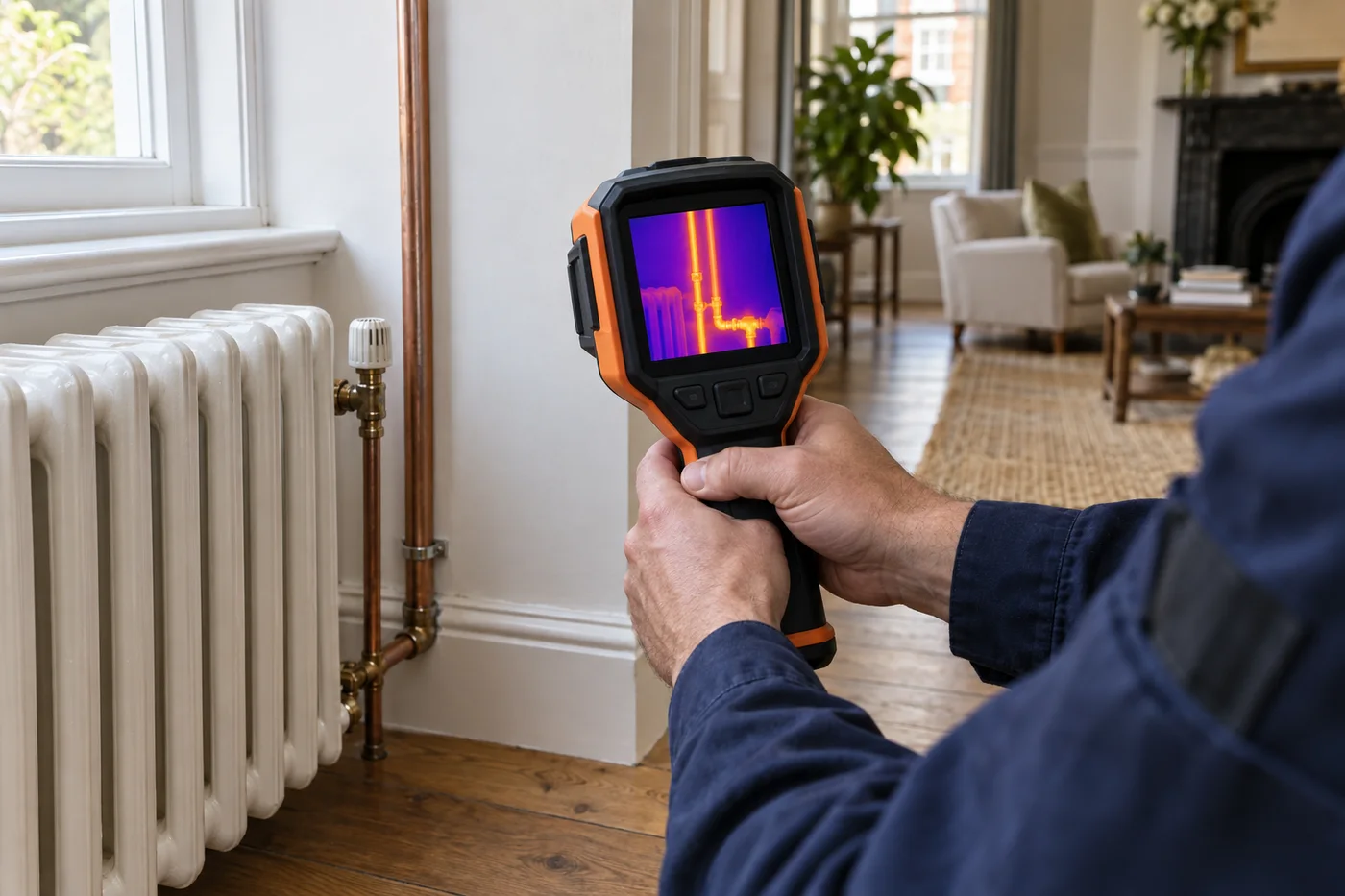
- Images the wall thermally. On a hot or heating pipe this is quick and decisive: the pipe run appears as a line, and the leak as the shape that spoils it. On a cold pipe in a cold wall it may show nothing, and an honest engineer will say so and move on rather than chase a fraction of a degree. See thermal imaging.
- Listens at contact points on the run. A pressurised copper pipe in a quiet house gives itself away. Plastic push-fit usually does not, which is the case in most post-1990 refurbishments. See acoustic detection.
- Drains the circuit and charges it with tracer gas when the first two have narrowed it but not pinned it. Hydrogen escapes at the leak and comes out through plaster, and it does not care whether the pipe is copper or plastic. See tracer gas.
- Cuts one hole. Usually around 150mm, at the confirmed point, into plasterboard or plaster that then gets patched.
What not to do
Do not run a stud detector along the wall and start cutting where it beeps. Do not push moisture meter pins into a wall where the leak might be near a cable chase. Do not replaster or repaint over a patch that is still reading wet, because the moisture goes on moving behind the new finish and takes the decoration with it in three months. And do not have the wall opened up on a guess by someone whose plan is to keep opening until they find it. How long a wet wall really takes to dry, and how to tell when it has, is covered in what drying out after a leak actually involves.
Cost and what happens after
Detection is £150 per hour, fixed before we attend, with no find, no fee. Most wall leaks are located inside two hours. Because the leak is behind plaster rather than under a floor, the repair usually follows immediately in the same visit: the pipe is repaired or re-run, and the plaster, skim and decoration are made good by our own team rather than left as a hole for you to find a plasterer for. See water leak repair. If the water has already spread along the wall, into skirting or through to the room next door, read repairing water damage after a leak before anyone quotes for the making good, and see leak damage repair and reinstatement for what that part of the job involves.