Fixed rate and fixed price are not the same thing
This is the distinction the whole page rests on, so it goes first.
| A fixed hourly rate | A fixed price |
|---|
| What is guaranteed | The rate per hour cannot change | The total cannot change |
| What is not guaranteed | The number of hours | Nothing, in theory |
| What it protects you from | Being charged more because the property is awkward, the access is tight or the visit is in the evening | An overrun |
| Honest before an inspection? | Yes | Only for work whose scope is already visible |
Our rate is £150 per hour, agreed before we attend. That figure does not move for a period conversion with three floor levels, a riser cupboard that has to be opened, or an eight o'clock start. What it cannot do is tell you the total, because the total is the rate multiplied by hours that depend on a leak nobody has located yet. Any firm presenting a total for detection before seeing the property is doing one of two things: padding it heavily, or planning to revisit it on the doorstep.
Why a fixed price for detection usually is not one
Look closely at fixed detection prices and they generally resolve into one of these.
- A capped first hour. The advertised figure buys sixty minutes. The tariff after that is a different, larger number, often not printed.
- An inspection fee. The fixed price is for attending and forming an opinion. The work is quoted afterwards, when you are already invested and the van is outside.
- A price for one method only. Acoustic, say. If the leak needs the circuit drained and traced with gas, that is a separate line, and hidden leaks in London properties routinely need more than one method.
- A price with the failures built in. If a firm charges everyone a flat fee whether the job takes one hour or six, the fee has to cover six. The easy jobs subsidise the hard ones, and most jobs are easy, which is how that maths works out in the firm's favour.
Which? makes the underlying point in its plumber cost guide: a price given over the phone is built on assumptions about pipework nobody has seen, so treat it as a ballpark. It also recommends getting an itemised breakdown of what you are being charged for, which is a useful test. A genuine fixed price survives itemisation. A soft one does not.
What actually consumes the hours
Detection is not one activity, it is a sequence, and the sequence stops as soon as something works. The bill is decided by how far down the list your leak makes us go.
- Isolation and pressure test. Confirm the loss, identify the circuit, size the leak. Fast, and it saves hours later.
- Acoustic. Strong on pressurised mains and hard floors, weak on low-pressure heating and in a noisy block of flats.
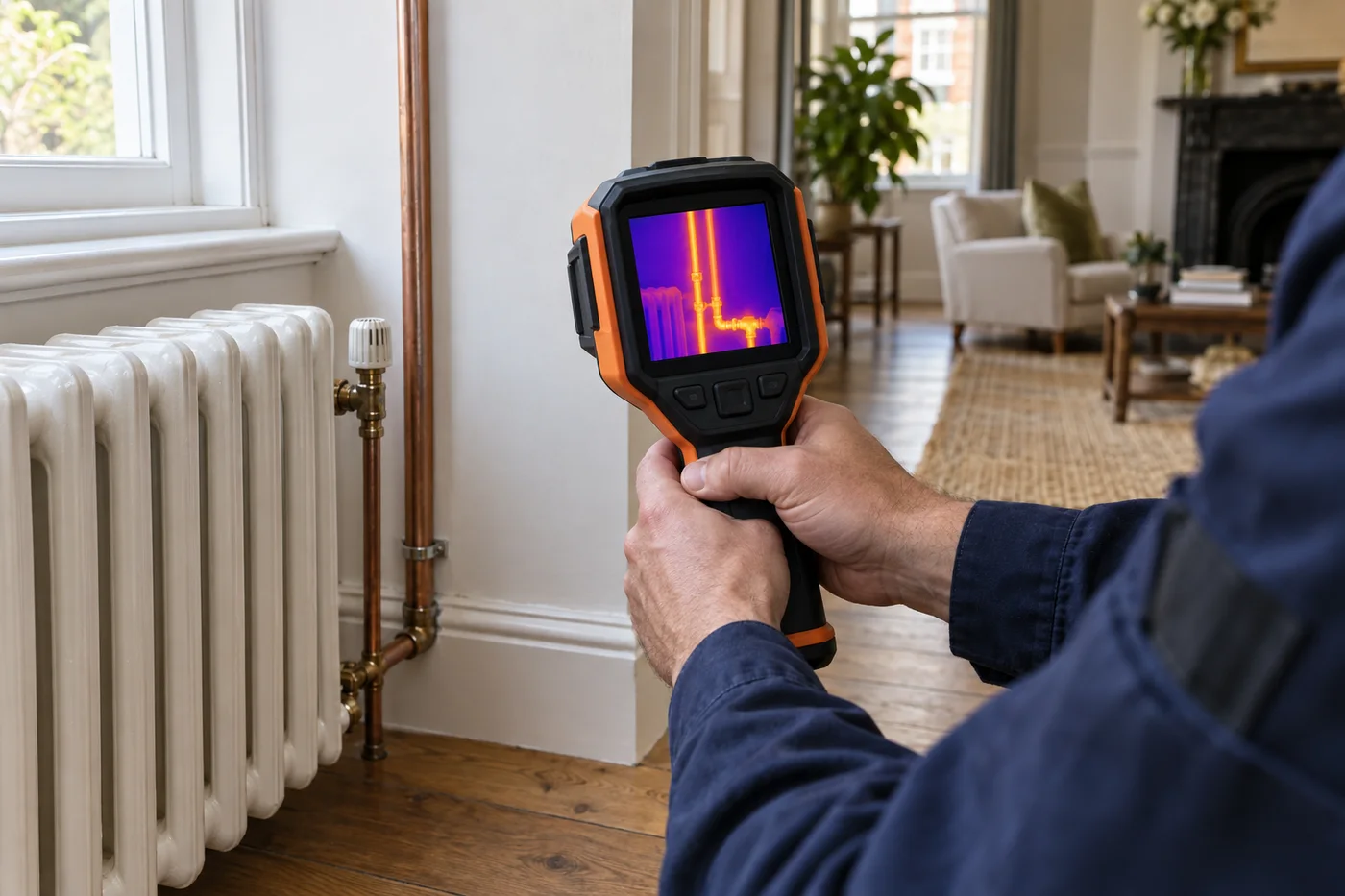
- Thermal imaging. Follows a hot run through screed and tile. Nothing to see on a cold feed.
- Moisture mapping. Maps where the water arrived, which can be metres from where it left the pipe.
- Tracer gas. Drain the circuit, push a hydrogen and nitrogen mix through it, pick it up at the surface. It finds what the rest cannot, and the draining and refilling is the time cost.
A weeping compression joint under a basin is found in step one. A pinhole in a 15mm pipe under 60mm of screed, in a flat where the damp appears in the hall and the pipe runs under the bedroom, can take all five. Charging both of those the same amount means one of them is being overcharged.
What makes a job quick, and what makes it slow
| Shortens the visit | Lengthens it |
|---|
| A meter reading taken with everything off | No evidence that there is a leak at all |
| Accessible stopcock and known pipe routes | Boxed-in pipework and a stopcock nobody can find |
| Timber floors with liftable boards | Screed, self-levelling compound or tile over concrete |
| A leak that runs constantly | A leak that only appears when the shower runs or the pump starts |
| Access to the flat above already arranged | Waiting on a neighbour or a managing agent |
| A clear account of when the damp appears | Three previous trades having already opened the wrong things |
How to keep your own bill down
- Do the meter test. Everything off, read the meter, wait an hour, read again. Free, and it turns a suspicion into a measurement. The method is in the water bills guide.
- Write down the pattern. When the damp appears, what was running, how the boiler pressure behaves over a week. Pattern is what narrows the search.
- Clear the access. Empty the airing cupboard, move what is on the floor, find the loft light. An hour spent moving furniture is charged the same as an hour of tracing.
- Arrange the neighbour in advance if there is any chance the leak is above you. Waiting in a hallway is the most expensive part of many flat jobs.
- Do not open anything speculatively first. A floor already lifted in the wrong place removes evidence and adds reinstatement.
Where a fixed price genuinely belongs
Once the leak is located, the unknown is gone. You can see the pipe, the run, the access and the making good, so the remaining work can be described before it starts rather than guessed at. That is the moment to ask for scope in writing, and it is why detection and repair are two conversations rather than one. The repair side is water leak repair, and the reinstatement after it is the part most detection firms in London leave to somebody else.
When paying by the hour is the wrong choice
- The leak is visible. You do not need time, you need a repair.
- The meter does not move with everything off. The water is coming from a waste, a roof, a shower seal or condensation, and none of those is a job for pressurised-system detection.
- The boiler only needs topping up once or twice a year. Normal. Read the boiler pressure hub before booking anybody.
- The leak is beyond your boundary. That pipe belongs to the water company, and so does the cost of finding it.
The guarantee that makes an hourly rate safe to accept is set out in what no find, no fee actually means.