These are UK market ranges from a named public cost guide. They are not our prices, and they are not a quote for your property.
| Item | Published figure | Source |
|---|
| Water leak detection, average | £162 | Checkatrade cost guide, 2026 |
| Water leak detection, typical range | £115 to £234 | Checkatrade cost guide, 2026 |
| Water leak detection, full published range | £80 to £1,600 | Checkatrade cost guide, 2026 |
| Thermal imaging camera detection | £150 to £1,000 | Checkatrade cost guide, 2026 |
| Typical duration of a test | Around half a day | Checkatrade cost guide, 2026 |
A twenty-fold spread between the bottom and the top of that range is not pricing chaos. It is the difference between confirming a leak at a visible joint and tracing a pinhole under a screed floor in a Victorian conversion where the pipe run was never recorded.
What you are buying is time, not equipment
Every detection method costs roughly the same to own and nothing to switch on. What separates a cheap job from an expensive one is how many methods have to be tried, and in what order, before the leak gives itself up.
The sequence
- Isolation and pressure test. Prove the loss is real, work out which circuit it is on, and get a rough size for it. This is the step that stops people lifting the wrong floor, and skipping it is the single most expensive shortcut in the trade.
- Acoustic. Correlators and ground microphones pick up the hiss of pressurised water escaping. Excellent on mains and on hard floors, poor on a low-pressure heating circuit and poor in a noisy block.
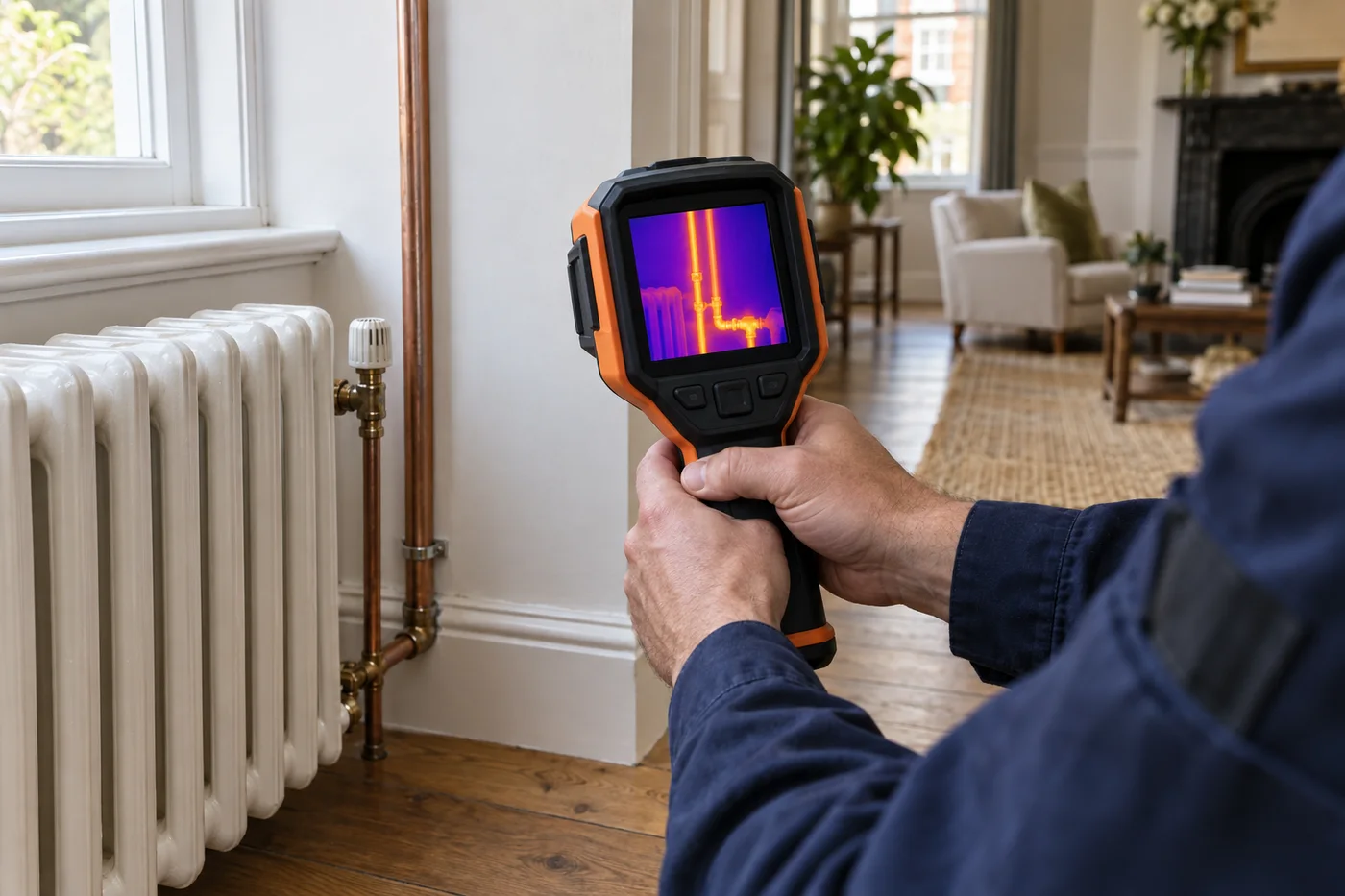
- Thermal imaging. Follows a warm pipe run through tile and screed and shows the plume where hot water is spreading. Useless on a cold feed unless the pipe has been artificially heated.
- Moisture mapping. Tells you where the water has ended up, which is not the same as where it came from. Water runs along joists and reappears three metres away.
- Tracer gas. The circuit is drained and a hydrogen and nitrogen mix is pushed through it. The gas escapes at the leak and is picked up at the surface. It is non-invasive and it finds what the other methods cannot, but it takes time to set up, which is why it is not step one.
A leak that surrenders at step two costs a fraction of one that needs all five. Nobody can tell you from a phone call which one you have.
What makes a London job longer
- Solid floors. Screed, self-levelling compound and tile over concrete hide both the pipe and the water.
- Period conversions. Pipework that has been re-run three times by three different trades, with no drawing and no logic.
- Flats. The leak is frequently not in the flat that is wet. Access to the property above, or to a riser cupboard, is often the rate-limiting step, and it is not something an engineer can force.
- Intermittent leaks. A joint that only weeps when the pump runs, or a shower tray that only leaks when someone stands in it, has to be provoked before it can be found.
- Nothing wet yet. A meter turning with everything off, and no damp anywhere, is the hardest brief there is. It is also the cheapest leak to fix if you catch it there.
Who else might pay
Your insurer
Most buildings policies include trace and access cover, which pays for the work of finding and exposing a leak, and for making the damage good, under an escape of water claim. It is a separate limit from the damage itself, and it is claimed on evidence: a written report describing what was tested, what was ruled out, where the leak was and how it was located. We write our report for that purpose. There is more on what a loss adjuster asks for in insurance claims and trace and access.
Your water company
If the leak is on your supply pipe, CCW advises contacting your water company to find out whether it offers one-off assistance in locating and repairing it, noting that conditions vary between companies. CCW also says a leakage allowance for the water lost is typically offered once the leak is repaired, usually as a one-off. If the leak is beyond your boundary, it is not your repair at all: the main, the communication pipe up to the boundary, the external stop tap and the meter belong to the company.
What we charge
£150 per hour. The rate is agreed before we attend and does not move for a difficult property, an awkward access or an evening. What it does not do is tell you the final figure, because the final figure is hours multiplied by the rate, and the hours depend on a leak nobody has found yet. A fixed rate is not a fixed price, and anyone who gives you a fixed price for detection before seeing the property is either pricing in a large cushion or planning to re-quote.
If we do not find the leak, you do not pay for the time we spent looking. That is the guarantee that makes an hourly rate safe to accept, and it is worth reading what it does and does not cover in plain terms.
When not to pay for detection
- You can see the leak. A weeping compression nut, a dripping valve or a visible split does not need tracing. It needs a repair, and what that part of the bill looks like is set out in how much it costs to fix a leak.
- You have not done the meter test. Turn everything off, read the meter, wait an hour, read it again. It takes no time, it costs nothing, and it is the evidence every later conversation depends on. The method is set out in the water bills guide.
- The water is coming from the flat above. That is the upstairs leaseholder and their insurer, not your detection bill.
- Your insurer has already instructed someone. Booking your own engineer in parallel can complicate the claim. Ask them first.