London-wide leak specialists
ResidentialCommercial
Get in touch
Book an engineer

Repairs

Gas Tracer Leak Detection in London

We drain the suspect pipe, push an inert hydrogen and nitrogen blend through it, and sweep the surface with a hydrogen probe until the reading peaks directly over the escape point — no floor is lifted to find it, and we repair and reinstate what we open.

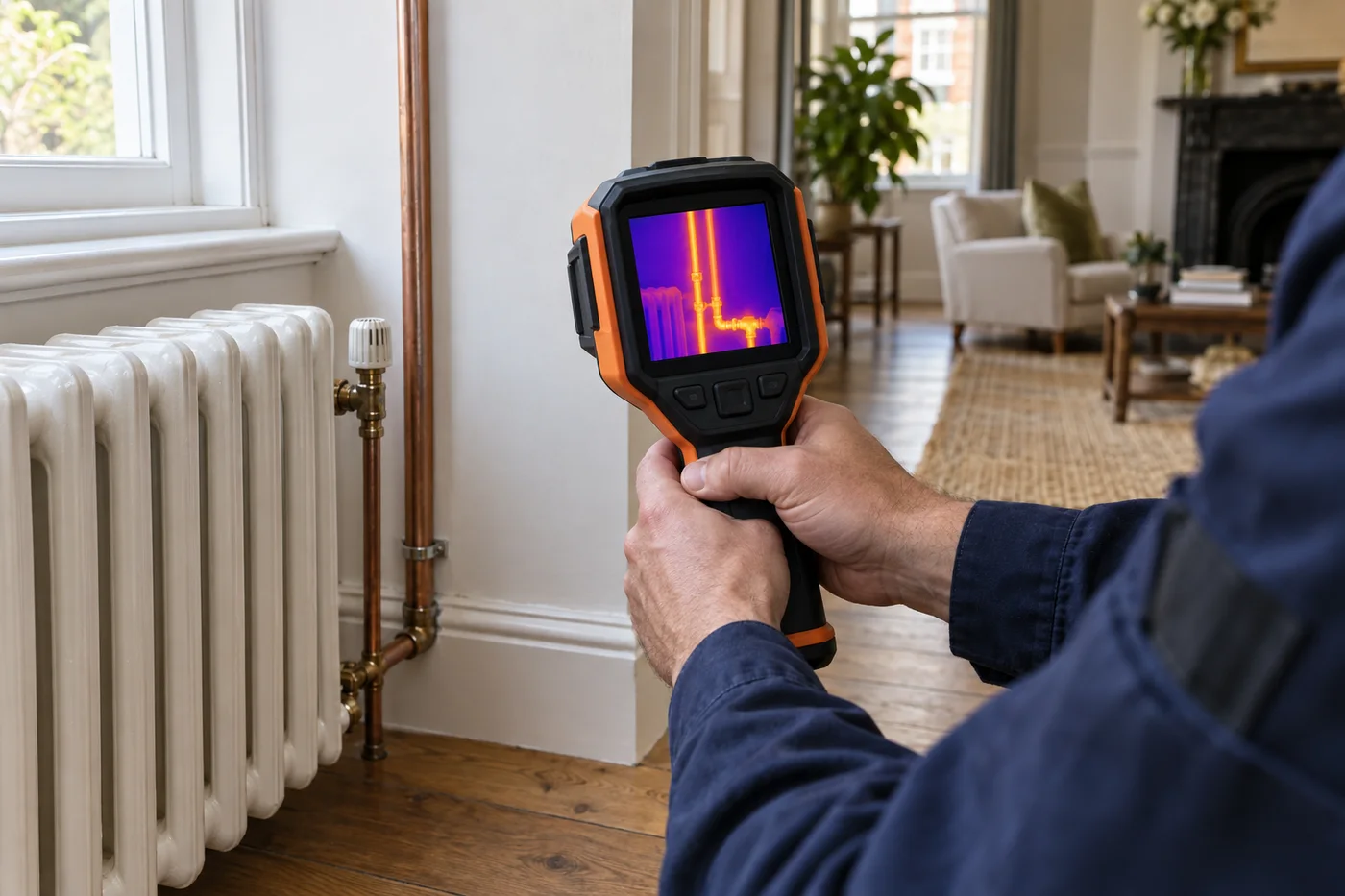
Thermal imaging survey being carried out to trace a hidden leak

What the job includes

  • Isolation and pressure testing of each suspect circuit before anything is drained
  • Drain-down, controlled introduction of inert hydrogen/nitrogen tracer gas, and refill afterwards
  • Full surface survey with a hydrogen probe, cross-checked against thermal imaging and moisture readings
  • Cross-confirmation of the location before any opening is cut
  • Minimum-size access opening cut at the confirmed point, not an exploratory search
  • The repair itself — copper, plastic, MDPE or lead — where access allows on the same visit
  • Screed, floor finish, tiling, plaster and decoration made good by our own team
  • Written detection report covering method, location, cause and remedial work, for your insurer

No find, no fee · £150 per hour. The rate is fixed before we attend and does not rise for a difficult property, an awkward access or an evening visit. The total depends on how long the job takes; the rate cannot change.

What tracer gas is, and what we do with it

Tracer gas detection puts a gas into your pipework and finds where it comes back out. The gas is a blend of hydrogen and nitrogen, industry-standard at around five per cent hydrogen, which is inert and non-flammable at that concentration. Hydrogen is the smallest molecule there is, and that is the whole point of using it. Pushed into a drained pipe, it escapes at exactly the point the water was escaping, then rises through whatever sits above the pipe — sand-cement screed, a concrete slab, tile adhesive, sub-base, floorboards — and reaches the surface of the floor directly over the hole.

We then walk the floor with a probe that responds to hydrogen in the air just above the surface. Away from the leak it reads nothing. Over the escape point the reading climbs and peaks, and that peak is the leak. Nothing is lifted, cut, drilled or guessed at to get to it.

This is why it is called non-invasive detection. The invasive part of a leak job is not the repair. It is the searching: the three boards lifted in the wrong place, the two holes cut in a ceiling that turn out to be dry, the section of tiled floor taken up because the leak "must be around there". Tracer gas removes the searching.

How the visit runs

  1. Confirm the loss is real, and size it. Before anything is drained we isolate the suspect circuit and pressure test it. A gauge that holds for the test window tells us the leak is not on that circuit and we move to the next one. A gauge that falls tells us how fast, which sets how much gas the system will need and how long the survey will take.
  2. Isolate and drain the section. Tracer gas only works in an empty pipe. Water in the run will sit over the hole and hold the gas back, so the circuit is drained down and the drain point closed.
  3. Introduce the gas at controlled pressure. It goes in at a fraction of normal system pressure. There is no risk of forcing a sound joint apart, and no risk to the property: the mix will not burn and displaces nothing in an occupied room.
  4. Let it migrate. Through a thin timber floor the gas surfaces almost at once. Through a hundred millimetres of screed or a slab it can take a while, and on tiled floors it comes up through the grout lines first. This waiting period is part of the method, not an engineer standing still.
  5. Survey the surface. The floor is swept in a grid — along the known pipe run first, then across it. Skirting lines, grout joints, expansion gaps and any penetration through the floor are checked, because those are the easiest escape routes to the surface.
  6. Cross-check before anything is opened. A peak reading is confirmed against the pipe run, the pressure test result and, where the pipe is warm, a thermal image. Two independent indications pointing at the same square foot of floor is the standard before a tool touches your home.
  7. Mark, open small, expose the leak. The point is marked, the opening is cut to the size it needs to be and no more, and the failure is exposed so you can see it.

What tracer gas finds that acoustic and thermal cannot

Leaks under screed and concrete

Acoustic detection listens for the noise a pressurised escape makes. A hundred millimetres of sand-cement screed, or a solid slab in a converted warehouse, absorbs most of that noise before it reaches a ground microphone. Thermal imaging reads surface temperature, so it only sees a leak that is warm enough and shallow enough to change the temperature of the floor above it. Deep in a slab, a cold-water leak does neither. Hydrogen does not care how deep the pipe is: it comes up through the screed because it is lighter than everything around it.

Leaks on plastic pipe

This is the one that catches people out. Plastic push-fit and barrier pipe damp sound dramatically compared with copper. The same pinhole that sings through a copper run is nearly silent in Hep2O or Speedfit, and an underfloor heating manifold feeding twenty plastic circuits under screed is close to the worst case for acoustic work. Tracer gas is unaffected by the pipe material, because it is not listening to the pipe. It is smelling the floor.

Systems too quiet to hear

A leak makes noise in proportion to the pressure behind it. A heating circuit sitting at a little over one bar, or a gravity-fed cold feed in an older London house with a tank in the loft, may have almost no pressure at the failure point. It can still empty a system over a week and still rot a joist, and it can still be inaudible. Because the gas is introduced at our chosen pressure rather than the system's, a quiet leak and a loud one look the same to a tracer survey.

The honest version: acoustic, thermal and moisture mapping are all good tools and we carry them. They are faster than gas when the conditions suit them. Tracer gas is the method that works when they run out of road, which on London floor build-ups is often.

What we most often find on these jobs

  • Pinholes in copper buried in screed. Usually where flux residue was never flushed out, or where the pipe was laid straight into the screed without a sleeve and has been abrading against it every time the heating cycles.
  • Underfloor heating circuits nicked during the build. A screed board cut, a fixing driven through a loop, a staple through the pipe. These sit quietly for years, then show as a pressure drop and a warm patch that never quite dries.
  • Push-fit joints made without the pipe insert. The joint holds under test and weeps under thermal movement. Common in flats refurbished at speed.
  • Compression joints buried under a floor. Legal in most positions, but a nut that was a quarter turn short will find you eventually, and it will be under the one section of engineered oak that runs wall to wall.
  • Cold mains runs in a slab in converted commercial buildings. No heat signature, no accessible route, and the first symptom is a neighbour's ceiling.

The repair, then the floor put back

This is where we differ from most leak detection firms in London, and it is worth being blunt about it. The standard London service is a detection visit that ends with a report and a marked cross on your floor. You then find a plumber to do the repair, and after the plumber you find a builder to put the screed, the tiles and the skirting back. Three companies, three waiting periods, and two of them arguing about who caused what.

We do all three. Once the leak is exposed, the pipe is cut out and repaired, re-run or replaced — see pipework repair and replacement for what that involves on copper, MDPE, push-fit and lead. Then the opening is made good: screed reinstated, the floor finish relaid or matched, tiling and grout made good, plaster and decoration finished. That is our reinstatement team, in-house, not a subcontractor you have to chase.

If the leak is on an underfloor heating circuit, the route is the same but the repair detail differs — that job is covered on underfloor heating leak repair.

When tracer gas is the wrong tool

Do not book a tracer survey for these:

  • A visible leak. If you can see the water and point at the joint, you need a repair, not detection. Paying for a survey to confirm what you already know is wasted money.
  • A wet patch after a shower and only after a shower. That is usually a failed seal or a waste, and it is found with a flood and dye test in a fraction of the time. See shower leaking through the ceiling.
  • Rising or penetrating damp. Damp at the base of a wall with no pressure loss anywhere in the system is a building fabric problem. There is no leak for gas to find, and we will tell you so rather than sell you a survey.
  • Pressure that drops only when the heating runs and climbs high when it is hot. That pattern is often a failed expansion vessel, not a leak, and it is ruled out with a gauge in minutes.

Not sure which of those you have? The symptom pages under warm patch on the floor and pressure dropping with no visible leak will usually tell you before you spend anything.

What it costs

Detection is charged at our hourly rate, fixed before we attend, and the rate does not change for a difficult floor build-up or an awkward access. The total depends on how long the job takes, which depends on the size of the property and how many circuits have to be eliminated. If we do not find the leak, you do not pay for the time we spent looking. Full terms are on the pricing page.

Every detection job ends with a written report covering the method used, the location found, the cause and the remedial work needed, written to be accepted by an insurer for a trace and access claim. What that claim covers and how it is made is set out under insurance claims.

Frequently asked

Is tracer gas safe to use in an occupied house?
Yes. The blend is mostly nitrogen with a small hydrogen fraction, which is inert and non-flammable at that concentration, non-toxic, and it dissipates upward into the air. It goes into the water pipework only, at low pressure, and the system is flushed and refilled before we leave.
Will you have to lift my floor to find the leak?
No. The survey itself opens nothing. The floor is opened once, at the confirmed point, to reach the pipe and repair it — and then we put it back. The difference between that and exploratory lifting is usually the difference between one small opening and a room stripped out.
Does tracer gas work on plastic pipe and underfloor heating?
Better than the alternatives. Plastic pipe absorbs the sound that acoustic detection relies on, and underfloor circuits under screed are often too deep for thermal imaging to resolve. Gas is unaffected by pipe material or depth, because it travels up through the floor rather than along the pipe.
How long does a tracer gas survey take?
It depends on how many circuits have to be eliminated, the floor build-up and the size of the property. A single suspect circuit in a flat is quick; a house with three heating zones and a slab floor takes considerably longer, because the gas needs time to migrate through the screed at each stage.
Can you repair the pipe on the same visit?
Where the access allows and the parts are standard, yes. Some jobs — a long re-run, a floor that has to dry before it is closed, a specialist floor finish to match — need a second visit for the reinstatement, and we will tell you which yours is once the leak is exposed.
What if the survey does not find anything?
Then you do not pay for the time we spent looking. That is what no find, no fee means. In practice a survey that finds nothing on the circuits tested usually means the loss is somewhere we have not yet been given access to, and we will say so in writing rather than keep charging.

Problems this repair solves