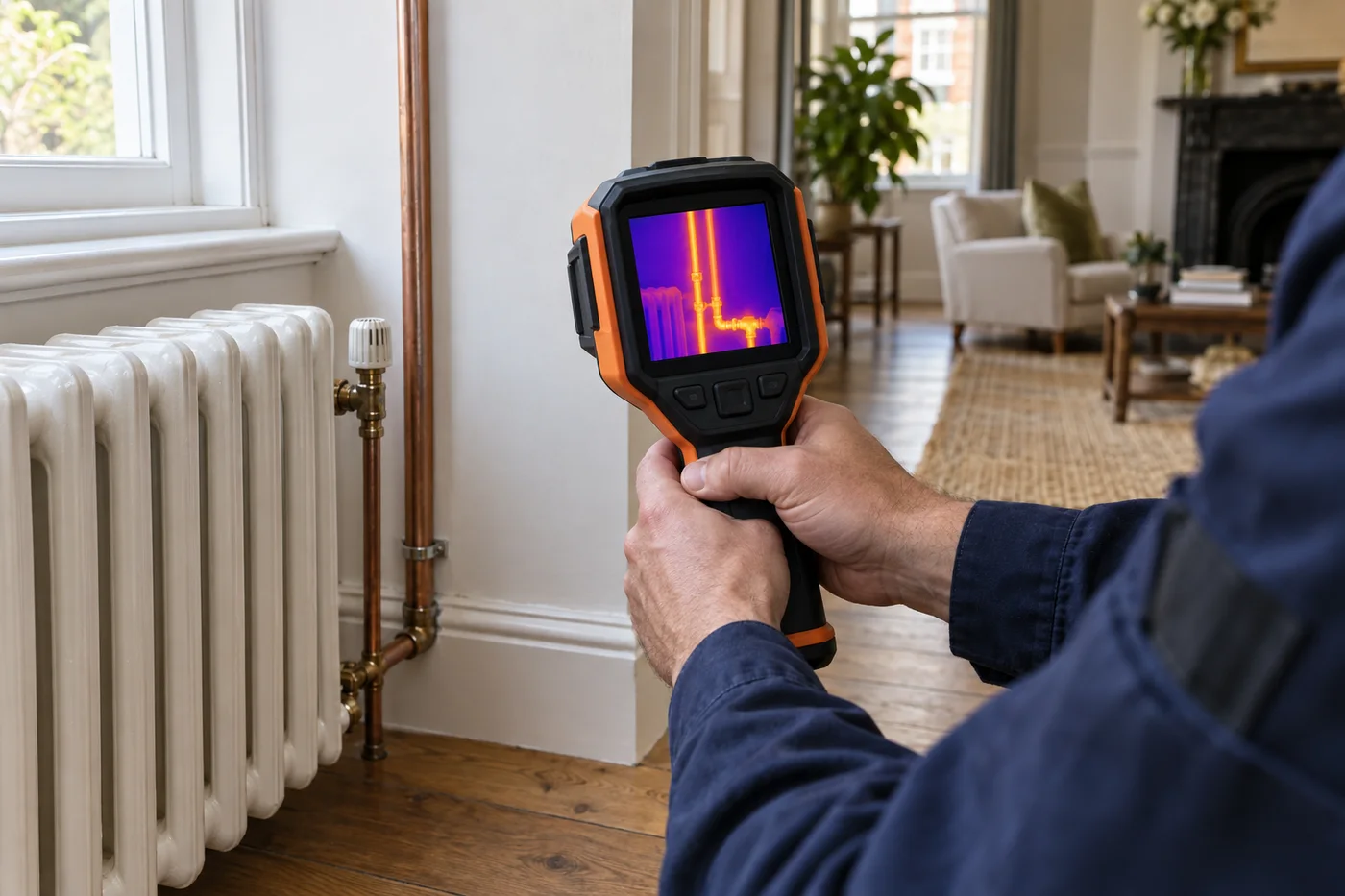
Two instruments that do different jobs
The pinless meter
A pinless meter presses a flat pad against the surface and measures the material's response to a radio-frequency or capacitance field, which changes with moisture content. Nothing is pushed into the wall, so it leaves no holes and it can be swept quickly across a large area. Protimeter, who make the meters most UK surveyors carry, describe pinless as the search tool: it tells you where moisture is present rather than exactly how much.
Its weaknesses follow from the physics. It responds to whatever is inside the field, so metal lath, foil-backed plasterboard, a pipe, a nail plate or a dense patch of render all read as wet. Material density and mineral content change the response, which is why it is less reliable on concrete than on plaster.
The pin meter
A pin meter pushes two probes into the material and measures electrical resistance between them. Wet material conducts; dry material does not. It reads only at the depth the pins reach, it leaves two small holes, and it is slower. In exchange it is the one you trust when the pinless meter has found something.
Its weakness is salts. Where a wall has had long-term moisture, hygroscopic salts concentrate at the surface, and they conduct. A salt-contaminated plaster face can read soaking on pins while the masonry behind it is dry. Surface coatings, temperature and poor pin contact all shift the reading as well.
Why the number is not a percentage
On timber, a calibrated resistance meter gives a genuine moisture content figure, because the relationship between resistance and water in wood is well established. On plaster, brick, screed and concrete it does not. What you get is a relative reading on the instrument's own scale, and it means something only in comparison with a reading taken on the same material in a part of the building known to be dry.
That comparison is the whole technique. A reading of 400 on a bedroom wall tells you nothing. A reading of 400 on a bedroom wall where the identical wall two metres away reads 80 tells you a great deal.
How a moisture map is actually made
- Establish a dry reference. Same material, same construction, well away from the suspect area. Everything else is measured against it.
- Sweep with the pinless meter on a grid. Typically every 200 to 300mm across the affected surface and well beyond the visible mark, because the wet area is nearly always larger than the stain.
- Record, do not just look. The readings get written onto a sketch of the room or photographed with the meter in frame. The point of a map is that it can be compared with the next one.
- Confirm the peaks with pins. Only where the pinless sweep found something, and only where a couple of 2mm holes do not matter.
- Read the gradient, not the maximum. Water spreads outwards and downwards from where it arrives. The wettest point is a clue to the source, but the shape of the gradient, and particularly the highest point on a wall that is still wet, usually says more.
- Repeat it later. Two maps a week apart separate an active leak from historic damage that is drying out. This is also the single most useful thing for an insurance claim.
What the map cannot tell you
- It does not find the pipe. It finds water. Water tracks along joists, under screed, down a cavity and across a ceiling void, and it can surface metres from the hole it came out of. A perfect moisture map with no other method behind it will still send you cutting in the wrong place.
- It does not tell you where the water came from. A leak, a failed shower seal, penetrating damp through a cracked render, a blocked gutter and condensation behind a wardrobe all produce wet walls. Distinguishing them is about pattern and season, not about the meter.
- It reads shallow. Both types measure at or near the surface. Water deep in a solid wall or under a screed can leave the face reading almost dry, especially where the floor is heated.
- Salts and metal give false positives. The two most common wrong calls on a survey are a salt-contaminated chimney breast read as a live leak, and foil-backed plasterboard read as a soaked wall.
Where it earns its place
Moisture mapping is the method that answers the questions the others cannot. Is this wet now or was it wet last year? Is it getting better since the repair? How much of this floor is affected and therefore how much has to come up? Those are the questions a loss adjuster asks, and a dated set of readings answers them in a way that a photograph of a stain does not. A trace and access claim is settled on how much reinstatement is needed, and the map is what sizes it. See insurance claims and trace and access.
It is also how a drying job is signed off. Air movers and dehumidifiers run until the readings match the dry reference, not until the wall looks alright, which is how people end up with mould behind new plaster.
What to do with a cheap meter at home
A basic pin meter is genuinely useful for one thing: comparing two places. Take a reading on the damp patch and take one on the same wall in the driest part of the room, and note both. Do it again in five days. If the difference is closing, something has stopped. If it is widening, it is live. Do not read the absolute number as a percentage of anything, and do not push pins into a wall where a cable or pipe might be chased.
If the readings say it is live, the next step is finding the pipe, which is a detection job, then a repair and making the plaster good. We do both; most firms do the first half.