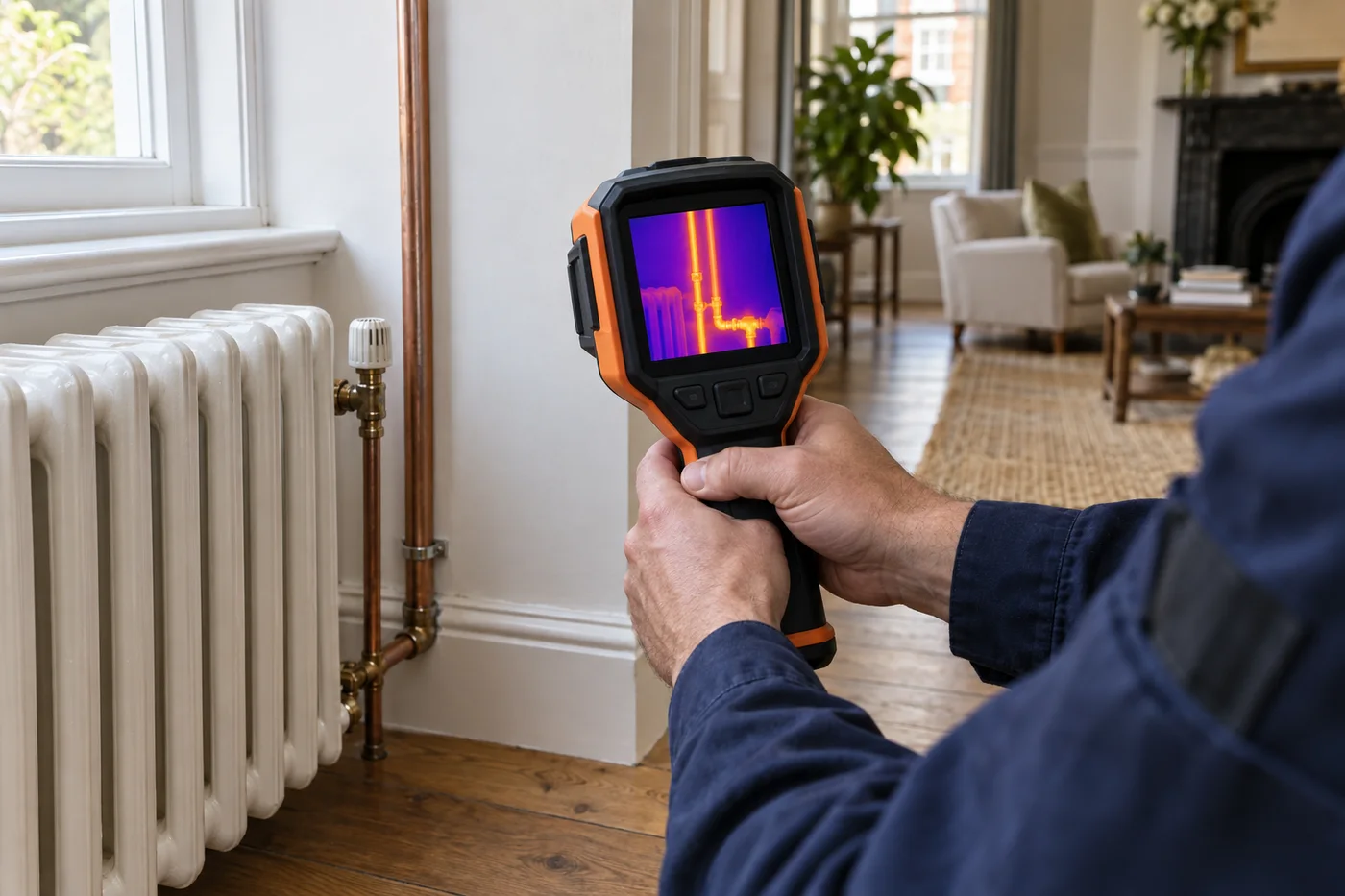
Where this example comes from
What follows is one real report written by this firm, summarised section by section. Before publishing it we removed the customer's name, address, postcode, contact details and the date of attendance. Nothing has been added. It is an anonymised example of a real report, not a case study: we are not naming a household, a claim or an outcome.
We chose it deliberately, because the investigation found nothing. The damp had reportedly been there around eight years, engineers had been out before and none had confirmed a source, and a full pressure test and tracer gas investigation concluded the plumbing was sound. A report that finds a dripping joint teaches you little about what a report is for. One that rules out an entire plumbing system, with a method and a hold time attached, shows you the whole job.
Reason for attendance
The opening section records who asked for the visit and what they said was wrong. Here the report states that the firm was instructed following ongoing reports of damp, that the owner advised the problems had been present for approximately eight years, and that previous engineers had attended without locating a confirmed source.
That eight-year figure is not flattering to the claim and it goes in anyway. An insurer is testing when the damage first became apparent — the gradual damage question, and where slow-leak claims usually fail. A report that quietly omits a long history is worthless the moment an adjuster reads the file properly. One that states it up front is a document somebody stands behind. If that test is relevant to you, read why water leak claims get declined before you submit anything.
What was inspected
The second section is a list, and more useful than it looks. This visit covered hot and cold water pipework, accessible pipework beneath the bath, the shower areas, toilets and visible connections, the kitchen sink with its waste and supply, the basin, accessible heating pipework, and visible joints, valves and fittings. The finding at this stage was negative: no active discharge, no dripping, no fresh staining attributable to a current leak.
The point of writing the list out is that it answers the adjuster's next question before it is asked. "Did anyone look under the bath?" is a question that costs a claim three weeks. A named list closes it on the page.
The method, and the readings
This is the section that separates a report from an opinion. Anyone can write that they checked for a leak. A report says what was done, to what, for how long, and what the gauge read.
Hot and cold tested separately
The hot water service was isolated first, pressurised to the standard operating level and monitored for a minimum of fifteen minutes. No measurable drop was recorded. The cold water service was then isolated and given an identical test, and again the pressure held throughout.
Testing them one at a time is the whole trick. Pressurise the lot together and a falling gauge tells you only that something somewhere is losing water. Isolated, each result is a fact about one circuit: this one holds, that one does not. Two clean holds rule out both supply circuits rather than leaving them "probably fine".
The heating circuit, including what could not be reproduced
The tenant reported that the heating pressure occasionally drops. The heating circuit was pressurised and observed for stability, the pressure remained constant, and no loss was detected. The report records the tenant's account, records that it could not be reproduced under test conditions, and leaves both statements standing side by side.
It would have been easier to leave the tenant's remark out. It matters because an intermittent loss is real even when it does not perform on the day, and because the recommendation that follows from it only makes sense if the observation is on the page.
Tracer gas
As the final diagnostic measure, tracer gas was introduced into the hot water, cold water and central heating systems in turn and each monitored for any indication of escape. Nothing was detected on any of the three. Gas emerging at one point in a floor is difficult for an adjuster to argue with, and it carries the same weight when it finds nothing. More on our tracer gas leak detection page.
Findings, written as exclusions
The findings section is a list of negatives: no visible plumbing leaks; none beneath the bath or around the shower; none around the toilets, kitchen sink or basin; no significant pressure loss on hot or cold; no pressure loss on the heating during testing; no tracer gas indication of a concealed leak.
Each line is a place ruled out by a named method, and that is what an insurer is buying. "Leak not found" invites a second visit from somebody else; seven tested exclusions mean the next person starts somewhere new.
Cause, and the limits of the report
The cause section states that the absence of pressure loss, visible discharge and tracer gas detection indicates the water-borne services are sound and the damp is likely unrelated to the internal pipework. Then it adds the sentence that matters most in the document: potential alternative causes such as rising damp, external penetration, condensation or structural defects remain untested by this visit.
A leak detection engineer is qualified to say what the plumbing is doing. Nobody on that visit tested the external fabric, the ventilation or the ground conditions, so the report does not pretend otherwise. A report that claims more than it tested falls apart under scrutiny and takes the rest of its findings with it.
Repair — including when there is none
No remedial work was required. The report still describes what happened physically: each service was isolated in turn, the normal configuration reinstated after each test, the systems re-pressurised and observed for a further period, and all services remained within the expected pressure range.
That records the property's condition on leaving. It also settles the trace and access question: nothing was opened up, so no access cost arises and there is nothing to reinstate. Where a leak is found and a floor does have to come up, this is the section that becomes the basis of the trace and access element of a claim.
Recommendations
The report closes by sending the owner somewhere specific rather than leaving them with a negative result and no next step.
| Recommendation | What it is for |
|---|
| Engage a qualified damp-risk assessor | Rising and penetrating damp — what this visit could not test |
| Monitor the heating pressure over a longer period | An intermittent fault a fifteen-minute hold will not show |
| Commission an external fabric survey | Walls, windows and roof penetrations as a route for ingress |
| Improve ventilation in kitchen and bathroom | Condensation, which looks like a leak and is not |
| Consider a building survey | Hidden structural defects behind long-standing damp |
Why a report that finds no leak is still worth having
Three reasons. It stops a claim being pointed at the wrong cause: "there must be a pipe leaking somewhere" collapses on the adjuster’s own investigation, and better to know before you file. It converts a vague complaint into a tested exclusion, which is what the next specialist needs to start anywhere useful. And under no find, no fee you do not pay for the looking time, so the exclusion costs you nothing but the appointment.
On telling damp and leaks apart, see moisture mapping and damp meters and, if the symptom is overhead, a damp patch on a ceiling.
How you actually use a report to claim
The order of operations is fixed, and people usually start at the end.
- Document first, before anyone attends. Photograph the damage with a date, note when you first saw it, and keep the meter reading if the loss is on the supply. Once a floor is lifted or a ceiling dried, that evidence cannot be recreated. See documenting a leak before anyone attends.
- Get it found and reported. The report is written up from the readings taken on site and issued after the visit, addressed to whoever instructed it.
- Then claim. Send the report as the expert evidence, not as a receipt.
What the insurer is deciding is narrower than most people expect. Not whether you had a problem — whether there was an insured event, when the damage became apparent, and whether the cost of finding the source was necessary. A dated document naming the method, the hold time and the reading answers all three. A one-line invoice reading "attend, trace leak, £X" answers none of them, and from the desk it is indistinguishable from somebody who lifted three boards and got lucky. For the specification rather than this worked example, read what an insurer-ready leak detection report contains.
And plainly: the insurer decides cover, not the engineer. Trace and access is a separate head of cover, often capped, and missing from some policies entirely. A good report makes the decision reviewable on evidence. It does not guarantee a payout, and anybody telling you otherwise is selling something.
What it costs
Detection is £150 per hour, agreed before we attend, with no call-out fee. The written report is part of the visit, not an extra line. If we do not find the leak you do not pay for the looking time — which is what happened in the report above. Where a leak is found, our own handymen and builders reinstate floors, plaster, ceilings and tiling. See pricing, or trace, access and reinstatement.