What the report has to answer
A trace and access claim is not decided on whether you had a leak. It is decided on whether the insurer can see, from a document, that the cost of finding it was necessary and that the damage came from an insured event rather than from something that had been happening quietly for years.
That collapses into three questions:
- Is there a live loss of water at all? Not a stain, not a smell. A measurable loss, on a named service, that was there on the day of the visit.
- Where is it? A point, not a room. "Under the hall floor" is not a location. "A weeping compression joint on the 15mm cold feed, 1.4m from the bathroom door architrave, 300mm in from the party wall" is.
- What has to be opened to reach it? This is the part the trace and access head of cover actually pays for, and it is the part most reports leave out entirely.
The Financial Ombudsman Service, setting out how it reviews home insurance claims, says it gives "greatest weight to reports from an independent expert" and asks businesses for the "expert evidence/reports relied upon". A report that answers those three questions with evidence is that document. A report that asserts them is not.
The sections
| Section | What goes in it | What it settles |
|---|
| Instruction and site | Address, date and time of attendance, who instructed the visit, claim or policy reference if one exists yet | Ties the document to the claim file rather than to a job sheet |
| Reported symptoms | What the occupier reported, and when they say it was first noticed | The date the damage was first apparent, which is the whole of the gradual damage argument |
| Systems present and isolated | Which services were shut down and in what order, and what each did once isolated | Proves the loss is live, and narrows it to one service before anything is opened |
| Method and findings, method by method | Acoustic, thermal imaging, moisture mapping, pressure testing and tracer gas: what each was applied to, and what each showed, including where a method returned nothing | Shows the conclusion was tested from more than one direction |
| Location of the leak | The point, measured from a fixed datum, cross-referenced to a numbered photograph | Lets an adjuster verify the finding without sending anybody back |
| Moisture readings | Meter readings at named positions, with a dry reference reading from unaffected material of the same type | Separates wet from historically stained, which is where a lot of claims die |
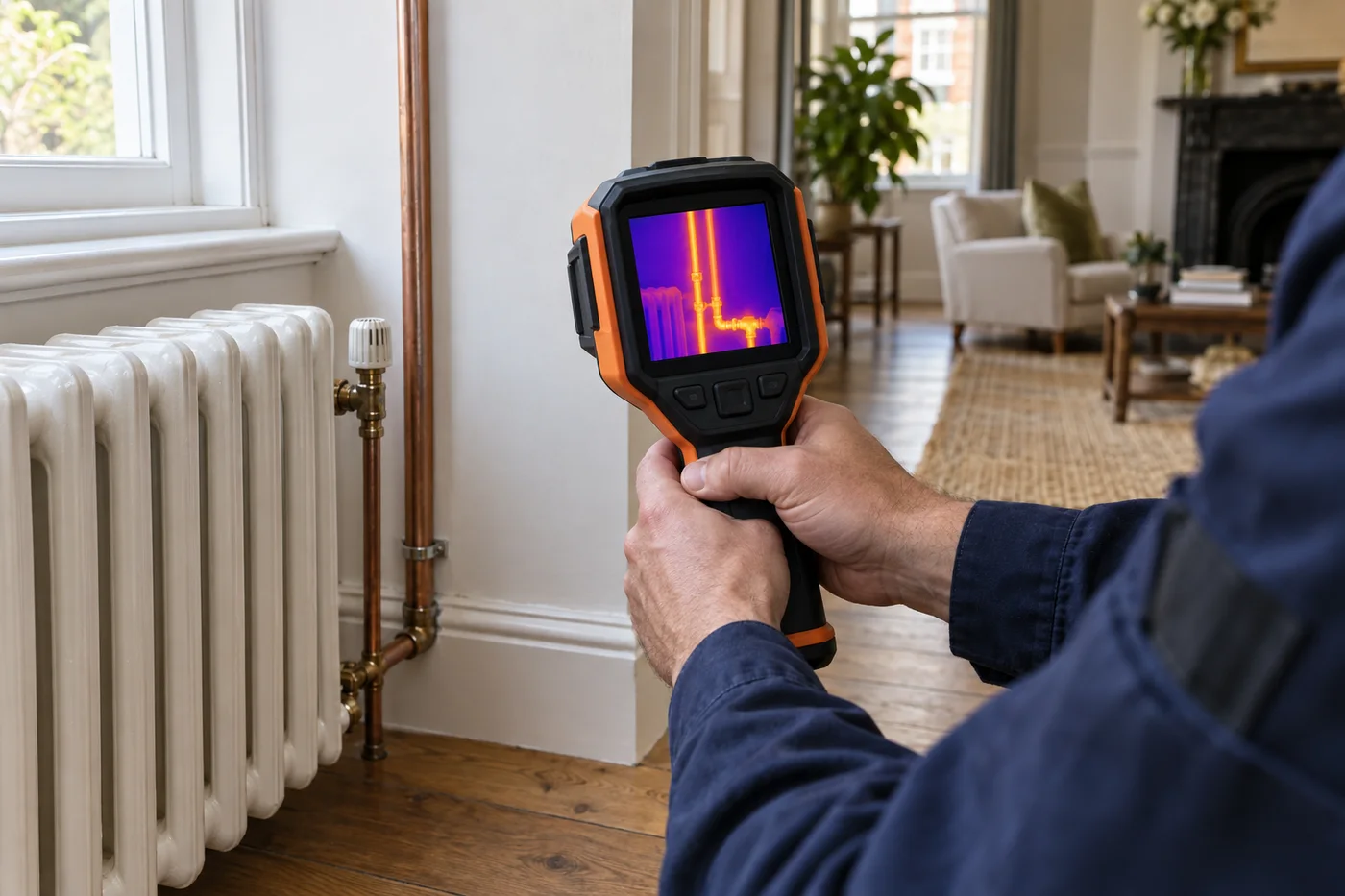
| Thermal images | Dated images with the temperature scale visible, and the corresponding visual photograph of the same frame | A thermal image with no scale and no matching photograph is decorative |
| Pressure test data | Test pressure applied, hold time, pressure at the end of the hold, on each circuit tested | Turns "it is losing water" into a number |
| Damage observed | What is wet, what is stained, what is structurally affected, room by room | The scope of the escape of water claim, as distinct from the trace and access element |
| Access required | Exactly what has to be lifted, cut or removed to reach the point, and the reinstatement that follows | The trace and access cover itself |
| Engineer and date | Name of the engineer who attended, date, signature | Makes it a document somebody stands behind |
What each method actually produces as evidence
Pressure testing
The most useful evidence in the whole report, and the cheapest to produce. A circuit is isolated, brought to a test pressure and held. A gauge that drops from test pressure over a recorded hold is a loss, in writing, with a number attached. A gauge that holds rules that circuit out, which matters just as much, because a report that says "the heating circuit held at test pressure for thirty minutes and was excluded" is a report that has done work.
Thermal imaging
Traces warm pipe runs through screed, tile and plasterboard, and shows evaporative cooling where water is moving through a cold structure. It is a survey tool, not proof on its own: a thermal anomaly is a place to point the other instruments. Images go in with the scale visible and with the matching visual photograph beside them, so the adjuster can see what they are looking at.
Moisture mapping
Readings taken on a grid across the affected area and, critically, on comparable unaffected material. The dry reference is the reading most reports omit and the one that makes the rest mean anything. It also gives you the shape of the wetting, which usually points uphill towards the source.
Acoustic
Listening for the pressure-driven hiss of water escaping a live pipe, ground microphone on hard floors, contact probe on exposed pipework and fittings. Strong on pressurised mains and cold feeds, weak on gravity waste and on anything that has already been depressurised.
Tracer gas
Non-invasive and the method of last resort in the good sense: the circuit is drained and charged with a hydrogen-nitrogen mix, and the gas escapes at the defect and rises through the floor build-up where a detector picks it up. It finds what nothing else does, including small losses on drained systems and leaks under deep screed. It is also the finding that tends to close an adjuster's questions, because it is difficult to argue with gas emerging at one point in a floor.
Why a one-line invoice gets the claim queried
The invoice most people send their insurer says something close to "attend property, trace leak, £X". From the desk it is indistinguishable from a plumber who lifted three boards and got lucky, and it gives the handler nothing to test. So the file goes back with questions: when did the damage start, how do we know the leak is where you say, why did that much floor have to come up.
Those questions are not hostile. They are the gradual damage test. The Financial Ombudsman's guidance for insurers on gradual damage says the insurer should consider "whether the customer could have known about the damage" and whether they "made the insurance claim, or took reasonable action, as soon as they could reasonably have known about the problem" — and that where the insurer relies on an exclusion, "it's your responsibility to prove it applies to the claim". A dated report that records when the symptom first appeared and what the readings were on the day answers that before it is asked. An invoice invites the insurer to fill the gap with an assumption.
What we deliberately leave out
- Any view on liability. Whose pipe it is, whose excess applies and whether a neighbour was negligent are not engineering findings. We record what and where. Read who pays for a leak from the flat above for how that question is actually settled.
- Any view on whether the policy covers it. Cover is what your schedule says. Trace and access is a separate head of cover on many policies and absent from others.
- Anything we did not test. If a circuit was not isolated because it could not be, the report says so and says why. An incomplete report that admits the gap survives scrutiny; a complete-looking report with an invented line in it does not.
When you do not need one
If the leak is visible and obvious — a split flexible tap connector under a basin, a failed washing machine hose, a radiator valve weeping onto a floor you can see — you need a plumber and a photograph, not a detection report. Most insurers will settle the damage on that basis and there is no access cost to claim, because nothing had to be opened. Paying for a survey to document something already in plain sight is money you will not get back.
The report earns its cost when the water is arriving somewhere other than where it is escaping: through a ceiling from a floor above, out of a screed, down inside a stud wall, or nowhere at all except on the meter. That is the situation trace and access cover exists for.
What it costs
Detection is charged at our hourly rate, agreed before we attend, and if we do not find the leak you do not pay for the time we spent looking. The report is part of the detection visit, not an extra. See pricing, or trace, access and reinstatement for how the repair and the making good follow on. If you have not had anyone out yet, document the leak first — the photographs you take today are evidence nobody can recreate later.