Three bills, three policy sections
A single leak under a hall floor generates three separate costs, and a great deal of frustration comes from people expecting one heading to absorb all three.
| Cost | Usual policy section |
|---|
| Locating the leak: detection visit, pressure testing, thermal, tracer gas | Trace and access |
| Opening up: lifting flooring, breaking screed, cutting plasterboard | Trace and access |
| Making that opening good: re-screed, re-plaster, re-tile, decorate | Trace and access |
| The new pipe section, fittings and labour to repair the defect | Usually excluded from both |
| The ceiling below, the swollen flooring, the soaked insulation | Escape of water |
| Ruined furniture, rugs, electronics | Contents, if held |
Admiral states the exclusion plainly: trace and access "doesn't include repairing the source of the leak, like tanks or pipes, or the cost of any damage the leak has caused". Allianz words it the same way. Some products bundle the repair in and rename the section, as Saga does with "Trace, Access & Repair", so the heading on your own schedule matters.
Why the excluded item is usually the cheapest one
This is the part that reads as unfair and is actually, in practice, the least of your problems.
A pinhole in a 15mm copper heating pipe is a cut, a clean, and a new coupling. A failed push-fit joint is two minutes once you can see it. The money on a hidden leak job is overwhelmingly in the finding and the putting back: the detection time, the screed, the plaster, the tiling, the second coat of paint that has to go across the whole wall so it matches. Those are the parts trace and access exists for.
So the exclusion is real but narrow, and we quote the repair separately for that reason. Our invoice splits detection, access, repair and reinstatement onto their own lines, because a handler who has to allocate a single total across three policy sections tends to query all of it.
Where the cover stops for other reasons
No damage, no claim
Saga states that a trace and access claim needs actual damage, and that without it the work counts as general maintenance. A spinning meter with a dry house is a supply pipe problem, and the route for that runs through your water company and the meter evidence, not the insurer.
The cash limit
Published limits in this market sit around £5,000 to £10,000, with some upper-tier products going to the sum insured. Those are the insurers' own published figures for their own products, not our prices and not a prediction about yours. Once the limit is reached, the balance is yours. It is worth knowing the number before the floor comes up.
Named exclusions
Saga excludes trace and access where the home was unfurnished or unoccupied at the time of the damage, where the cause was subsidence, ground heave, settlement or landslip, and for repairs to underground services including broken clay pipes and collapsed pitch-fibre drains resulting from wear and tear. Similar carve-outs appear across the market.
Contents-only cover
It is the building being opened up, so the cover sits with buildings insurance. Admiral confirms it is not included on contents-only policies. If you are a leaseholder, the building is usually insured by the freeholder or managing agent, and the trace and access claim belongs there.
What makes the difference in practice
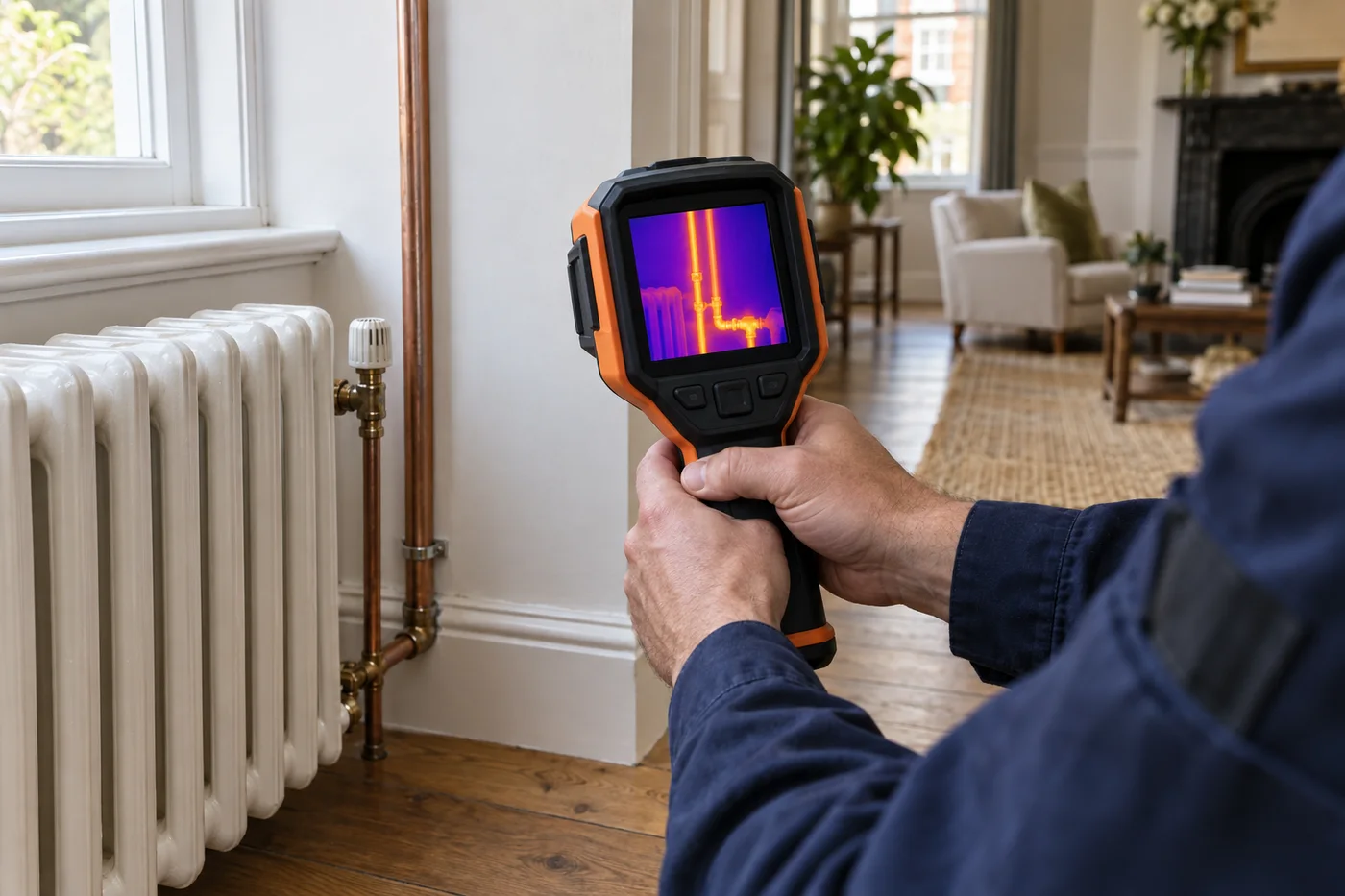
Whether an insurer pays the access element without an argument almost always comes down to whether the report justifies the opening. A handler seeing "lifted the hall floor" has no way to tell a targeted excavation from a search. A handler seeing a thermal image, a pressure test result, a moisture map and a tracer gas confirmation at one measured position, followed by a photograph of the defect at that position, has a file that answers itself.
We produce a full leak detection report written to be accepted for a trace and access claim, covering the method, the readings, the located defect, and the reinstatement carried out. It is the reason our trace, access and reinstatement work is one visit and one paper trail rather than a detection firm, a plumber and a plasterer producing three unrelated invoices.
Non-invasive first, always
The cheapest access is the access you do not need. Tracer gas on a drained circuit, thermal imaging across a screed floor and moisture mapping across a wall between them locate most losses before anything is cut. That keeps the access element small, which keeps it inside the limit, which is the practical difference between a claim that settles and a claim that runs out of cover halfway through.
If the insurer refuses the access element
Ask for a written final response that quotes the exact wording relied on. FCA rule ICOBS 8.1.1R requires an insurer to handle claims fairly and not to reject one unreasonably, and the Financial Ombudsman Service says that where an insurer has relied on an exclusion, it looks at whether the exclusion has been applied fairly. If eight weeks pass without a final response, or you disagree with it, refer it to the ombudsman within six months of that response. The service is free.
When not to call us
If the damp patch is under a bathroom in the flat above and you are a leaseholder, the block policy and the managing agent come first. If the water is visibly coming from a perished sealant line you can see, buy sealant. If your policy has no trace and access section at all, you can still have the leak found, but understand you are funding it, and ask us for the fixed hourly basis before we attend. We work at £150 per hour, and if we do not find the leak you do not pay for the time we spent looking.