What the money is actually for
You have a stain on a ceiling, a warm patch on a floor, or a meter that turns with every tap shut. The water is coming from somewhere behind the building fabric. Two costs follow from that, and they are separate things.
The first is the cost of finding it and getting to it: the detection visit, then lifting boards, cutting a section of plasterboard, breaking into screed, and afterwards re-screeding, re-plastering, re-tiling and decorating that area. That is what trace and access is for. Admiral describes the cover as paying "the cost of removing and replacing parts of the building when trying to find the source of a leak" and "the cost of putting your home back to the way it was before the leak was found and fixed".
The second is the damage the water did on its way out: the ruined ceiling below, the swollen flooring, the soaked insulation. That normally sits under a different heading in the policy, usually escape of water, with its own terms.
People conflate the two constantly, and then get surprised when an insurer pays one and argues about the other.
Where it sits in a policy
Trace and access lives in buildings cover, because it is the building that gets opened up. Admiral states that its trace and access cover is not included on contents-only policies. If you rent, and you hold contents cover alone, the trace and access question belongs to whoever insures the structure, which is normally the freeholder or the managing agent.
Whether you have it at all varies. The Association of British Insurers notes that trace and access cover is not always offered as standard. Some insurers include it on every tier, some sell it as an add-on, and some include it only above a certain product level. Check the schedule, not the marketing page.
Typical published limits
The limit is usually a cash cap rather than a share of the sum insured. These are the figures the insurers themselves publish, quoted as examples of how the market sets limits, not as any kind of guide to what your own policy does:
| Insurer | Published trace and access limit |
|---|
| Admiral | Up to £5,000 on Admiral and Gold levels, up to £10,000 on Platinum |
| Allianz | £5,000 on Bronze and Silver, £10,000 on Gold |
| Saga | Up to £5,000 on Select, up to the sum insured on Plus |
Read that as a range the market works in. Your own limit is on your schedule, and it may be lower, higher or absent.
The exclusion that catches most people
Admiral is direct about it: the cover "doesn't include repairing the source of the leak, like tanks or pipes, or the cost of any damage the leak has caused". Allianz words it the same way, describing trace and access as the cost of removing and replacing part of the building to find the source, and excluding the repair of the tank, appliance or pipe.
So on a typical claim there are three pots of money, and only one of them is trace and access:
- Finding it and opening up, then making good. Trace and access.
- The damage the water caused. Usually escape of water, subject to its own limits and excess.
- The new length of pipe and the joint. Usually the policyholder, out of pocket.
That third item is the smallest of the three on almost every job we attend. A pinhole in a 15mm copper run is an hour of work and a few pounds of fittings. The expensive part was always the finding and the making good, which is exactly the part the cover exists for. We handle all three so there is one job rather than three trades blaming each other, and we itemise them separately so your insurer can see what belongs to which heading. That is the whole point of our trace, access and reinstatement service.
What is not trace and access
Home emergency cover
A different product. The Financial Ombudsman Service describes home emergency insurance as cover for "a quick response to sudden emergencies" which "doesn't usually cover any damage the emergency has caused". It gets a tradesperson through the door and makes the situation safe. It is not a detection budget, and its call-outs are usually capped tightly.
Escape of water
The damage heading. A claim can succeed on escape of water and still fail on trace and access, or the reverse, because they are assessed against different policy words.
A leak with no damage
Saga is explicit that a claim needs actual damage, and that without it the work is treated as general maintenance. If your meter is spinning but nothing inside the house is wet, that is a supply pipe question rather than an insurance one. Start with the meter reading and your water company.
What an insurer wants before it pays
Insurers are not obliged to take your word for where the leak was, and they rarely do. What tends to get agreed without argument is a report that shows the method used, the readings taken, where the loss was found, why the building had to be opened at that point, and what it took to put it back.
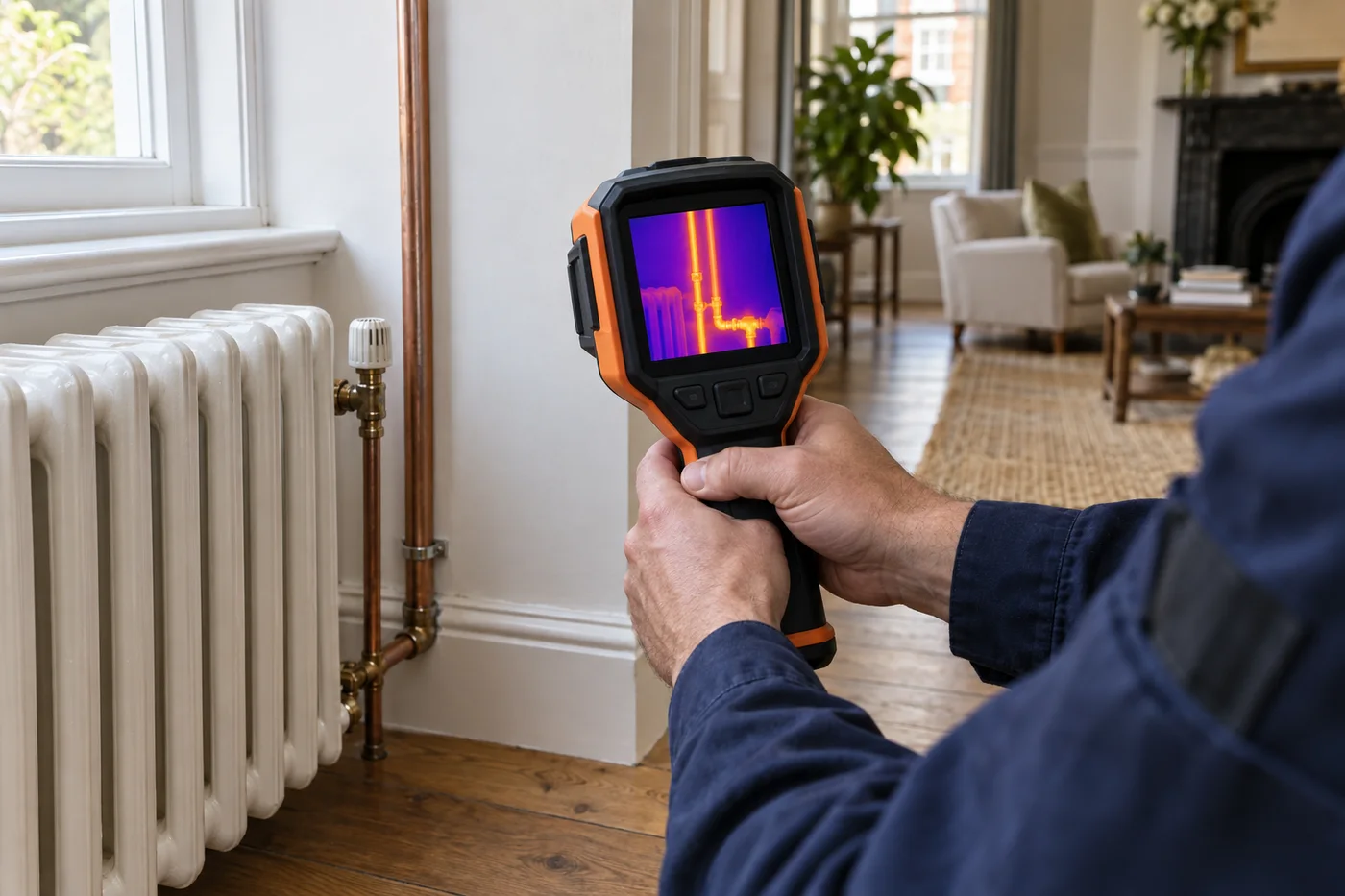
Our leak detection report is written for that purpose. It sets out the acoustic, thermal, moisture and pressure test results, photographs the located defect, and separates detection, access, repair and reinstatement into their own lines so nobody has to unpick a single total. It is written to be accepted for a trace and access claim.
The regulator's baseline sits behind all of this. FCA rule ICOBS 8.1.1R requires an insurer to "handle claims promptly and fairly", to "provide reasonable guidance to help a policyholder make a claim", and not to "unreasonably reject a claim".
If the claim is refused
Complain to the insurer in writing first and ask for a final response. If the answer does not come within eight weeks, or it comes and you disagree with it, the Financial Ombudsman Service can look at it. You have six months from the date on the final response to refer it, and the service is free.
When not to call us
If the water is coming from a visible failed sealant line around a bath or shower tray, that is a tube of sealant and an afternoon, and most policies exclude it anyway. If the stain sits directly under a bathroom in the flat above and you are a leaseholder, the first move is a written report to the managing agent, not a detection visit you may not be liable for. And if you have a boiler that only loses pressure in winter, read the boiler pressure pages before anyone lifts a floor.
When a visit is the right answer, we work at £150 per hour agreed before we attend, and if we do not find the leak you do not pay for the time we spent looking. Pricing and booking are both straightforward.