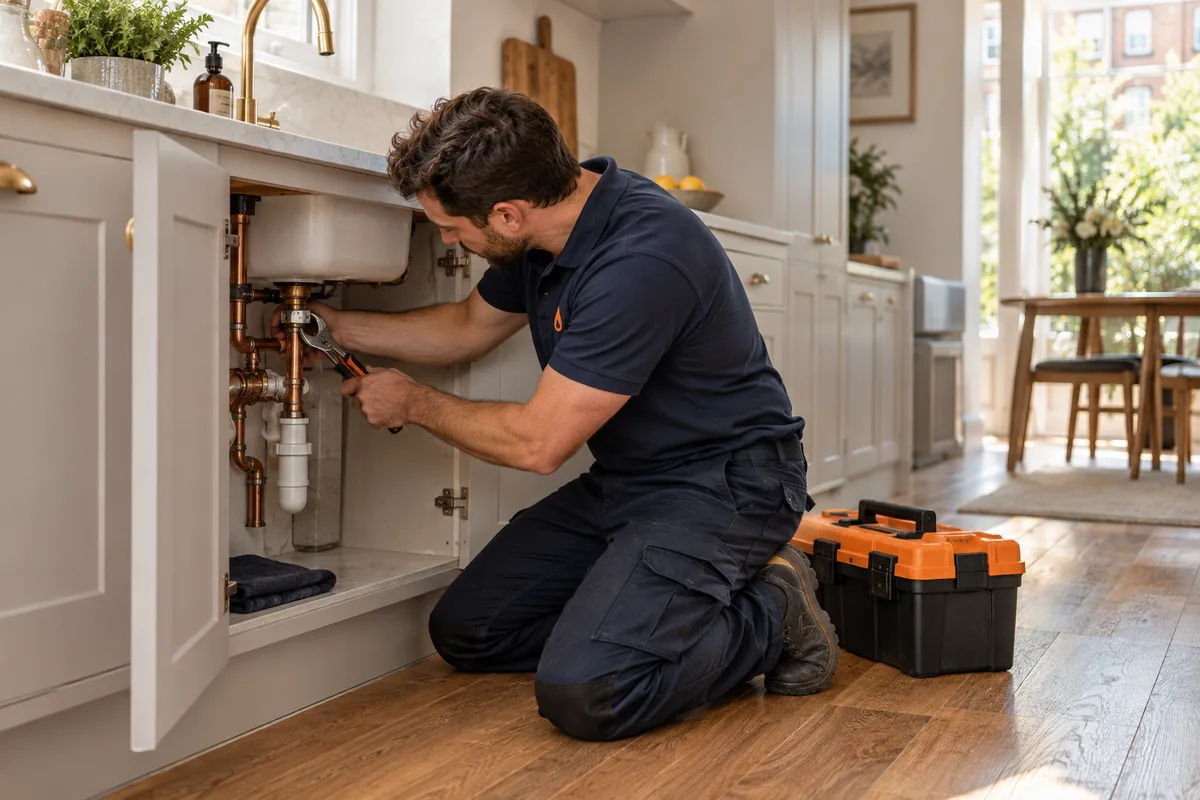
What you are actually paying for
A call-out fee is the charge for turning up. It covers the drive, the parking, the van and the hour the engineer cannot sell to anyone else. It is not payment for the work. On most London pricing structures the clock then starts on top of it.
That is the part people get caught by. A fee quoted on the phone as "the call-out" is very often the floor of the bill rather than the bill.
What the market charges
These are published UK market ranges from named cost guides, not our prices.
| Charge | Published range | Source |
|---|
| Standard hourly rate to call a plumber to your home | £40 to £60 per hour | Checkatrade cost guide, 2026 |
| Emergency call-out fee | £100 to £120 | Checkatrade cost guide, 2026 |
| Day rate | £325 to £375 | Checkatrade cost guide, 2026 |
| Out-of-hours hourly rate | Up to twice the standard rate | Checkatrade cost guide, 2026 |
| Repairing a burst water pipe, labour and materials, excluding VAT | £100 to £500 | Which?, plumber cost guide |
Which? also notes that prices sit at the upper end of the national scale in London and the South East, which is worth holding in mind when a national average looks reassuring.
The three structures you will be quoted
Call-out plus hourly
The most common. You pay the fee for attendance, then the hourly rate from the moment work starts. Ask whether the fee includes any working time at all. On many emergency structures it does not, and Checkatrade notes a minimum one-hour charge is common on emergency call-outs on top of the fee.
Call-out inclusive of the first hour
Better value if the job is short, worse if it is long, because the inclusive hour is usually priced above the standard rate. It is also where the second hour tends to be quietly more expensive than the first.
Free call-out, and the very low advertised figure
A free call-out is not free labour. It means the attendance cost has been folded into the hourly rate, the minimum charge or the price of the repair itself. A headline figure well below the market ranges above is an entry price for the simplest imaginable visit, and the phrase to look for underneath it is "subject to inspection". Ask what the second hour costs, because that is usually where the money has been moved to.
Why call-out fees exist at all
Because a plumber who cannot find a leak has still spent the afternoon on your job. Somebody pays for unproductive time, and a call-out fee is the honest version of doing that in the open rather than inflating the repair price to cover it.
The argument against it is that it charges you the same whether the engineer solves your problem or shrugs at it. That is the trade-off, and it is why a no find, no fee guarantee matters more on detection work than the headline fee does. We explain exactly what that guarantee covers in what no find, no fee actually means.
Four questions to ask before you book
- Is the call-out fee separate from the hourly rate, or does it include working time? Get the answer in a message, not in conversation.
- What is the minimum charge? A one-hour minimum on a ten-minute job is standard, and fine, as long as you knew.
- When does the clock start and stop? On arrival, or when work begins. Does a trip to a merchant for a part count.
- What is the rate outside normal hours, and what counts as outside normal hours? Some firms treat 5pm as out of hours, some treat 8pm as out of hours.
Which? recommends getting at least three comparable quotes and asking for an itemised breakdown of labour, materials and terms, which is straightforward advice that almost nobody follows during a leak.
When you should not be paying anyone a call-out fee
- The leak is on the water company side of your boundary. CCW is clear that the water main, the communication pipe up to your property boundary, the external stop tap and the meter belong to the water company. Report it to them before you pay a private engineer to look at it.
- A dripping tap. A washer or cartridge is a parts-shop job for most people, and the isolating valve under the basin means you do not even need the stopcock.
- A boiler on low pressure that you top up twice a year. That is normal. Read the boiler pressure guide before you book anyone.
- A leak your landlord or freeholder is responsible for. In a block, water coming from the flat above or from a shared riser is usually not your repair to commission. Tell the managing agent in writing first.
What we charge
One number. £150 per hour, fixed before we attend. It does not rise because the property is difficult, the access is awkward or the visit is in the evening. There is no separate call-out fee and no minimum-charge surprise bolted on afterwards.
What the rate does not do is tell you the total, because nobody knows the total until the leak is found. A fixed rate is protection against being re-priced on the doorstep; it is not a fixed price. That distinction is the whole subject of why leak detection is charged by the hour.
And if we do not find the leak, you do not pay for the time we spent looking. For water coming through now rather than a slow mystery, start at emergency leak repair.