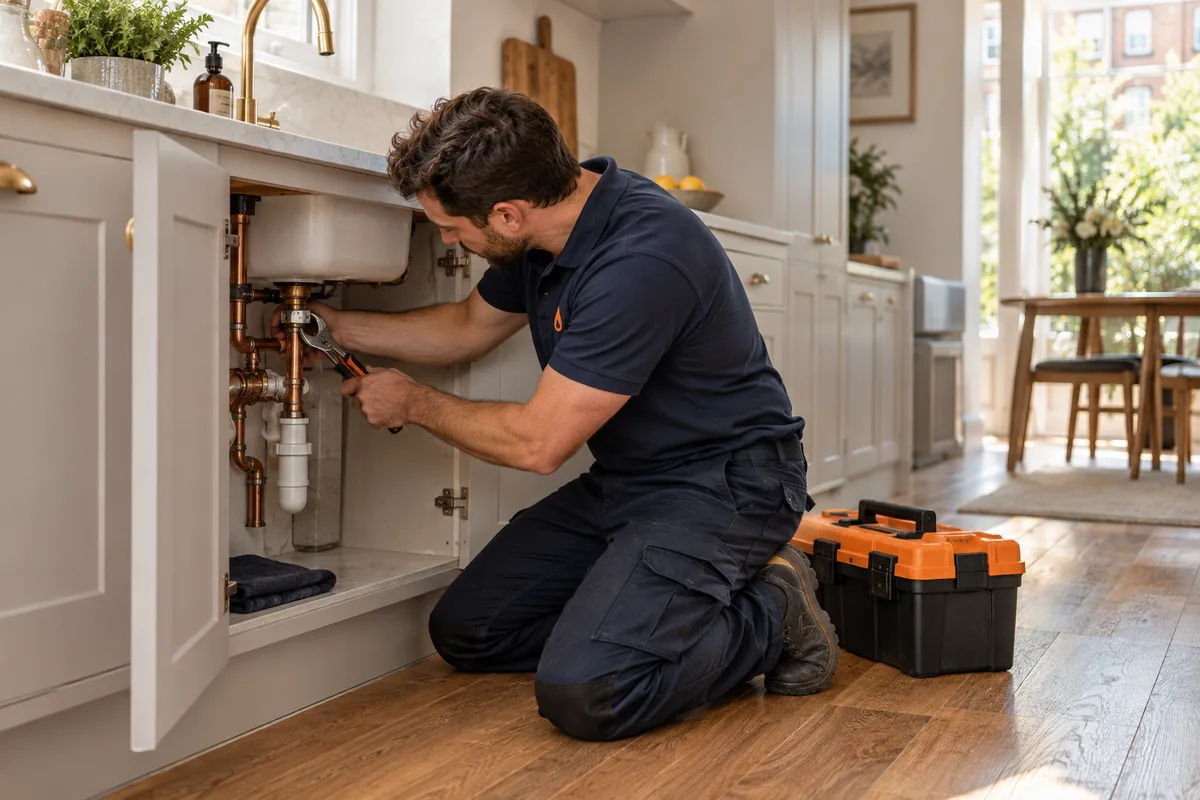
Every radiator has two valves at the bottom. The one you turn by hand, usually a thermostatic valve with a numbered head, controls how warm the room gets. The one at the other end, under a plain plastic cap, is the lockshield. It controls how much of the system's hot water that radiator is allowed to take, and it is set with a spanner or a key rather than by hand so nobody changes it by accident. If a radiator is cold while the rest of the house is warm, or water is weeping from under that cap, the lockshield is usually where to look.
What the lockshield actually does
Water leaves the boiler, runs round a circuit of pipes and takes the easiest route back. Radiators close to the boiler, or on short pipe runs, are the easiest route, so left fully open they take more than their share and the ones at the far end of the house get what is left. The lockshield is a restriction you set on each radiator so the flow is shared out. Closing it partly on a greedy radiator pushes more water on to the next one.
That is why it has a cap and no handle. Once it is set, it is meant to stay where it is. Radiator valve types names every part of both valves if you want to see how the lockshield sits alongside the thermostatic valve, the tail and the union.
How to tell which valve is the lockshield
- It has no numbers. The thermostatic valve has a head marked 0 to 5 or with a snowflake. The lockshield has a smooth cap, often white or chrome, that spins freely when you try to turn it.
- The cap pulls or unscrews off. Underneath is a small square or hexagonal spindle, sometimes with a slot across the top.
- On older radiators with two manual valves, the one with the wheel handle is the on/off valve and the one with the cap is still the lockshield.
It does not matter which end of the radiator the lockshield is on. Most modern valves work with water flowing either way through them.
How to adjust a lockshield valve
You need an adjustable spanner, a small pair of grips or a plastic lockshield key from any plumbers' merchant, which fits most spindles. Some caps are made so that turning them upside down makes them into the key.
- Pull or unscrew the cap to expose the spindle.
- Clockwise closes it, anticlockwise opens it, looking down at the spindle.
- Count the turns before you change anything. Close it gently, counting quarter turns until it stops, and write the number on a piece of masking tape on the pipe. That number is the setting someone chose when the system was balanced, and you will want it back.
- Do not force it at either end. The spindle is thin brass, and a lockshield that has not moved in ten years can shear or start weeping if it is wrenched.
- Refit the cap so the setting is not knocked.
How many turns take a lockshield from closed to fully open depends on the make, which is another reason to count rather than guess. On a balanced system most sit part open, with the ones near the boiler closer to closed and the ones furthest away closer to open.
A cold radiator is often a closed lockshield
This is the most common lockshield problem we see as the heating comes back on in autumn. A radiator was taken off to decorate over the summer, the lockshield was closed to isolate it, and it went back on the wall without being reopened. Or a well-meaning visitor tried to turn the radiator off with the lockshield and it stayed that way. The radiator stays cold, or warm only at the pipe end, while everything else is hot.
If the thermostatic valve is open and the radiator is still cold, take the lockshield cap off. If the spindle will not turn clockwise at all, it is closed. Open it the number of turns you wrote down, or, with no record, about a turn and a half as a starting point, run the heating for twenty minutes and check again. If it is still cold, bleed it using how to bleed a radiator, and if that does not do it, radiator not heating up goes through the causes one by one.
Lockshields and balancing
Balancing means setting every lockshield in the house so each radiator heats up at roughly the same rate. It is done with the heating on, working out from the boiler, and it is usually done properly with a clip-on thermometer on the pipes at each end of the radiator rather than by hand. If a whole house heats unevenly, rather than one radiator, it is a balancing job and not a fault with any one valve.
The thing to take from this for a single radiator: if you close or open one lockshield a long way, the radiators on either side of it change too. Put it back where it was and the rest of the house stays as it was.
Why lockshield valves leak
A lockshield is a valve like any other, with the same seals, and it leaks in the same places. Autumn is when most of them start, because the first heating cycle warms seals and joints that have sat cold since spring.
| Where the water is | Usual cause | What it needs |
|---|
| Under the cap, around the spindle | Worn gland packing or O-ring, often after the spindle has been turned for the first time in years | A small tightening of the gland nut, or new packing. Some can be repacked without draining. |
| At the large nut joining the valve to the radiator | The union seal, often disturbed when the radiator was off the wall | The union remade, with the valve body held still |
| At the nut where the pipe enters the valve | The compression olive on the pipe | Isolate and remake the joint. More tightening rarely holds. |
| From the valve casting itself | Corrosion through the body | A new valve. Nothing to tighten. |
Radiator leaking from the valve has a fuller guide to reading the drip, and leaking radiator covers water coming from the radiator panel itself rather than a valve.
A few things to do while you wait: put a folded cloth and a tray under the valve, check it once the heating is off and cold so you can see whether it is still weeping, and keep an eye on the boiler pressure gauge if you have a sealed system. A lockshield weeping steadily lets enough water out over a week or two for the pressure to fall.
When a lockshield needs replacing
- It turns and turns without stopping. The spindle is stripped. It can no longer open or close the valve, so it cannot isolate the radiator either.
- It will not move at all and has been seized for years. It may free with patience, but if the choice is forcing it, leave it.
- The casting is weeping, pink and powdery or crusted green.
- The gland keeps weeping after it has been adjusted once.
Replacing one is not just a swap. The radiator has to be isolated, which needs a working valve at the other end, then drained into a tray, the old valve taken off the pipe and the tail, and the new one fitted with a new olive. If the thermostatic valve at the other end will not hold either, the circuit has to be drained or the pipe frozen on each side so the job can be done with the system full. How to drain a radiator covers the draining side, and how to drain down your system covers the whole circuit. It makes sense to change both valves on a radiator at the same time, since they are usually the same age.
What not to do
- Do not use the lockshield as an on/off switch. Every time you close and reopen it you lose the setting and disturb the gland.
- Do not keep tightening a weeping nut. A quarter turn is a fair try. After that you are crushing an olive or cracking a union.
- Do not undo anything on a hot system. Heating water can scald and comes out under pressure.
When to call someone
If a lockshield is weeping and a small tightening has not stopped it, the spindle is stripped, or the boiler pressure keeps dropping after you have been working on a radiator, it is time to hand it over. Pressure that keeps falling means water is leaving the system, and it is not always from the valve you can see.
We repair and replace radiator valves across London, freezing the pipe where that saves draining the system, and we reset the lockshield to where it was so the rest of the house still heats. We charge £150 per hour, agreed before we attend, with no call-out fee. If the leak turns out to be under the floor rather than at the valve, we find it before anything comes up, and it is no find, no fee. See radiator and valve leak repair, or check the pricing page before you call.