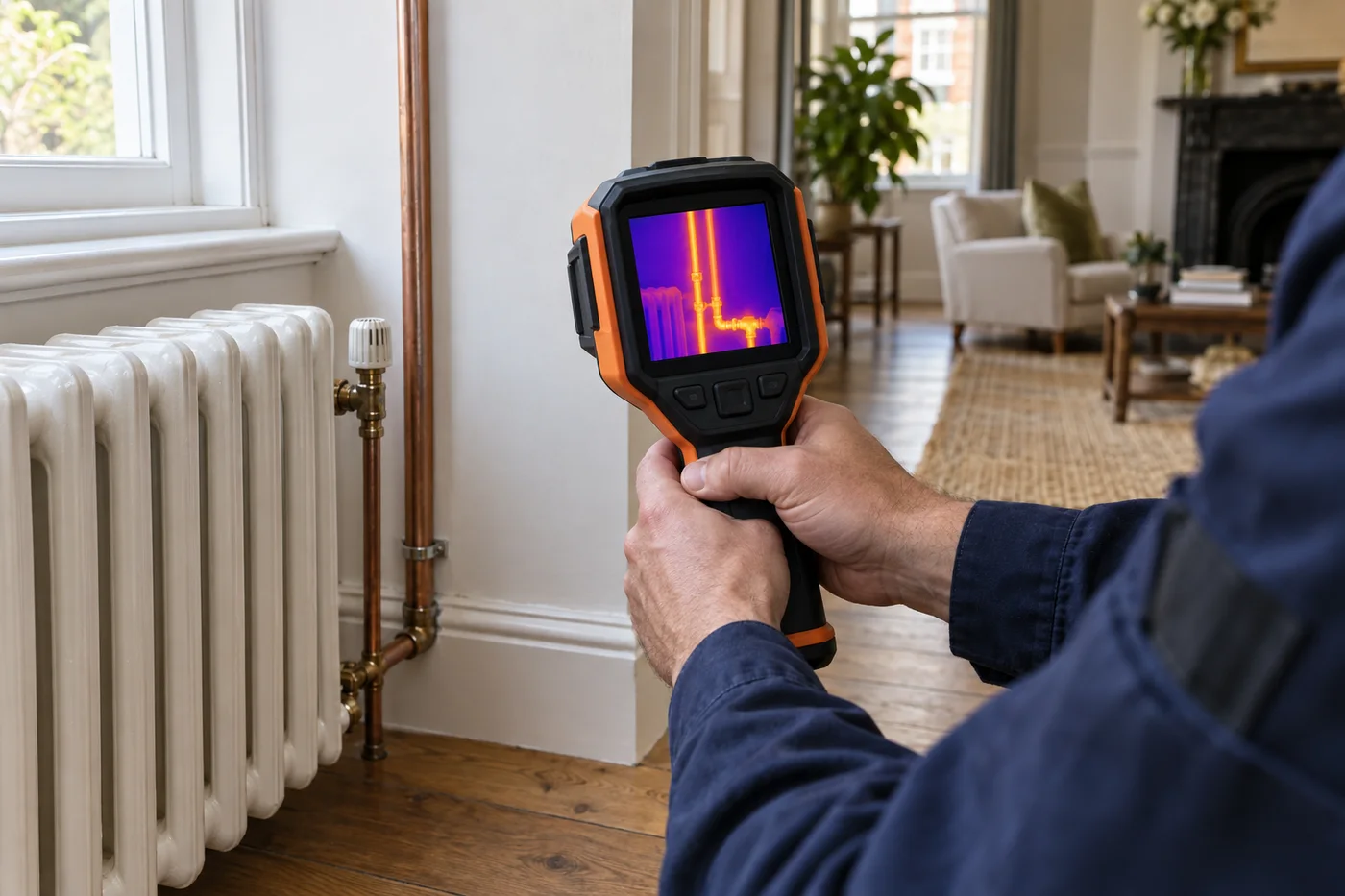
Two instruments, two physical quantities, one number on the screen
The general method of mapping damp on a grid is covered in the moisture mapping guide. This is about the reading itself: what the instrument is physically doing, and what makes it lie.
A pin meter passes a current between two probes and measures resistance. Wet material conducts, dry material does not. Protimeter, whose meters most UK surveyors carry, calibrate that resistance against oven-tested wood samples, and report the result as WME, Wood Moisture Equivalent: the moisture level in any building material as if it were in close contact and in moisture equilibrium with wood, expressed as a percentage of the moisture content of wood.
Read that definition twice, because it is the answer to most arguments about damp readings. On timber, a WME figure is close to a genuine moisture content. On plaster, brick, screed or concrete it is not a percentage of anything in that material. It is a statement about a hypothetical piece of wood sitting next to it.
A pinless meter is doing something different. It presses a pad to the surface and measures the response of whatever sits inside a radio-frequency field, which changes with moisture. Nothing is pushed in, nothing is damaged, and a large area can be swept quickly.
The numbers that do mean something
Protimeter's colour bands are the closest thing to a universal scale, and they are worth knowing because they are what a surveyor's report is implicitly using. Below roughly 16 to 18 percent WME is the green zone, equivalent to about 75 percent relative humidity, and treated as safe. Above 20 percent WME, in any material, is the red zone and indicates a hazardous condition. Between the two is an amber band that means keep watching.
Those thresholds work because they are about risk rather than about how much water is present: at those equivalent humidities, mould and fungal growth become possible, whichever material is holding the moisture. What they do not do is tell you where the water came from.
Why readings come out too high
Salts, which is most of it
Protimeter are explicit: salts left by rising damp, penetration of water from an old flue, or by leaching out of old walls over many years can cause electrical moisture meters to over-read the moisture level. Hygroscopic salts conduct, and once they are concentrated in a plaster face, the pins read them as water even when the masonry behind is dry.
This is the single most common wrong call in damp surveying, and in London it is everywhere: chimney breasts that carried combustion products for a century, old bricked-up flues, and Victorian walls that have been damp at some point in their lives are all salt-loaded.
There are two disciplined ways round it. Protimeter make a dedicated salts detector, which distinguishes salt contamination from moisture. The field alternative is a deep wall probe reading taken just above skirting level, which samples the masonry behind rather than the contaminated plaster face.
Conductive things that are not water
The pinless meter responds to whatever is inside the field. Foil-backed plasterboard, expanded metal lath, a nail plate over a joist, embedded conduit and a pipe all give a strong response and read as soaking. So does a dense patch of sand-cement render next to lightweight plaster, because density changes the response.
The discipline is the same in each case: before treating a pinless reading as water, work out what is behind that part of the wall. A perfect rectangle of high readings is a sheet of something, not a leak.
Why readings come out too low
Depth is the part most people get wrong in the other direction. A pin meter reads at the depth the pins reach, which is a few millimetres unless a hammer probe is used. The pinless meter is not a surface instrument: Protimeter specify their non-invasive radio-frequency mode as finding moisture from 19mm to 120mm below the surface, and note that search mode is not adversely affected by surface moisture.
That has two consequences worth holding. A pinless reading can come from a wet joist 60mm in while the plaster face is bone dry, which is a genuine find and gets dismissed because the pins disagree. And a face that has been drying under a heated floor for weeks can read low while the screed below still holds water.
The measurement that actually settles it
When the meter readings are contested, the honest answer is not a better meter. It is to stop measuring conductivity and start measuring humidity.
Protimeter describe the principle: seal a waterproof tent of polythene, foil, or a box over the suspect area, and let the trapped air come into equilibrium with the material. The relative humidity of that trapped air is a direct statement about how wet the material is, and it is unaffected by salts, by density, and by whatever metal is behind the plaster. Their own caveat is the reason it is not the default: it takes several hours per measurement point, which makes it impractical as a survey method.
For floors there is a standardised version of the same physics. Protimeter's hygrometry mode measures equilibrium relative humidity in concrete floors using the in situ probe method, which is the recognised way to decide whether a slab or screed is dry enough to receive a floor covering. If an argument about a floor has reached the point of who pays for relaying it, this is the measurement that ends it, not a handheld sweep.
Reading a set of readings, not a reading
One number is close to worthless. Three things make a set of readings mean something:
- A dry reference on the same construction. Same material, same build-up, well away from the suspect area. Every other number is relative to it.
- A gradient. Water spreads outwards and downwards from where it arrives, so the shape of the readings says more than the peak. The highest point on a wall that is still wet is usually closer to the truth than the wettest point.
- A second visit. Two sets a week apart separate a live leak from historic damage drying out, which is the question an insurer actually asks.
What to do with a cheap meter, and when not to bother
A basic pin meter is genuinely useful for comparison and useless as an absolute. Take a reading on the damp patch and one on the driest part of the same wall, write both down with the date, and repeat in five days. A closing gap means something has stopped. A widening one means it is live.
Do not push pins into a wall where a cable or a pipe may be chased. Do not read a chimney breast and conclude you have a leak, because that is the classic salts false positive. And do not buy a meter to decide whether to replaster, because the question there is whether the wall has reached equilibrium, which needs the humidity method rather than a conductivity one.
Where this becomes our work is when the readings say it is live and you need the pipe found, opened once, repaired and the surface put back. Detection is £150 per hour, fixed before we attend, with no find, no fee. The map also sizes the reinstatement, which is what a trace and access settlement turns on: see leak damage repair and reinstatement and insurance claims.