Do this now
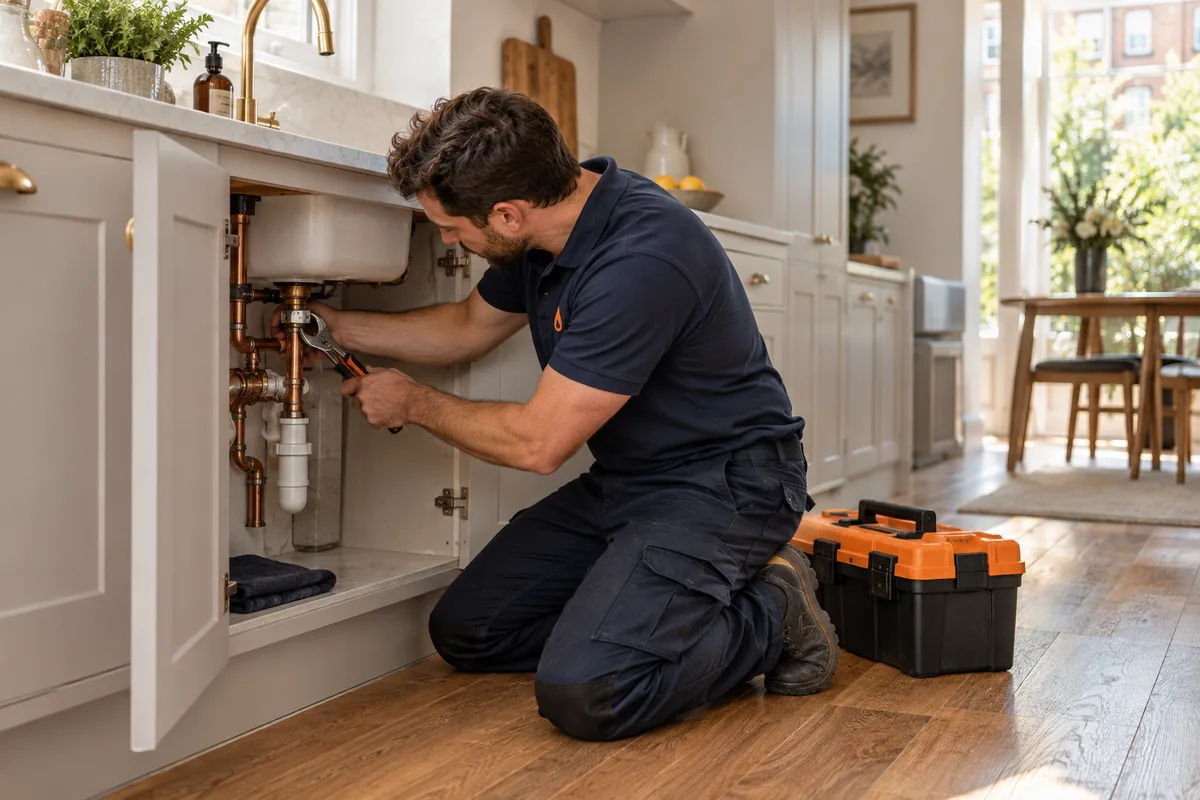
- Find the inside stop valve and turn it clockwise. Thames Water describe it as usually sitting just after the water pipe enters the house, most often under the kitchen sink. It takes several turns, not a quarter turn. If you cannot see it, where is my stopcock lists the places it hides in London properties.
- Open the cold tap over the kitchen sink. That drains the standing water out of the rising main rather than leaving it to keep feeding the leak. Thames Water warn that taps can run for a few minutes after the valve is shut for exactly this reason.
- Open the other cold taps, lowest floor first. On a leak that is running through a ceiling, this is the fastest way to empty the pipework above it.
- Switch off anything that heats water. Immersion heater at the switch, and the boiler at its own switch. Both can be damaged by running dry.
- If the water does not stop, use the outside stop valve. Thames Water keep this one for emergencies, such as a leak on the supply pipe between the outside and inside valves, and it usually needs a stop tap key. Turn it clockwise, and never force it.
Then deal with the water already out: keep people away from a bulging ceiling, and turn off the electrics to any affected circuit at the consumer unit rather than touching wet fittings.
What the stopcock does not turn off
This catches people out, because the tap keeps running and they assume the valve failed.
| What you have | What closing the stopcock does |
|---|---|
| Mains-fed cold taps and a combi boiler | Stops everything within a minute or two |
| A cold water storage tank in the loft | Stops the refill, but the tank keeps feeding whatever it serves until it empties. Sometimes that is a long time and a lot of water |
| A hot water cylinder | The cylinder stays full and can keep draining through the hot taps |
| A sealed heating system | Nothing. The heating circuit is closed and holds its own water, which is why a radiator or underfloor leak does not stop when the mains does |
| A leak in the flat above | Nothing. Their supply, their valve |
If the water keeps coming after the mains is off, that is useful information rather than a failed attempt: it tells you the leak is on the heating circuit, on the stored water side, or not in your property at all.
Isolate one thing instead of the whole house
Most leaks do not need the house shut down. There is usually a smaller valve closer to the problem.
- Service valves on the pipes feeding basins, toilets and taps, usually a slotted screw in the body of the valve. A quarter turn with a flat screwdriver, so the slot sits across the pipe, closes it.
- Washing machine and dishwasher valves behind or beside the appliance, normally a small lever.
- The toilet fill valve, which is the one people turn the whole house off for when a cistern will not stop filling.
- Radiator valves at each end of a leaking radiator, which isolate it from the rest of the heating without draining the system.
Shutting a branch rather than the main means you keep drinking water and a working toilet while the repair is arranged, which matters if the work is going to take more than an afternoon.
Turning off the water to one radiator
A radiator is on the heating circuit, not the mains, so the stopcock does nothing to it. It has its own two valves, one at each end, and closing both cuts it off from the rest of the system.
- Heating off first, and let the radiator cool.
- Close the control valve. On a thermostatic valve, turn the head to its lowest or off setting. Some only close fully with the head removed and the plastic cap that came with it screwed on in its place. On a manual valve, turn it clockwise until it stops.
- Close the lockshield at the other end. Pull off its plastic cover and turn the spindle clockwise with a spanner or pliers. Count the turns as you go, because that is how you set it back to the same balance afterwards.
- Check it has held. Put kitchen roll under the leak. If it is still wet after half an hour, one of the valves is not sealing, or the leak is on the pipe below the valve, which the valves cannot isolate.
If the leak is at the valve itself, the detail on what each kind of weep means is on a radiator leaking from the valve.