Look here first
The inside stop valve sits on the rising main, as close as the plumber could get to where it comes through the floor or wall. In most houses that is the back of the cupboard under the kitchen sink, behind the waste trap and whatever is stored in front of it. It is brass, it has a crutch handle or a small round wheel, and it is usually the only valve of its kind on that pipe.
If it is not there, Thames Water's own list of the next places to look is: an airing cupboard, under the stairs, under the floorboards, near the front door, and in the garage, utility room, bathroom or cellar.
Where it is in London housing stock
The building type narrows it down faster than a general list does.
| Property | Where it usually is |
|---|
| Victorian or Edwardian terrace | Under the kitchen sink in the back addition, where the main was re-run when the kitchen was last done. In houses with a cellar or a front vault, often at the cellar head instead, on the pipe where it rises out of the floor at the front of the building |
| Terrace converted into flats | Each flat has its own valve, commonly under the kitchen sink or in a hall cupboard, and there is a communal one where the main enters the building. Thames Water describe exactly this arrangement for shared supplies |
| Purpose-built block | In the airing cupboard, or in the riser cupboard off the landing, sometimes behind a panel the managing agent controls. Lever valves rather than brass crutch heads |
| New build or recent conversion | In the utility cupboard next to the meter and manifold, usually a quarter-turn lever, and often labelled |
| Outside, at the boundary | The external stop tap, under a small metal or plastic cover at the property line, in the path or the pavement. Thames Water describe a cover about the size of a CD case, near the boundary, and sometimes shared between houses |
Two London-specific things. Where a house has been converted in stages, the original stopcock is often still in place under the old kitchen position and a second one has been added in the new kitchen, so you may have two, and one of them may do nothing. And in a basement flat, the valve serving the whole building is frequently inside your property, which makes you the person everyone knocks for when there is a leak upstairs.
How to recognise it when you see it
- It is on the rising main, which is the pipe that comes up out of the floor or through an external wall and carries mains pressure. Trace back from the cold tap over the kitchen sink and you will usually get there.
- It is a brass body with a handle that turns several times, not a quarter-turn lever, in anything older than about twenty years.
- Next to it you will often find a drain-off cock, a small brass fitting with a nozzle. That is not the stopcock and closing it does nothing.
- If there is a meter inside the property, the valve is almost always immediately before or after it.
What it is not: the gate valves on the pipes from a loft tank, which are usually red wheel heads and control stored water rather than the mains, and the small screwdriver-slot service valves under basins and behind appliances.
Test it before you need it
Thames Water suggest a monthly reminder to check the inside stop valve works. That is a five-second job: turn it fully off, run the kitchen cold tap until it stops, then turn it fully back on. Doing it occasionally is what stops it seizing solid, and finding out that it is seized on a dry Tuesday is a great deal cheaper than finding out at two in the morning. The full shut-off sequence, including the heating circuit and a loft tank that the stopcock does not stop, is in how to turn off your water supply.
Two things to expect. It may be stiff the first time. And an old valve that has not moved in years sometimes weeps from under the handle afterwards, which is the gland packing rather than anything serious, and is covered on stopcock leaking. If it will not move at all, leave it and locate the outside valve instead, because Thames Water are clear that excessive force is the wrong answer.
If you genuinely cannot find one
In that order: follow the cold pipe back from the kitchen tap, lift the hall or kitchen floor hatch if there is one, check the meter position on your bill or in the outside cover, and in a flat ask the managing agent where the riser isolation is. Then find the outside stop tap and make sure you can open the cover and reach the valve, which usually needs a stop tap key rather than a hand.
It is worth knowing which valve is which for another reason. The boundary stop tap marks where responsibility changes hands: the supply pipe from there into your property is the one you look after, which is why a leak in the front garden is a different conversation from a leak in the pavement. There is more on that boundary, and on what to do with a leak notice, in the Thames Water section.
When the stopcock hunt is really a leak hunt
Most people search for the stopcock because something is already wrong. If you have found it, closed it, and the meter still creeps or the damp patch still spreads, the shut-off has not told you what you wanted to know.
The specific symptom: with the inside valve fully closed and every tap shut, the meter dial still turns. That means water is escaping upstream of the valve, on the supply pipe between the boundary and the house, and no amount of isolating indoors will stop it. In London that usually means an old lead or steel supply running under a front garden, a path or a drive. If Thames Water have already written to you about it, the repair clock is running: see who can repair a supply pipe and, once it is fixed, the leak allowance for the water you lost.
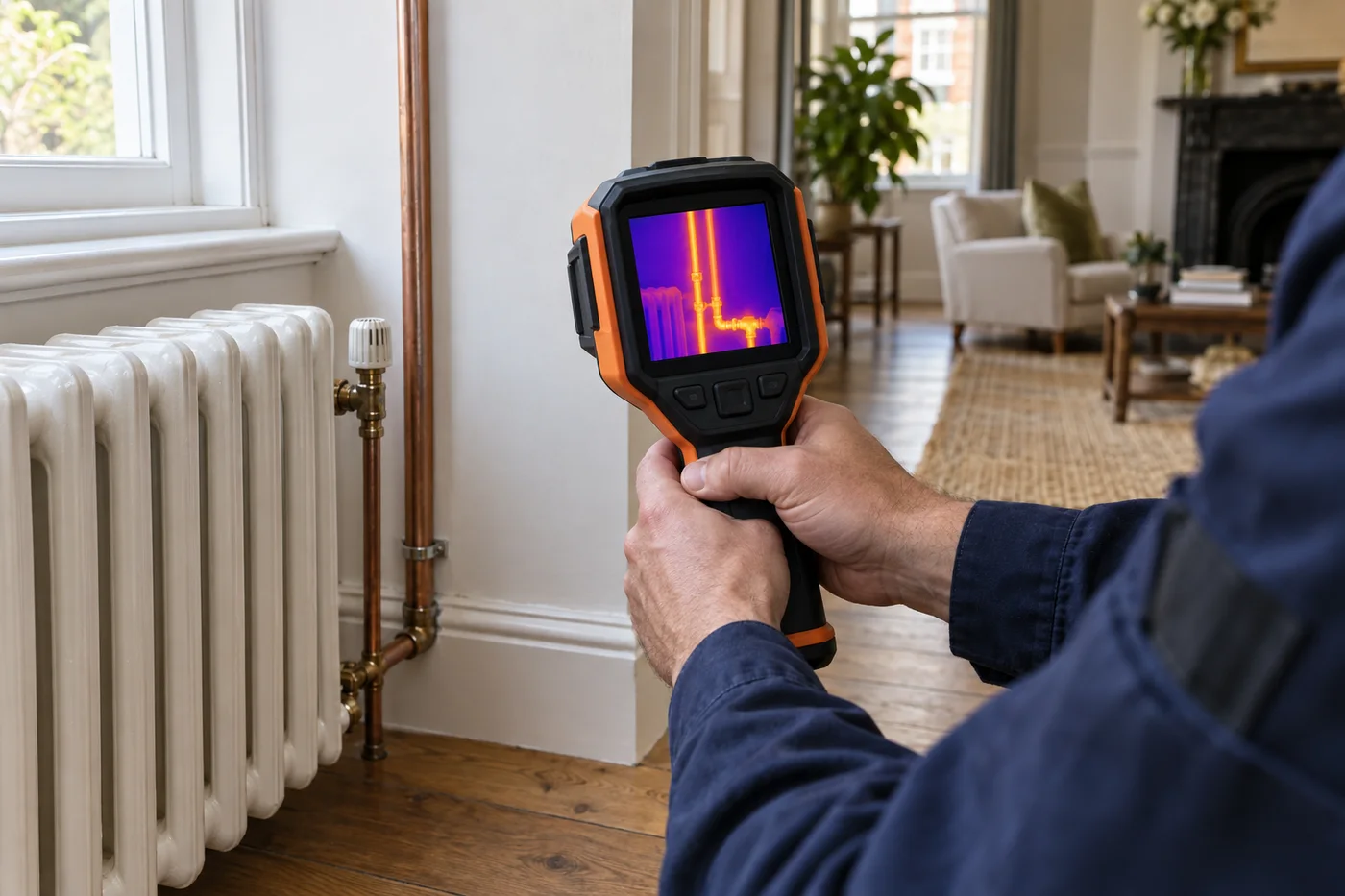
The other pattern worth naming: the stopcock is closed, the flow stops, and it comes straight back when you reopen it, with nothing visible to blame. The mains is feeding a pipe inside a wall or under a floor. Both cases are traced with acoustic listening, thermal imaging and tracer gas rather than by digging to look, and both are charged at our hourly rate, fixed before we attend, with no find, no fee. See water leak repair or, for the run outside, mains and supply pipe repair.