If water is running now, read the next two sections and nothing else. The rest waits until the floor is dry.
Where the stopcock is: the realistic list, in order
The internal stopcock sits on the rising main, the single cold pipe that brings mains water into the building. So the real question is where that pipe comes in, and in UK housing there are only a handful of answers.
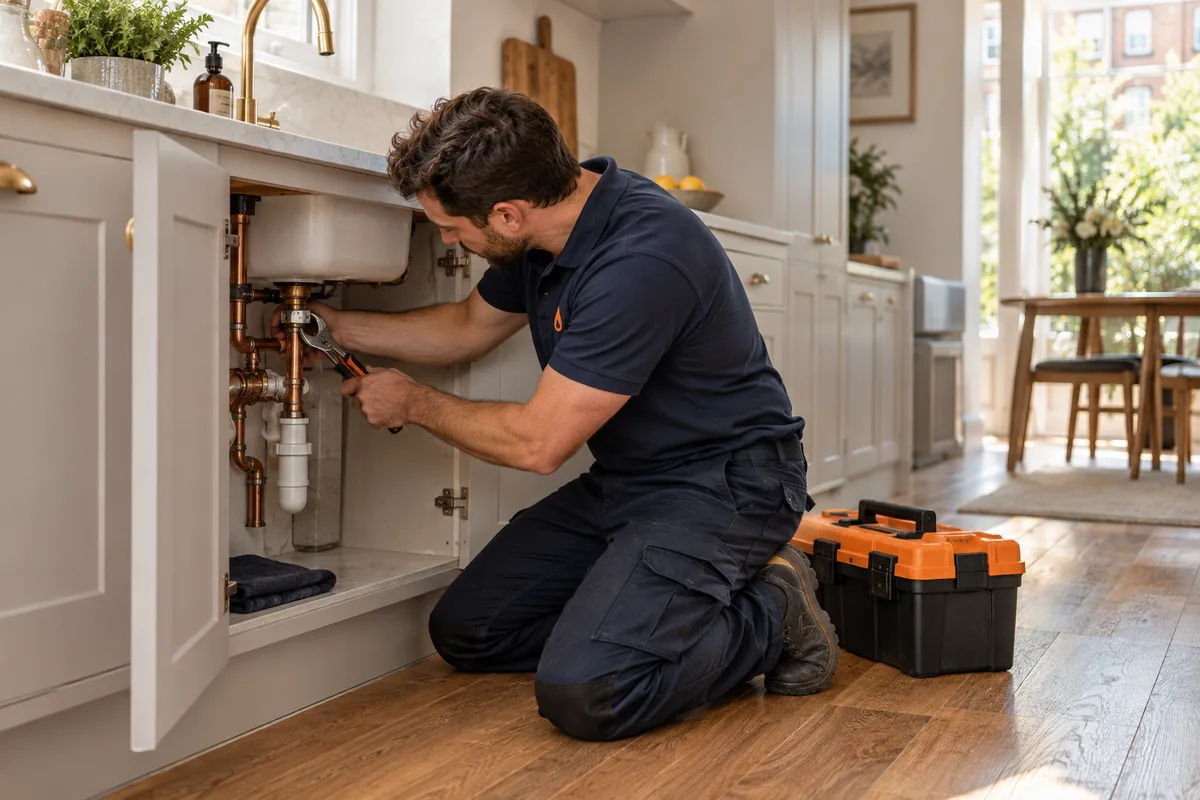
- Under the kitchen sink. Right at the back, behind the waste trap and a crate of cleaning products. Look here first in most houses and flats, because the kitchen cold tap is normally the one fed straight off the main.
- A downstairs cloakroom or utility room. Common where the kitchen has been refitted and the main was moved, and in newer builds where the incoming pipe lands next to the boiler or the washing machine.
- Under the stairs. Standard in Victorian and Edwardian terraces. Often at the back of the cupboard, low down, behind the hoover.
- In the hallway, under a floor hatch. A small lifting panel or a screwed-down board near the front door, frequently hidden under carpet or laminate laid over the top.
- A cellar, or the front room by the bay. Where the supply enters the front elevation rather than the back.
- An airing cupboard, or boxed in behind a bath panel. The worst cases, and the reason to go looking today rather than at 2am.
What you are looking for: a brass valve on a 15mm or 22mm pipe, with a small crutch-shaped handle, a round wheel head, or a lever. It is usually the only brass thing on that pipe run. If you cannot spot it, follow the pipe down from the kitchen cold tap.
Flats: your stopcock may be outside your front door
In purpose-built blocks and converted houses the isolation for your flat is often not inside the flat at all. Check, in this order: under your kitchen sink, then a riser cupboard on your landing, then a shared cupboard by the lift or the stairwell, then the meter cupboard in the entrance lobby. In a riser you will find a vertical bank of pipes with a valve for each flat — labelled well, labelled badly, or not labelled.
Two warnings. Turning the wrong valve in a riser cuts off a neighbour. And if the cupboard is locked, the managing agent or porter holds the key — find out whose number that is now, because at 2am it is the difference between a wet ceiling and a wet building.
The external stop valve in the pavement is a different valve, with a different owner
Outside, near the property boundary, there is usually a second valve under a small metal or plastic cover in the footpath, the driveway or the front garden. It is often marked with a W, and it can be a metre or more down a narrow chamber.
This is not the same valve, and it is not the same owner. It marks the boundary between the water company's communication pipe and the supply pipe you maintain. Thames Water put it plainly: they look after the mains and the communication pipe, from the boundary into your home the supply pipe is yours, and once a leak on it is confirmed you have four weeks to arrange the repair.
To operate it you need a stop tap key — a long T-handled bar, not a screwdriver on a stick. They cost a few pounds from any merchant. The chamber is often full of silt, and the valve inside is often seized, because nobody has touched it in twenty years. If it will not move, or the chamber is collapsed or buried under a resurfaced pavement, that is a call to your water company rather than to a plumber. It is their fitting, and there is normally no charge for them attending it.
Turning it off: which way, and the step most people skip
- Clockwise to close. Same direction as a tap. Turn it steadily until it stops. Do not lean on it once it has stopped.
- Open the kitchen cold tap. This is the step people miss. The rising main stays full of pressurised water after you close the valve, and a burst below the stopcock will keep running off that stored water until the pipe empties. Opening the cold tap drains it in a minute or so.
- Watch the tap. It should slow to a dribble and stop. If it keeps running steadily after a couple of minutes, the stopcock has not sealed — old washers often close most of the way and no further. Go to the external valve.
Now the bit that catches people in older houses. If you have a cold water tank in the loft, closing the stopcock stops the incoming supply but not the tank. The bathroom taps, the bath and the toilet cistern run off it by gravity and keep flowing until it is empty. If the leak is on a tank-fed pipe you need the gate valves on the tank outlets too, or you empty the tank deliberately by running those taps. On a combi with no loft tank, the stopcock is everything. The heating circuit is separate again: a leaking radiator needs its own two valves closed, and how to turn off your water supply walks through isolating a radiator, an appliance or a single tap instead of the whole house.
If it will not turn, stop. This is how a drip becomes a flood
Many people searching for this have already found the stopcock; it just will not budge. Forcing it is the most common way a small problem becomes a serious one.
Here is the failure mode. The spindle is brass, the washer is bonded on with scale, and the valve body may be seventy years old. Put a spanner and body weight on the handle and one of three things happens: the head shears off, the spindle snaps inside the body, or the body itself splits. In every case you are now next to an open mains pipe that cannot be closed, and in the last case the water is coming out of the stopcock. That is an emergency created by the attempt to prevent one.
What to do instead:
- Use two hands, not tools. One on the valve body to hold it still, one on the handle. That stops you twisting old pipework or a soldered joint further up.
- Try short back-and-forth movements. A nudge closed, a nudge open. Scale often breaks up with movement where it will not break with force.
- Give penetrating oil time on the spindle where it enters the body. That is a job for a calm Saturday, not a live leak.
- If it does not yield to light effort, go outside. The external valve is the fallback, and at that point it is the right answer.
Expect one side effect: after a stopcock shut for decades finally moves, water often weeps up around the spindle. That is the gland nut, the small nut directly behind the handle, where the packing has hardened. A quarter turn tighter usually stops it; over-tighten and the valve becomes impossible to turn again. If it still weeps, or it drips from the body rather than the spindle, a leaking stopcock is a replacement job, not an adjustment.
Why they seize, and why London is worse for it
Stopcocks seize for two reasons and both are about time. Hard water deposits build on the spindle and seat, and dissimilar metals in an old pipe run corrode where they meet. Most of London sits on chalk, so the scale side happens faster here than in soft-water regions. A valve cycled twice a year stays free. A valve untouched since the house was rewired is a liability dressed up as a safety feature.
There is also a design trap: leave a stopcock wound hard against its fully-open stop and the spindle can bind there. The habit that avoids it is to back it off a quarter turn once it is fully open. It still flows fully, and it will move next time.
Test it before you need it
Twice a year, close it fully, check a cold tap goes off, then open it and back it off that quarter turn. Two minutes. While you are there, label it and tell whoever else lives in the house where it is — the person home during a burst is often not the person who reads articles like this one.
If the test fails, get it replaced while nothing is wrong. That means isolating upstream at the external valve, or freezing the pipe where that valve is unusable. A short job done deliberately; a long one done in a panic with water running.
Where we fit, and where we do not
If the water is off and the leak has stopped, you have bought time and you do not need a call-out tonight. Book in normal hours. If you cannot turn it off, or it runs on with everything closed, that is an emergency leak repair, and the sooner someone attends the less floor comes up. A leak on the buried supply pipe between the boundary and the house is ours — mains and supply pipe work, the pipe you are liable for. A leak in the road, or a broken external stop valve chamber, is the water company's, and we will say so rather than charge you to find out. If you are deciding whether a split pipe needs someone tonight or can wait until morning, emergency pipe repair sets out what gets done after dark and what should wait for daylight.
Our rate is £150 an hour, agreed before we attend, with no call-out fee, and if we are called to find a leak and do not find it you do not pay for the looking time. Figures are on the pricing page. If a pipe has already burst, what to do if a pipe bursts covers the next hour.