London-wide leak specialists
ResidentialCommercial
Get in touch
Book an engineer

What Should Boiler Pressure Be?

Between 1.0 and 1.5 bar with the system cold, which is where Worcester Bosch, Vaillant and Ideal all put it, rising to roughly 2 bar while the heating is running. What matters more than the exact figure is whether it stays there.

Leak Fix LondonLast updated

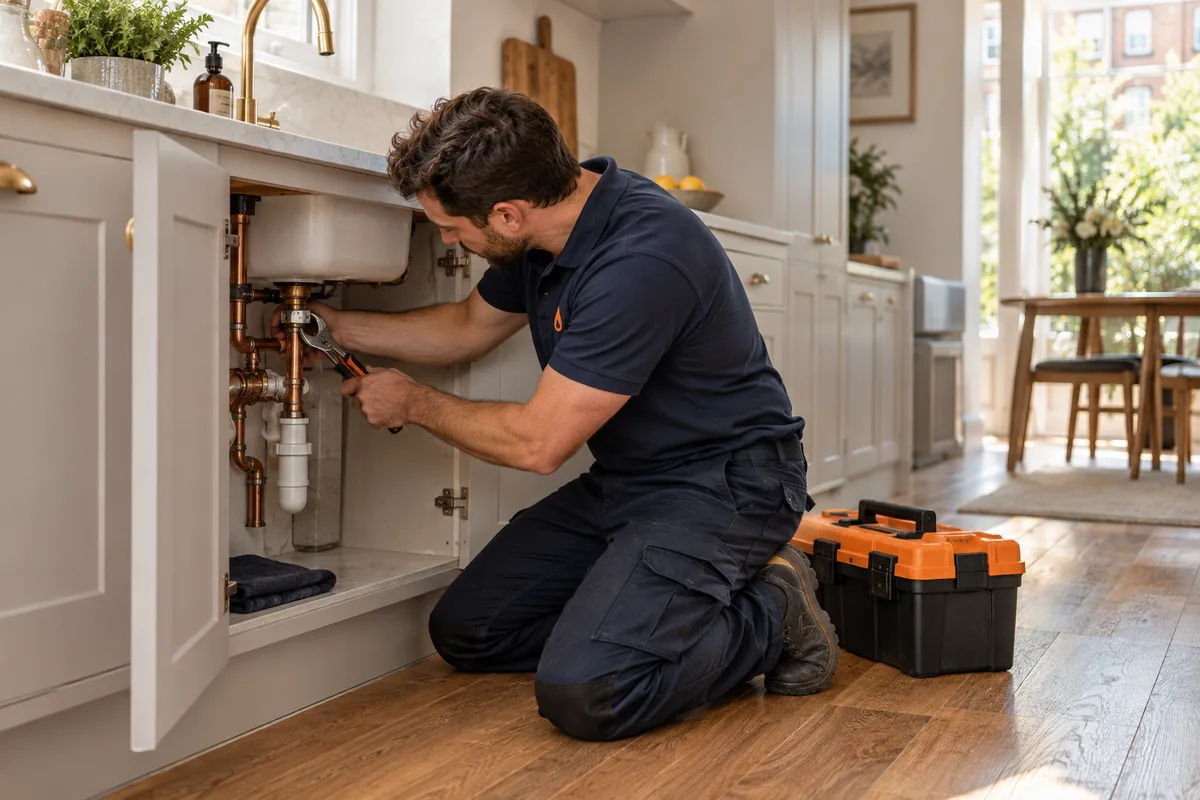
A Leak Fix London engineer working on pipework in a London home

The reading, cold and hot

System stateWhat the gauge should show
Cold, heating off1.0-1.5 bar. Worcester Bosch put the needle in the green section here, Vaillant state 1 to 1.5 bar with the heating off, and Ideal give the same band.
Running, up to temperatureHigher, and that is normal expansion. Ideal say it may rise to around 2 bar; Vaillant describe 1 to 2 bar as the usual running range.
Too lowBelow 1.0 bar cold is worth topping up. Worcester Bosch treat below 0.5 bar as water having escaped the system.
Too highWorcester Bosch put the top of the red at about 2.75 bar. Vaillant advise reducing pressure if it exceeds 2.5 bar at room temperature.

If your gauge is digital rather than a dial, the same numbers apply. If it is a dial with a green band and no figures, the band is the manufacturer's target and the middle of it is a safe place to sit.

Why hot and cold read differently

Water expands as it heats. A sealed heating system has nowhere to send that expansion except into the expansion vessel, a steel tank with a rubber diaphragm and a charge of air behind it. The air compresses, absorbs the increase, and the gauge rises a little. As the system cools, it comes back down. That is the whole mechanism, and it is why the only reading worth comparing against a number is a cold one.

It also gives you a free diagnostic. Worcester Bosch state that if the pressure rises by more than 1 bar once the heating is up to temperature, the expansion vessel may need repressurising. A system that swings from 1.2 bar cold to 2.6 bar hot has lost its air charge: the water is heating, expanding, and has nothing soft to push against.

A steady wrong number beats a moving right one

This is the part the head term hides. A system sitting at 1.0 bar every day of the year is healthier than one you set to 1.2 bar every fortnight, because the second one is losing water.

A sealed system is closed. Worcester Bosch put ordinary top-up frequency at once or twice a year and say to contact your installer if you need it much more often. Ideal ask the question directly: if the system is enclosed, how can the pressure drop at all. So the useful test is not what the gauge reads today, it is what it read a month ago.

What the gauge doesWhat it means
Sits anywhere in the band and staysNothing to do
Drifts down a little over a yearNormal, and normal after bleeding radiators
Falls monthlyA weeping joint, valve or towel rail, or a tired expansion vessel
Falls weekly, or overnightAn active leak, usually under a floor or in a wall
Climbs on its own with the heating offA filling loop left open, or a passing filling valve letting mains water in
Swings more than about 1 bar between cold and hotExpansion vessel charge, not a leak

What the boiler does when the number is wrong

Below its minimum, most modern boilers lock out rather than fire, and you lose heating and hot water together. The fault shows as a pressure code: Vaillant's own bleeding guide notes F22 appearing when pressure is incorrect, and every brand has an equivalent. Resetting clears it until the pressure falls again, which is why a code that comes back after every reset is information rather than a nuisance.

Above its maximum, the pressure relief valve opens and dumps water to the discharge pipe outside, usually a small copper pipe through the wall near the boiler. A boiler that keeps losing pressure and a discharge pipe that drips after every firing are the same fault seen from two ends.

Where the water goes when it is not in the system

There are only so many places. In rough order of how often we find them: radiator valve spindles and tail nuts, the underside of a corroded panel, a towel rail in a bathroom, the pump or diverter valve inside the boiler case, the pressure relief valve passing, and pipework buried in a floor. Ideal's own advice on spotting the slow ones is worth repeating: look for clean patches on a dusty hard floor, black marks around joints, and stains on ceilings below.

The one that costs money is the buried one. Under screed, a pinhole loses enough to move the gauge weekly while the screed absorbs the water and the heating dries it, so nothing shows until a floor lifts or the ceiling below marks.

Setting it correctly, and the limit of DIY

Topping up is a homeowner job and takes five minutes: cold system, both filling loop valves open until the gauge reaches the band, valves fully closed. The full walkthrough is on how to repressurise a boiler, and if the pressure has fallen rather than never been set, boiler pressure too low covers why. If it reads above the band with the system cold, boiler pressure too high covers how to reduce it and what made it rise.

The symptom that means the number is not the problem: you set it correctly cold, and within a week it is below the band again with nothing visibly wet. At that point topping up is not maintenance, it is replacing water that is going somewhere, and each refill adds oxygenated mains water that corrodes the system from the inside and dilutes the inhibitor.

That is the point to have it traced rather than topped up. We isolate and pressure-test the system to prove the loss and size it, then follow the pipe runs with thermal imaging and tracer gas before anything is opened. It is charged at our hourly rate, fixed before we attend, and if we do not find the leak you do not pay for the time we spent looking. Pricing sets out the rate. Boiler and heating leak repair sets out what that includes.

Frequently asked

What should boiler pressure be when the heating is on?
Higher than the cold reading, typically around 1 to 2 bar, because heated water expands. Ideal describe a rise to about 2 bar as normal. A rise of more than 1 bar above the cold reading points at the expansion vessel rather than at anything you can adjust.
Is 1 bar too low for a boiler?
No. One bar cold sits at the bottom of the manufacturers’ band and most systems run happily there. Below 1 bar is worth topping up, and Worcester Bosch treat below 0.5 bar as water having been lost from the system.
Is 2 bar too high for a boiler?
Not while the heating is running. Two bar with the system stone cold is high, and Vaillant advise reducing pressure that exceeds 2.5 bar at room temperature. Bleed a radiator briefly to bring it back into the band.
Why does my boiler pressure keep changing?
Between cold and hot, expansion. Over weeks, either a leak taking water out or a filling loop letting mains water in. Read the gauge at the same point in the cycle each time, always cold, or you are comparing two different things.
Does boiler pressure affect hot water?
On a combi, yes, indirectly. If the system pressure drops far enough the boiler locks out, and you lose hot water as well as heating. Water pressure at the tap is a separate thing, set by the mains, not by the gauge on the boiler.

Sources

No find, no fee · £150 per hour. The rate is fixed before we attend and does not rise for a difficult property, an awkward access or an evening visit. The total depends on how long the job takes; the rate cannot change.