The letter is an inference, not an observation
Nobody walked down your street and saw water. The usual sequence is that something in Thames Water's monitoring told an analyst that your connection is passing water when it should not be, and a letter followed. Knowing what produced that inference tells you how much weight to put on it, and where it is likely to be wrong.
The stack, in their own numbers
Thames Water's leakage performance report sets out what they are running:
- Acoustic loggers. Increased "from 21,000 to over 70,000" in a year, "over three times the number at the end of last year", and prioritised to areas with the highest level of leakage breakouts. These sit on network fittings and listen, mostly at night when background noise falls away.
- AI analysis. Alongside the loggers, they report that "leak detection accuracy has improved from 35% in 2024/25 to 65% in 2025/26".
- Smart meter data. They state that they use it "to prioritise leakage activities and are able to provide advice to customers when leaks arise at their properties".
- A pre-activation check on every new meter. On their metering programme page: "Once we've fitted your meter, we'll check remotely for leaks before activating it. This normally happens within 90 days but may take longer."
Add the passive channel they also rely on — customers reporting what they can see — and that is the whole detection estate. It is genuinely impressive for its purpose, which is deciding where to send a crew tomorrow across thousands of kilometres of main.
What 65% accuracy means when the letter is about you
Take that figure seriously in both directions. It represents a large improvement: in 2024/25, on their own reporting, roughly a third of detections were accurate. In 2025/26 roughly two-thirds were. That is real progress and it is honestly published.
It also means that about one identification in three was still wrong in the most recent reported year. If a letter has arrived telling you there is a leak at your property, the correct posture is neither panic nor dismissal. It is verification, before you spend a pound.
That is not a criticism of the method. A logger hears noise through a metal fitting; noise travels, and a defect two properties away sounds a great deal like a defect at yours. Continuous flow at a meter is continuous flow for any reason, not only a burst. Machine learning ranks probabilities; it does not dig.
Verify it yourself in half an hour
Thames Water publish the test and it costs nothing. Turn off every appliance, close your internal stop valve — usually under the kitchen sink — take a meter reading, wait thirty minutes without using water, and read again. "If the two readings are the same, you don't have a leak. If they're different, you have a leak somewhere between the meter and the inside stop valve."
With a smart meter you can often do it without going outside, by looking at the overnight profile in your online account. A household with nothing running should reach a flat zero for a few hours before dawn. A floor that never touches zero is the real signal, and it is the one their systems are reading too.
How to read the meter properly covers the traps, of which the commonest is a toilet cistern refilling quietly during the thirty minutes and producing a false positive on your own test.
Things that look exactly like a leak and are not
Continuous overnight flow has more causes than most people expect. In our experience the recurring innocent explanations are a water softener regenerating on a timer, an irrigation or garden watering system running at night, a pond or pool top-up valve, a toilet with a slow-passing flush valve, a failing float valve on a cold water storage cistern feeding an overflow that discharges outside where nobody looks, and a shared supply pipe where the property actually losing water is a neighbour's.
The last one matters more than the others in London terraces, because the notice lands on whoever the company has as the consumer, not on whoever has the defect. If several houses are fed from one pipe, work out whose branch is losing before anyone agrees to pay. Shared supply pipes and who pays sets out how that is apportioned.
Why they can tell you it exists but not where it is
Everything above measures flow or listens to a network fitting. Neither produces a position on private land. When the company's own repair process reaches a confirmed network leak, they describe having to "dig down to the pipe by hand to be safe, particularly if it's in a tricky position and surrounded by other utility pipes like gas mains" — and that is with the advantage of their own records of their own pipe.
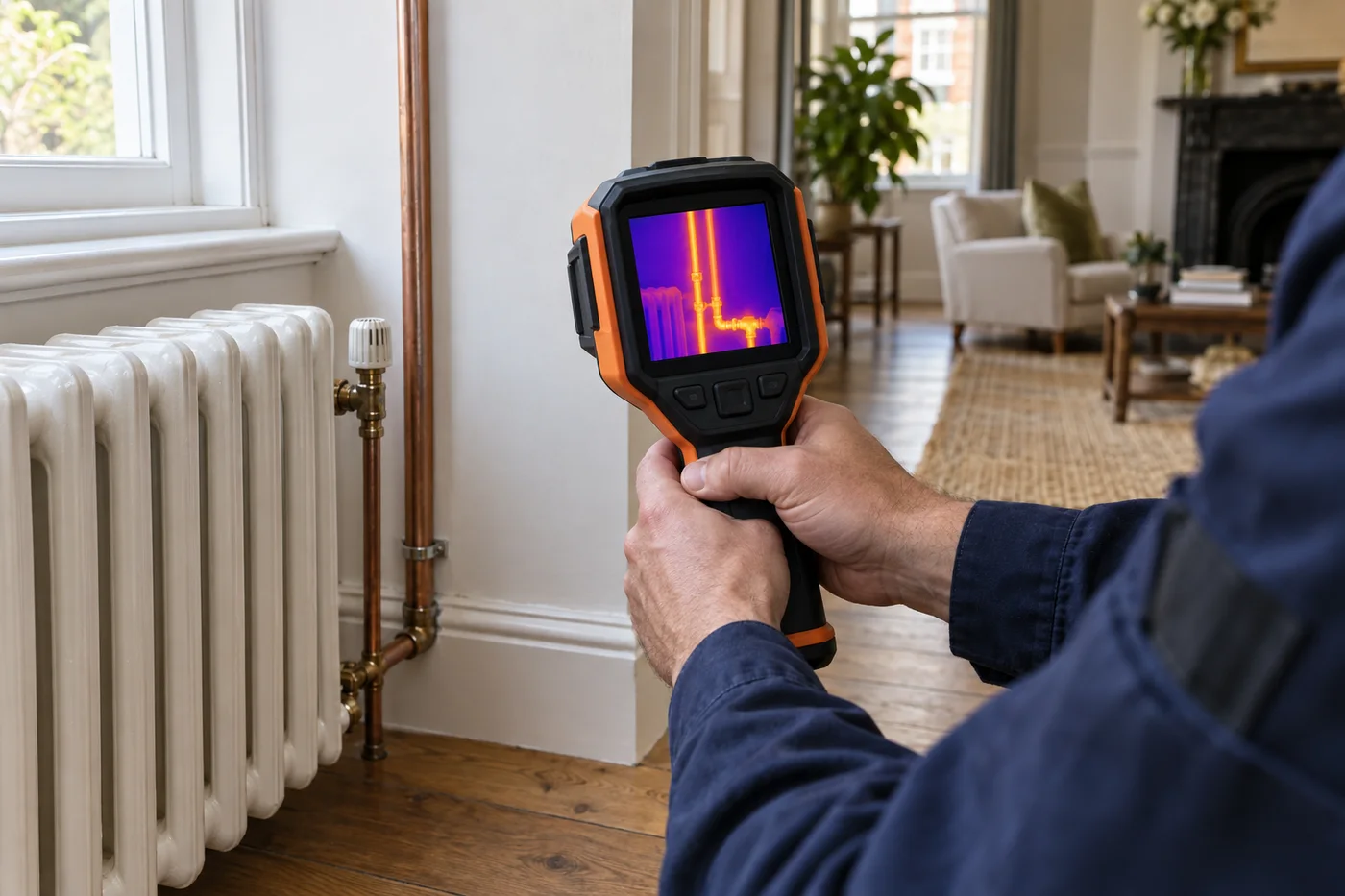
On your property there are no such records. The supply pipe was laid by whoever built the house, has usually been patched at least once, and rarely runs where anyone assumes. Getting from "there is a leak here" to "it is nine metres out, 600mm down, under the second row of tiles" is a separate job with separate equipment: acoustic correlation between two contact points, tracer gas pushed through a drained line where plastic pipe gives acoustic nothing to hear, thermal imaging where the run passes under a floor, moisture mapping to bound the wet zone, and pressure testing to prove the loss and size it before anything is opened. How leaks are actually found goes through the methods and what each one is blind to.
Keep your own record, because theirs is the only other one
Everything in the paragraphs above lives on the company's systems. If the identification was wrong, or the leak turns out to be a neighbour's, or you repair inside the window and want the water credited back, the only evidence on your side of the table is what you wrote down.
Three things are worth recording from the moment a letter arrives: the date on it and whether it is a notice or an advisory letter, the meter reading with a photograph of the dial each time you take one, and the dates you booked and completed any work. Thames Water's allowance conditions turn on exactly those items — a repair inside four weeks of notification, evidence of the repair by a plumber's invoice or their own job number, and a claim within three months of the repair date. A phone photograph of a meter dial with a timestamp has settled more of these than any amount of argument.
The practical order once a letter arrives
- Read the letter for the date and for what it is. A formal waste of water notice under section 75 and an advisory letter are different documents with different consequences — what the letter means and what to do separates them.
- Run the meter test. Confirm the inference before acting on it.
- Establish whose pipe. Water in the road is theirs; inside your boundary is almost certainly yours.
- Rule out the innocent explanations above before booking anyone.
- Then locate it, before anybody digs. One hole in the right place is cheaper than three in the wrong ones, and the reinstatement is usually the larger number.
When not to call us
If the meter does not move with the internal stop valve closed, the loss is inside the house and often findable in ten minutes with a torch. If the loss turns out to be a leaky loo, a softener or an irrigation timer, fix the fitting and tell the company the matter is resolved. If the water is surfacing in the road or pavement, that is their communication pipe or main and reporting it costs nothing. If you rent, the repair is your landlord's and your job is to put it to them in writing.
Call us when the loss is confirmed, on your side, and nobody can say where. £150 per hour agreed before we attend, no find no fee on the detection, and the same firm repairs the pipe and puts back whatever had to be opened to reach it.