The number, and the number they were supposed to hit
Thames Water publish a short document called Our Leakage Performance. It is worth reading because it does not spin the result. In their words, over the last three years "leakage decreased by 15.1% based on a three-year average (2023/24, 2024/25 and 2025/26) reduction against a 2019/20 baseline", and although that is better than last year's 13.2%, "it has not reduced as much as we would like and we have fallen short of our regulatory target of a 21.3% three-year average reduction for the reporting year 2025/26".
Six percentage points short of a target measured as a three-year rolling average is not a rounding error. It is also not free: the in-period determination Ofwat published on 13 November 2025, which Thames Water cite as one of the inputs to this year's charges, adjusts their allowed revenue for outcome delivery incentive payments tied to actual performance. Underperformance on measures like leakage eventually appears in what customers are charged, in both directions.
What they are doing about it
The same report sets out the response, and the operational numbers in it are more informative than the headline:
- They repaired around 20% more visible leaks in 2025/26 than the year before, while saying they focus on the "quality" of leaks rather than the quantity.
- Acoustic loggers, used to monitor flow and identify leaks, went from 21,000 to over 70,000 in a year, prioritised to areas with the highest level of leakage breakouts.
- Alongside AI analysis, leak detection accuracy improved from 35% in 2024/25 to 65% in 2025/26.
- They have set an ambition to replace 200 to 250 kilometres of pipe per year by the end of AMP8, the 2025 to 2030 regulatory period.
- They use smart meter data to prioritise leakage work and to advise customers when leaks arise at their properties.
For scale, the report gives its own conversion: leakage is measured in megalitres per day, and one megalitre is "around 12,500 baths, or 40% of an Olympic size swimming pool".
The line that matters most to you is one sentence long
In the middle of the same document, under types of leaks: "Customer leaks aren't on our network, and it is the customers responsibility to fix these."
Everything above — seventy thousand loggers, machine learning, a quarter of a thousand kilometres of new main a year — is aimed at the pipes Thames Water own. It stops at the outside stop valve. Missing a regulatory target does not create a duty to come and fix your supply pipe, and being behind schedule does not soften the four-week window you get once a leak on your side is confirmed. Where their pipe ends and yours begins sets that boundary out properly.
What does change for you
You will hear from them earlier
Tripling the logger count and adding smart meter analysis does not only find leaks on mains. Continuous overnight flow at a metered connection is exactly the signature these systems are built to surface, and a supply pipe leak inside your boundary produces it. The practical consequence is that the letter arrives sooner than it used to, often before there is anything visible to look at. What to do when that letter arrives has not changed; the timing has.
A better-detected network is a more disturbed network
The report's own list of what causes leaks includes "high pressure or sudden changes in pressure" and "sudden heavy traffic causing ground movement". A company running an aggressive find-and-fix programme is also isolating, draining and recharging sections of main, and digging in streets. Old iron and lead services connected to that main experience all of it. We are not claiming a statistic here, only noting the obvious: an ageing supply pipe that has held for forty years fails when something disturbs it, and there is more disturbance about.
Mains renewal in your street does not renew your pipe
Two hundred kilometres a year sounds like a lot until you remember what it is. It is their main, and where they replace a lead communication pipe it is their side of the boundary stop valve. The private supply pipe running from that valve under your front garden is not in the programme and never was. If yours is lead, the replacement route is a separate scheme with its own criteria, covered on the lead pipe replacement page.
Why their detection capability cannot find your leak
This is the part most customers get wrong, and it is a difference of purpose rather than of quality. A water company is optimising a number measured in megalitres per day across a district. Its tools reflect that: loggers sit on network fittings and listen overnight, flow is compared across a metered zone, and the output is a priority list of areas. It is a superb way to decide where to send a crew tomorrow morning.
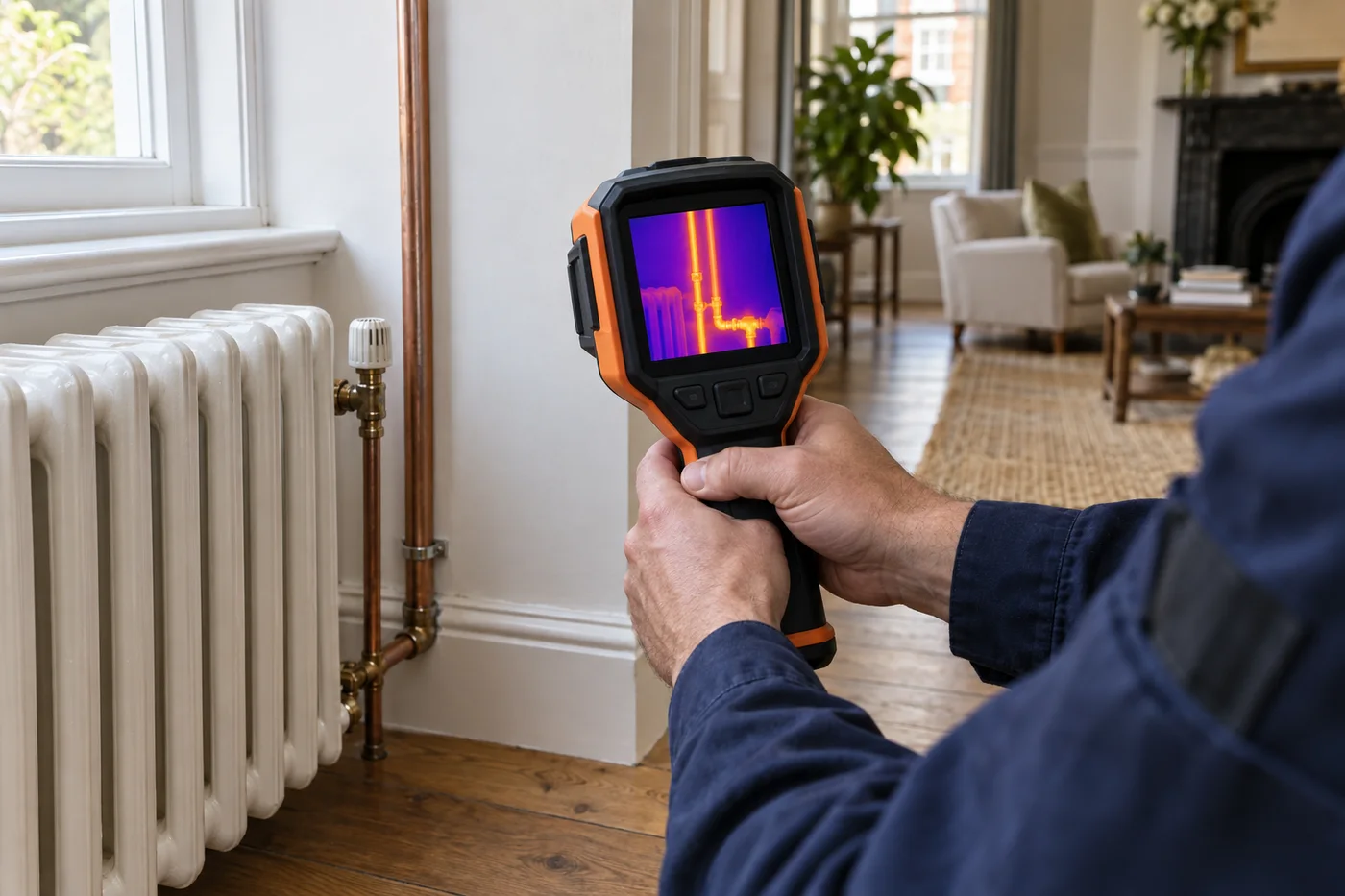
You need something else entirely. You need a point on the ground and a depth, because the cost of your job is not the water, it is the hole. A 25mm plastic supply pipe running fifteen metres from a footpath stop tap, under a tiled path, a bay window step and a threshold, has one right place to excavate and several expensive wrong ones. Network-scale data does not narrow that. Acoustic correlation between two contact points, tracer gas on a drained line where plastic pipe defeats acoustic, thermal imaging where the run passes under a floor, and physical pipe tracing do.
Their own report concedes the general version of this: "Over 95% of leaks are never seen by our customers. They're often small, underground, and hard to find. Visible leaks — the ones that do reach the surface — are larger, but they don't normally lose as much water." Where the water shows is not where the water leaves.
The channel they still depend on most
For all the loggers and machine learning, the report keeps coming back to customers. Under how you can help: "You can help us find leaks and save water. If you spot a leak, please let us know through our view and report a problem page on our website." Under types of leaks: "Our customers help too. They often report leaks to us and we start to fix them soon after they appear."
That is worth acting on, and not only out of public spirit. Water surfacing in the road or the pavement outside your house is on their side of the boundary, and a report costs nothing. It is also the fastest way to close off a question that otherwise hangs over your own supply pipe, because a communication pipe failing near a boundary stop valve can push water into a front garden and look for all the world like yours. Establishing whose pipe is losing water is the cheap step; excavating to find out is the expensive one.
You will see a different number on their customer-facing charges page, which credits last year's money with helping "reduce leakage by more than 13%", footnoted as compared to 2019-20 leakage performance. That is not a contradiction of the 15.1%; it is the previous reporting year's three-year average, which the leakage report gives as 13.2%. Marketing pages and regulatory reports update on different clocks. When the two disagree, take the report.
When not to call us
Water surfacing in the road or the pavement is theirs. Report it, free, and do not pay anyone to look at it. If you rent, the repair is your landlord's and the useful thing you can do is put it to them in writing and keep the copy. If you are on Thames Water's Priority Services Register, WaterHelp or WaterSure, their leakage code of practice describes discretionary help with supply pipe leaks, so ask them first.
Where we are worth paying is the confirmed loss inside your boundary that nobody can place. £150 per hour agreed before we attend, no find no fee on the detection, and the path, floor or ceiling goes back afterwards by the same firm that opened it. Supply pipe repair is the usual shape of that job.