Find the meter before you plan the test
Most London meters sit outside, under a small metal or plastic cover in the driveway, front garden or footpath, near the boundary. Where the meter was fitted later, or the property has no front garden, it is usually indoors: under the kitchen sink beside the inside stop valve, or in a basement, cellar cupboard or garage. Purpose-built flats often have a bank of meters in a communal riser cupboard or the car park rather than one meter per door.
Where it sits changes what the test can tell you. A meter at the boundary has the whole supply pipe between it and your house, so it sees a supply-pipe leak. A meter under your kitchen sink is already past the supply pipe, so it cannot see one at all.
The digits your water company tells you to ignore
For a bill you record only the black digits. Thames Water's instruction is to write down the black numbers, which show cubic metres, and to ignore the red ones, which record tenths and hundredths of a cubic metre.
For a leak test that advice is exactly backwards. One cubic metre is 1,000 litres. A leak large enough to turn a black digit inside half an hour would already be coming through a ceiling. The red digits are the test. Note every digit on the face, black and red, in order, and treat the red ones as the decimal places of a cubic metre reading.
So a face showing black 00421 and red 647 is 421.647 m³. Some meters have four red digits rather than three, and some newer ones show a single continuous digital figure. Copy whatever is on the face rather than rounding it.
Test one: is anything drawing water at all
- Turn everything off. Taps, washing machine, dishwasher, ice maker, irrigation timer, water softener. If you have a combi boiler, check the filling loop is properly shut and detached.
- Read the meter in full and write it down with the time. Photograph it. You will want the picture later if a claim follows.
- Use no water for thirty minutes. That includes flushing. One flush ruins the result.
- Read it again. Identical readings mean nothing was flowing during that half hour. Different readings mean something was.
Thames Water publishes the same test and draws the same conclusion: if the two readings are the same you do not have a leak, and if they differ you have one somewhere between the meter and the inside stop valve.
Thirty minutes catches anything substantial. It will not reliably catch a weep, because a meter needs a certain flow before the register turns at all. If you suspect something slow, run the test overnight instead: last reading before bed, first reading before anyone uses a tap. Eight hours of no usage is a far more sensitive instrument than thirty minutes.
Test two: inside the house, or under the garden
If test one moved, close the inside stop valve, usually under the kitchen sink, and repeat the reading and the wait.
- The meter stops. The loss is inside the house, downstream of that valve. Start with the WC cisterns and the taps. A tap that drips from the spout when closed usually needs a new washer, and how to change a tap washer covers that job.
- The meter keeps turning. Water is escaping between the meter and the closed valve. With an outside meter, that is your supply pipe, running under the garden, drive or path.
The Consumer Council for Water puts the same rule more briefly: if you turn off the inside stop valve and the meter dial is still spinning, there may be a leak on your outside supply pipe.
The reason this matters more than the reading itself is ownership. Your water company is responsible for the main, the communication pipe up to the boundary, the external stop tap in the footpath and the meter. You are responsible for the water pipes on private property up to the boundary of the road. That line is where the bill for the repair lands, and the meter test is what locates the loss relative to it. The Thames Water hub sets out the boundary and the notice process in more detail.
Turning the gap into litres per day
A pair of readings is a diagnosis. The arithmetic makes it a number you can act on.
- Subtract. Second reading minus first, in cubic metres. Example: 421.683 − 421.647 = 0.036 m³.
- Convert to litres. Multiply by 1,000. 0.036 m³ = 36 litres.
- Scale to an hour. Those 36 litres passed in 30 minutes, so the rate is 72 litres per hour.
- Scale to a day. 72 × 24 = 1,728 litres, or 1.728 m³ a day, every day, including the ones before you noticed.
Those readings are an illustration. Put your own in. The point of the exercise is that a figure with no visible symptom attached to it becomes something you can multiply by your own metered rate and by the number of days since your usage changed. Working out what a leak costs per day takes that number through to money using your own tariff.
What a moving meter does not prove
A turning meter tells you water is flowing. It does not tell you that you need a leak detection engineer, and several of the common causes are yours to fix in an afternoon:
- A leaking WC. The most common cause of a meter that never stops, and the easiest to miss, because a cistern that overflows into the pan leaves no mark. Wipe the back of the pan dry, hold a dry square of toilet paper against the porcelain below the cistern outlet for a few minutes, and look for a wet line.
- An outside tap or irrigation timer that is passing, or running on a schedule nobody remembers setting.
- A water softener stuck in regeneration, which can run to drain continuously without a drop appearing anywhere visible.
- A boiler filling loop left cracked open, quietly topping a heating system that is itself losing water. If your boiler pressure also drops, read the boiler pressure guides first.
- A float valve in a loft tank passing to the overflow, which on a cold day discharges outside where nobody looks.
Rule those out before anyone charges you to look for something more exotic. If the meter stops when you close the inside stop valve, the problem is inside and usually one of the above.
When the test says call someone
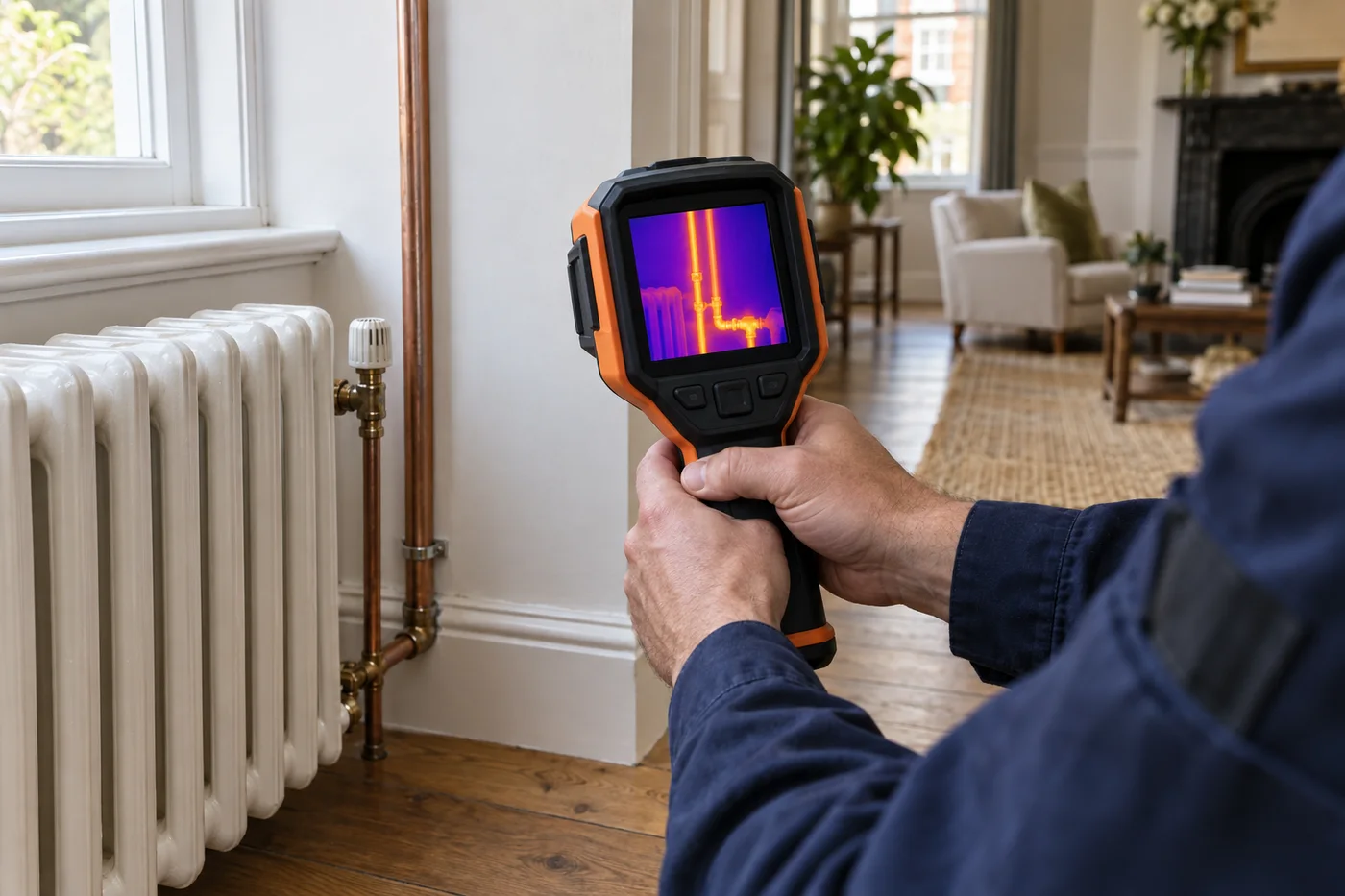
Book detection when the meter still turns with the inside stop valve closed, when the supply pipe is buried under a drive or a slab you cannot open on a guess, or when the loss is inside but nothing visible accounts for it. Our rate is £150 per hour, fixed before we attend, and if we do not find the leak you do not pay for the time we spent looking. What that time buys is an isolation and pressure test to confirm the loss is real, then acoustic and thermal tracing to put a mark on the ground before anything is dug or lifted.
Keep every reading and every photograph. The same two numbers that proved the leak are the numbers your water company will ask for when you claim the water back, and they are also the start of the paper trail if damage follows and the matter turns into an insurance claim.