Read the letter for two things
Thames Water say you may receive a letter or email if they detect a leak at your property, usually because their own leak detection work in the area has picked up continuous flow on your connection overnight.
Before anything else, find two pieces of information in it. First, the date. Thames Water's position is that you must fix the leak "within four weeks", counted from them confirming it. Second, whether the document is a formal waste of water notice under section 75 of the Water Industry Act 1991 or an advisory letter. Their code of practice uses both, and they are not the same. A formal notice must specify the date by which the steps are to be taken and must set out their powers to act if you do not. An advisory letter is an early warning, and the sensible response to one is to act as though the notice is coming.
Confirm it yourself, in half an hour
Do not take anyone's word for a leak, including ours. Thames Water publish the test and it costs nothing:
- Turn off your internal stop valve, usually under the kitchen sink.
- Check no toilet cistern is filling and every tap is closed.
- Read the meter and write the figure down.
- Leave the stop valve shut for half an hour.
- Read the meter again.
The two readings should be identical. If the second is higher, water is moving between the meter and your closed internal valve, which means the loss is on the supply pipe. If the readings match, nothing is escaping outside, and any loss is inside the house past that valve — a running overflow, a leaking loo, a cylinder or a heating circuit.
With a smart meter you can often see the same thing without walking outside, by looking for a flat continuous overnight baseline in your online account rather than a curve that drops to nothing between two and five in the morning.
Work out whose pipe it is
Thames Water own the main and the communication pipe up to the outside stop valve at your boundary. From that valve into the house the supply pipe is yours, along with all internal plumbing. The external stop tap itself is their apparatus, and the position of the meter does not change the boundary. If water is surfacing in the road or pavement rather than inside your boundary, report it and do not pay anybody.
If you rent, the repair is your landlord's, and Thames Water advise telling the landlord or letting agent as soon as possible in writing, keeping a copy. If a single pipe serves several houses, you are into shared supply territory, where the shared section is a joint responsibility and only the branch serving your house alone is yours. Where the boundary actually falls covers the awkward cases, including a pipe that crosses somebody else's land.
Then find where it is, before anyone digs
Knowing you have a supply pipe leak is not the same as knowing where it is, and the gap between the two is where the money goes. A 25mm MDPE run from a footpath stop tap to a London terrace can be fifteen metres long, under a tiled path, a bay window step, a resin drive and a threshold. Excavating it blind means several holes, several reinstatements and no certainty.
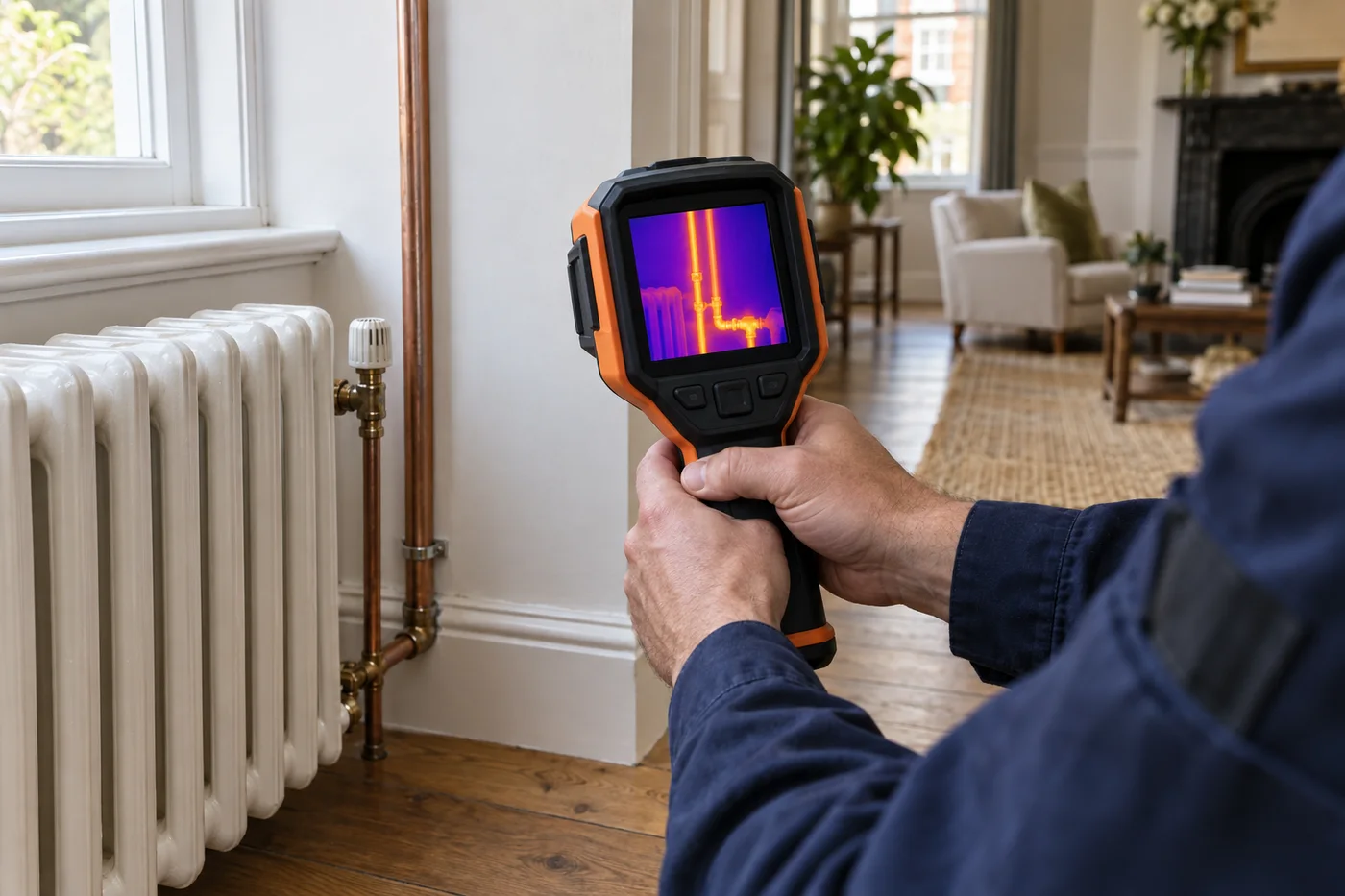
The alternative is locating first. On a pressurised supply pipe, acoustic correlation between two contact points narrows the position by comparing the arrival time of the leak noise. On a drained line, tracer gas pushed through the pipe surfaces above the defect and is picked up at ground level, which works where acoustic does not — plastic pipe, deep runs, and noisy ground. Thermal imaging adds the temperature contrast where the pipe runs under a floor.
The output that matters is a single mark on the ground and a depth, so one hole goes in the right place.
Repair, and who does it
Thames Water recommend using an approved plumber or a leak detection specialist, and for underground work a WaterSafe approved contractor. There is a concrete reason to take that seriously: on their leaks page they say that if you did not use a WaterSafe approved plumber they may come out to check the work, and will carry out and charge you for extra repairs if they think they are needed. What that approval means is worth five minutes before you book anyone.
Check your insurance first. Thames Water suggest starting with your home buildings policy, and separately with any home emergency cover, before arranging a repair yourself. Some policies cover the repair of a supply pipe leak, and many cover the trace and access work needed to find a leak inside the house even where they exclude the pipe itself. That is a different subject with its own rules — see insurance claims and trace and access.
A partial repair is a trap worth naming. Where a pipe is lead, or is old galvanised iron with wall loss along its length, clamping one hole frequently produces the next one within months. Thames Water's own guarantee position reflects this: they guarantee their repairs and connections for two years under normal use, but explicitly do not guarantee the condition of the existing pipe on either side of the repaired section.
Close it out properly
- Tell Thames Water it is fixed, so they can record that it was resolved inside the four weeks.
- Get the certificate of water regulations compliance from whoever did the work. Thames Water ask for it, and under section 73(1A) of the Water Industry Act 1991 a certificate from an approved contractor is what supplies your statutory defence if the installation is later challenged.
- Keep the invoice. Thames Water ask for proof of repair, such as a plumber's invoice or insurance documents, when a third party fixed the leak for you.
- Deal with the bill separately. If you are metered, an allowance for the water lost may be available once the repair is done; that is its own process with its own conditions and it is not a reason to delay the repair.
If you do nothing
Thames Water say that if you do not fix the leak within four weeks they will step in, and that under section 75 of the Water Industry Act 1991 they will carry out and charge you for the repairs. Their code of practice adds that the recovered cost includes their administration charges, that refusing entry may be charged as a wasted visit, and that continued refusal may lead to an application to the magistrates' court for a right of entry warrant. In an emergency they may turn the supply off until the leak is repaired, and they may also disconnect where the property appears unoccupied and no work has taken place.
The statute puts limits on this too: recovery under section 75(9) is of expenses reasonably incurred, and section 75(10) removes the right to recover anything at all where the steps taken turn out not to have been necessary. The deadline explainer sets out the mechanics.
When not to call us
If the meter test shows no movement with the internal valve shut, the loss is inside and often visible: a leaking loo passing into the pan, a dripping overflow, a cylinder or a heating system that will not hold pressure. Check those first, and if the gauge on a combi keeps falling, that is a heating question, not a supply pipe one.
If the water is in the road, report it to Thames Water. If you rent, tell your landlord in writing. If you are on Thames Water's Priority Services Register, WaterHelp or WaterSure, ask them about assistance before paying anyone, because their code of practice says they may help at their discretion.
Where we earn the money is a confirmed loss inside your boundary with no visible source and a deadline attached. £150 per hour agreed before we attend, no find no fee on the detection, and the floor, path or ceiling goes back afterwards by the same firm that opened it. Book an engineer if that is the situation you are in.