London-wide leak specialists
ResidentialCommercial
Get in touch
Book an engineer

What a Leak Costs You Per Day, and How to Work It Out

Measure the loss in litres per hour at your own meter, convert to cubic metres a day, and multiply by your own charge per cubic metre for clean water plus wastewater. Anyone quoting a single figure for what a leak costs is guessing, because the answer depends entirely on the size of the hole and your supplier’s tariff.

Leak Fix LondonLast updated

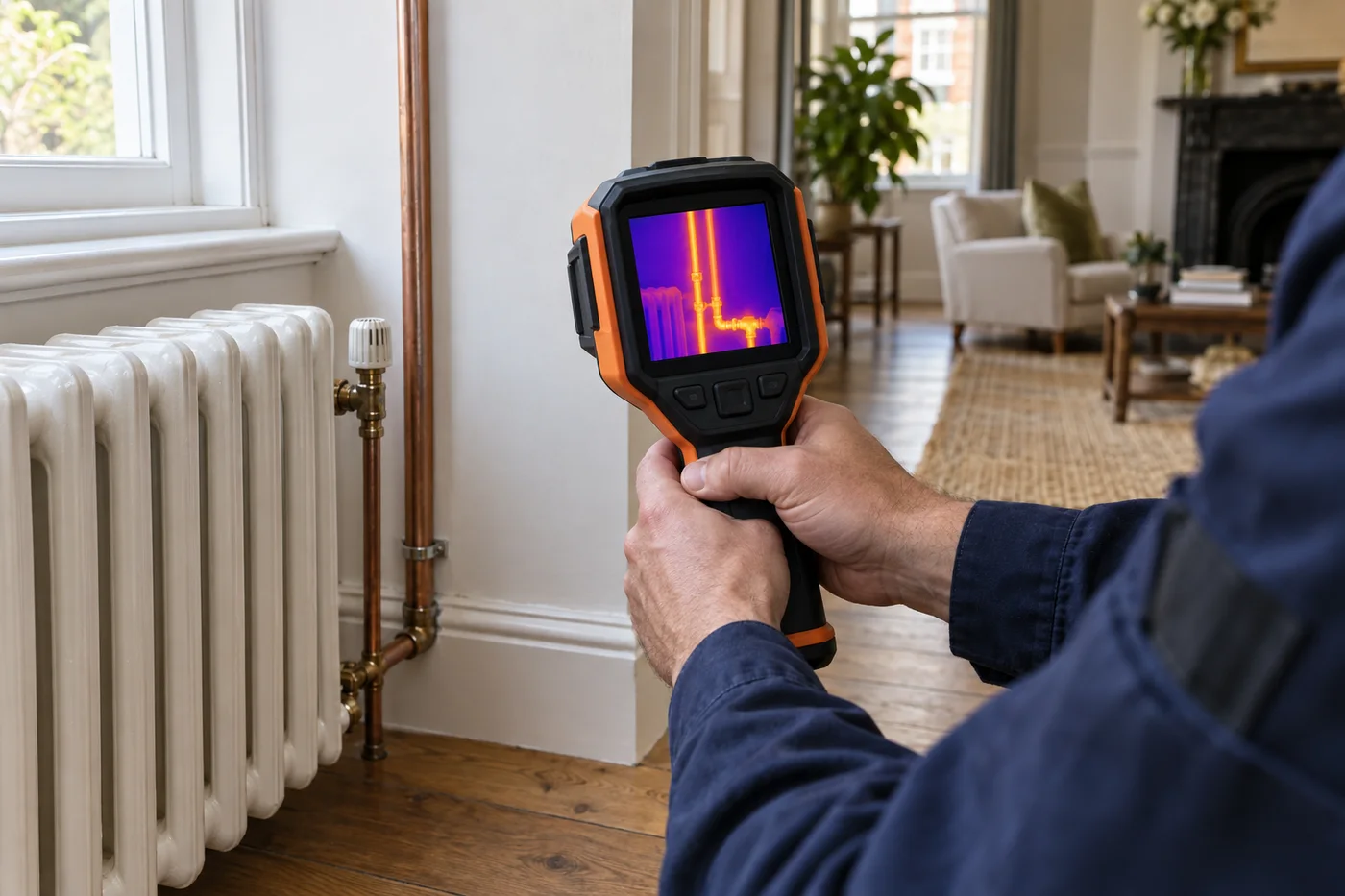
Thermal imaging survey being carried out to trace a hidden leak

Why nobody can tell you the figure

The cost of a leak is the volume lost multiplied by your rate. Both halves are specific to you. A weeping compression joint and a split 25mm MDPE supply pipe differ by orders of magnitude, and charges per cubic metre differ by supplier and change every April. A page that tells you a leak costs a given amount per day is inventing at least one of those numbers.

What can be given is the method. It takes ten minutes, it uses your own meter, and the answer is defensible if you later have to argue about a bill.

Step one: measure the loss

Turn off every tap, appliance, irrigation timer and softener. Take a full meter reading including the red digits, note the time, and photograph the face. Use no water for at least thirty minutes, and preferably overnight. Read again.

Thames Water's guidance is that identical readings mean no leak and different readings mean a loss between the meter and the inside stop valve. The two-reading test in full covers finding the meter, reading it properly, and isolating inside from outside.

Step two: turn the readings into a daily volume

Take the difference in cubic metres, multiply by 1,000 for litres, divide by the hours elapsed, then multiply by 24.

Worked through with example readings, which you should replace with yours:

  1. First reading 421.647 m³ at 23:00. Second reading 421.899 m³ at 07:00.
  2. Difference: 0.252 m³.
  3. In litres: 0.252 × 1,000 = 252 litres in 8 hours.
  4. Per hour: 252 ÷ 8 = 31.5 litres.
  5. Per day: 31.5 × 24 = 756 litres, which is 0.756 m³.

That is a loss nobody in the house would notice. It leaves no puddle and makes no sound through a floor. It is also three quarters of a cubic metre a day, every day.

Step three: apply your own rate

Find the charge per cubic metre on your bill. On a metered account there are usually two: one for clean water and one for wastewater, because wastewater is billed on the volume the meter records. Add them together to get the rate that applies to a leak, since the meter counts the lost water for both.

As a concrete example of the arithmetic, Thames Water's published metered charges for 2026-27 are £2.7346 per cubic metre for clean water and £1.4721 per cubic metre for wastewater from 1 April 2026, which is £4.2067 per cubic metre combined. Those are Thames Water's figures on that date, not a national average and not a forecast. Substitute the two numbers from your own bill.

  1. Daily cost: 0.756 m³ × your combined rate per m³.
  2. On the Thames Water figures above: 0.756 × 4.2067 = about £3.18 a day.
  3. Over a six-month billing period of around 182 days: about £579.

Run the same three lines with your own loss and your own rate. The useful output is not the pounds, it is the comparison: a daily figure you can set against the cost of finding and fixing the pipe, which for us is £150 per hour agreed before we attend, with no fee for the time spent looking if we do not find it.

What the arithmetic does not include

Two things stay the same whether you leak or not. Fixed charges do not move with volume, so leave them out of the comparison. Thames Water's are published separately, at £66.87 for water and £128.13 for wastewater in 2026-27, or £80.43 with the surface water drainage rebate.

The other exclusion is the damage, and it is the one that dwarfs the water. A supply pipe losing under a litre a minute into clay under a solid floor will wash fines out from under the slab long before anyone sees a stain. The water bill is the cheap part of that story, and it is the part an allowance can refund. The building damage is a separate route entirely: see the insurance claims hub for how trace and access cover pays for getting at the pipe.

Why the daily figure matters for a leak allowance

Water companies are required by their licences to reimburse the cost of water lost through leakage as credits to the bill. That is what a leak allowance is, it can apply to water supply charges and to wastewater charges, and it can only be claimed once the leak has been repaired. Companies can refuse in defined circumstances, for example where the repair was not arranged within a reasonable timeframe they specified, or where the leak was caused by the customer's own negligence.

Your own arithmetic matters here for three reasons. It tells you whether the sum at stake justifies the effort of claiming. It gives you a cross-check on the credit the company calculates, which is usually based on comparing your historic usage against the metered volume during the leak rather than on your measurement. And the readings you took to produce it are part of the evidence. What a claim needs sets out the pack and the deadlines, which are set by each company. If your supplier is Thames Water, the Thames Water hub covers their notice and repair windows.

The decision the number is for

A daily cost turns an open-ended worry into a comparison. Against it, put the cost of locating the leak properly rather than digging on a hunch, and the fact that the loss continues every day you delay. Where the loss is large, or the pipe is under a drive, a slab or a finished floor, the daily figure usually settles the argument on its own.

What it should not do is send you digging. Measure first, locate second, open the ground once.

Frequently asked

How much does a water leak cost per day?
It depends entirely on the size of the leak and your tariff, so work it out rather than take a figure off a page. Measure litres lost per hour at your meter with everything off, multiply by 24 and divide by 1,000 for cubic metres a day, then multiply by your own combined charge per cubic metre for water and wastewater.
Do I pay wastewater charges on water lost from a leak?
On a metered account, usually yes, because wastewater is billed on the volume the meter records even though water lost underground never reaches the sewer. That is why a leakage allowance can apply to both charges.
What is a leak allowance?
A credit to your bill for the cost of water lost through a leak. Companies are required by their licences to reimburse that cost, it can cover water supply and wastewater charges, and it can only be claimed once the leak has been repaired.
Can my water company refuse a leak allowance?
Yes, in defined circumstances. Examples include failing to arrange the repair within a reasonable timeframe the company has specified, and a leak caused by the customer’s own negligence. Each company must publish how it handles allowances and when it refuses them.
Should I keep the leak running until the allowance is agreed?
No. An allowance can only be claimed after the repair, and companies set deadlines from the date the leak was identified. Delay increases the loss and puts the claim at risk.

Sources

No find, no fee · £150 per hour. The rate is fixed before we attend and does not rise for a difficult property, an awkward access or an evening visit. The total depends on how long the job takes; the rate cannot change.