Start with the gauge, not the boiler
Everything on an Ideal Logic, Logic Max, Vogue or Exclusive that people call a pressure problem is really a water problem. The circuit is sealed. The only water in it is the water the installer put in, plus whatever you have added since. If the number on the gauge keeps falling, litres are leaving the building's pipework, and the boiler is simply the thing that noticed.
Ideal's own faults guidance is short on this and useful: if the system requires topping up frequently, it needs to be checked by a professional to find the source of the pressure loss. This page is about doing the first half of that yourself.
The overnight test
Ten minutes of your attention, spread over a night, and it narrows the search more than any amount of guessing.
- Top the system up cold to 1.2 bar, within the 1 to 1.5 bar band Ideal specify, and close the filling loop fully.
- Turn the heating and the hot water off completely. Write the reading down with the time.
- Read it again in the morning, still cold, before anything runs.
- Now run the heating for a full cycle and read it once more, cold again, that evening.
| What the gauge does | What that points at |
|---|---|
| Holds overnight, holds after a heating cycle | Not currently leaking. Air release from a recent refill, or a one-off. |
| Holds overnight, drops after the heating runs | A leak on a circuit that only pressurises under pump head, or a relief valve lifting. Often a buried run or an underfloor loop. |
| Drops overnight with everything off | A continuous leak. Somewhere water is running out of the system every hour of the day. |
| Climbs high when hot, falls below the start when cold | Expansion vessel, not a leak. See below. |
The four places an Ideal system loses water
1. The pressure relief discharge pipe
A copper or plastic pipe emerging through the outside wall near the boiler. If it drips when the boiler fires, or shows limescale streaking down the brickwork beneath it, the system has been venting through the relief valve. Either the valve is passing on a dirty seat, or the expansion vessel has failed and the valve is doing its job. Check this before anything else, because it is the one loss that leaves no damage indoors and the one people never look at.
2. Joints, valves and the boiler case
Radiator valve spindles, the tail nut where the valve meets the radiator, towel rail welds, and the pipework inside the boiler case itself. Small weeps evaporate off warm pipe and leave a green or white crust rather than a puddle, so look for staining rather than water. A dry tissue run around each joint finds what a finger misses.
3. Under the floor
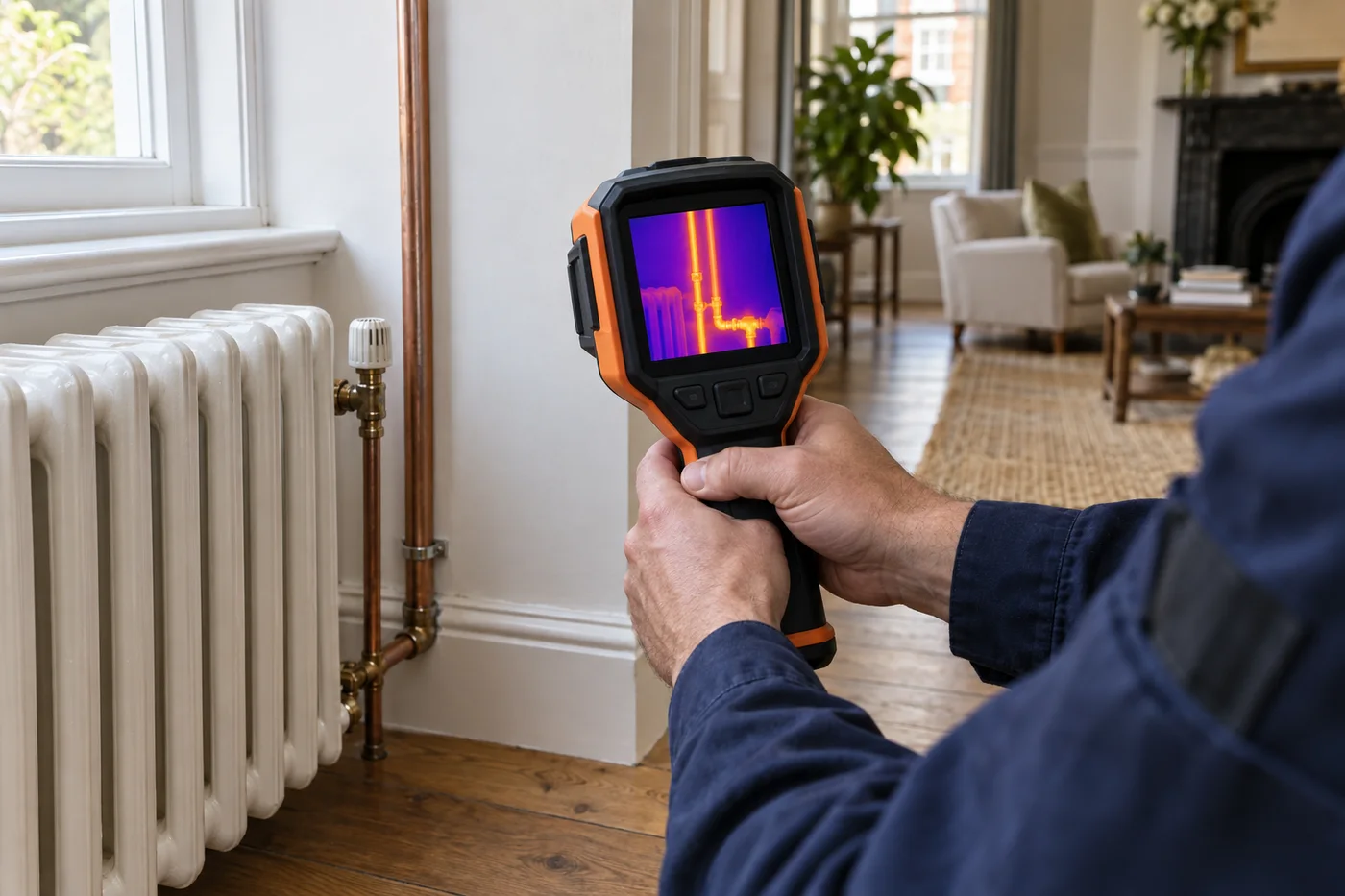
The common one, and the reason detection exists. A pinhole in a 15mm copper pipe under a screed or chipboard floor can drop the gauge weekly for months with nothing visible above it, because the screed absorbs the water and the heating dries the surface. Nail and screw strikes from a previous floor covering are a frequent source, and so is corrosion where copper has been laid in contact with screed without sleeving.
4. Underfloor heating circuits
If part of the house is on underfloor heating, that is a lot of buried pipe and a lot of connections in a manifold cupboard. Start at the manifold, which is accessible, before assuming the loop is at fault. We cover this on the underfloor heating leak repair page.