Separate stopping damage from authorising an investigation
If water is actively damaging the property, make the situation safe and contact the insurer's emergency or claims route promptly. Do not stand beneath a bulging ceiling or approach wet electrical equipment to take photographs. Safely isolating the water and documenting an emergency are different from authorising several days of exploratory work, drying and redecoration.
This guide concerns the point where you are about to book a leak specialist and expect your insurer to reimburse the bill. It is a practical preparation checklist, not a determination that your policy covers the work. The policy wording, schedule, endorsements, circumstances and insurer's instructions decide that. If a claims handler is still checking cover, keep that uncertainty visible in your booking decision.
A useful first distinction is between “you may arrange someone to stop the immediate leak” and “we approve this investigation at this cost”. Do not turn the first statement into the second. Ask what can happen now, what needs a quotation and when you should contact the insurer again before the contractor proceeds.
Find the right policy section before discussing a price
The terms “leak detection allowance”, “trace and access”, “escape of water” and “home emergency” are often used together in conversation. They can refer to different benefits and different claims teams. Ask the insurer to identify the section it is considering and send you the relevant wording if you cannot find it in your documents.
Admiral's published trace-and-access explanation, for example, distinguishes finding and accessing a hidden leak from repairing its source and from home-emergency assistance. It also explains that a customer may need to pay initially and seek reimbursement. That describes its published approach, not a promise that every insurer or every policy works the same way.
Your first email or call should therefore name the symptom and the work proposed, rather than simply asking “am I covered for a plumber?” A falling boiler pressure gauge, water beneath flooring and a metered supply losing water outdoors may involve different evidence and policy questions. The insurer needs the facts before either party can sensibly discuss a spending limit.
For definitions, our trace-and-access cover guide explains the categories. Here the priority is recording what has been authorised for your particular incident before you enter a contract with the repair firm.
Prepare a one-page description of the problem
Give the claims handler a short chronology: when the symptom was discovered, what you can see, what has changed and what action has already been taken. Avoid declaring that a concealed pipe has burst if no one has found it. “Pressure drops between cold readings and there is no visible leak” is evidence; “the pipe under the kitchen has failed” is a diagnosis that needs support.
Add photographs that show the location and extent of visible damage, plus any reliable meter or pressure records. Label observations with dates. If a plumber has attended, attach the report and explain whether it confirms a leak, identifies a possible cause or recommends further investigation. Those are different conclusions.
Include practical access restrictions. A floor may contain underfloor heating, the affected room may be in a flat, or a landlord may need to authorise opening a service duct. A quotation which ignores those constraints may change once the engineer arrives. Describing them early helps the insurer assess a realistic first stage rather than approving an incomplete job description.
Ask these questions and record the actual answers
| Question | What a useful answer clarifies |
|---|
| Which policy section is being considered? | Whether the discussion concerns detection, access, damage, emergency assistance or another benefit |
| Is cover confirmed or still under review? | Whether you are receiving approval or only instructions to gather evidence |
| Who appoints the contractor? | Insurer-appointed attendance versus your own booking |
| What is approved at this stage? | Survey only, specified testing, limited opening or another defined task |
| What limit applies? | The authorised amount and whether further agreement is needed |
| What costs remain mine? | Relevant excess, excluded repair work and other customer liabilities |
| What must the report and invoice contain? | Evidence needed to assess reimbursement |
| Who pays the contractor initially? | Your payment obligation versus any direct-billing arrangement |
These are questions to obtain a decision, not statements of universal policy requirements. If the handler cannot answer immediately, ask which person or team will confirm it and how to submit the quotation. Write “awaiting confirmation” in your own notes rather than treating silence as consent.
Record the name or team, date, time and claim reference for a telephone conversation. Then send a short written summary and request correction or confirmation through the insurer's normal channel. A contemporaneous note can preserve context, but it is not a substitute for a decision the insurer has not made.
Define the first stage instead of approving an open-ended search
A useful investigation scope names the symptom, the circuit to be checked and the intended outcome. For example, a first stage might establish whether loss is on the incoming water supply or inside the property, then report the evidence and recommend the next step. It should not promise a precise repair location before the necessary tests have been performed.
Ask the contractor what is included in the initial attendance and what happens if more time or access is required. If a quotation is hourly, decide how progress will be communicated and who can authorise continuation. The insurer's acceptance of an hourly rate does not necessarily mean it has accepted unlimited hours.
For concealed work, agree a stopping point. That may be before lifting a fixed floor finish, before opening a second area or before moving from detection to repair. A stopping point is useful to the owner, contractor and claims handler because it turns an uncertain investigation into stages which can be reviewed against the evidence obtained.
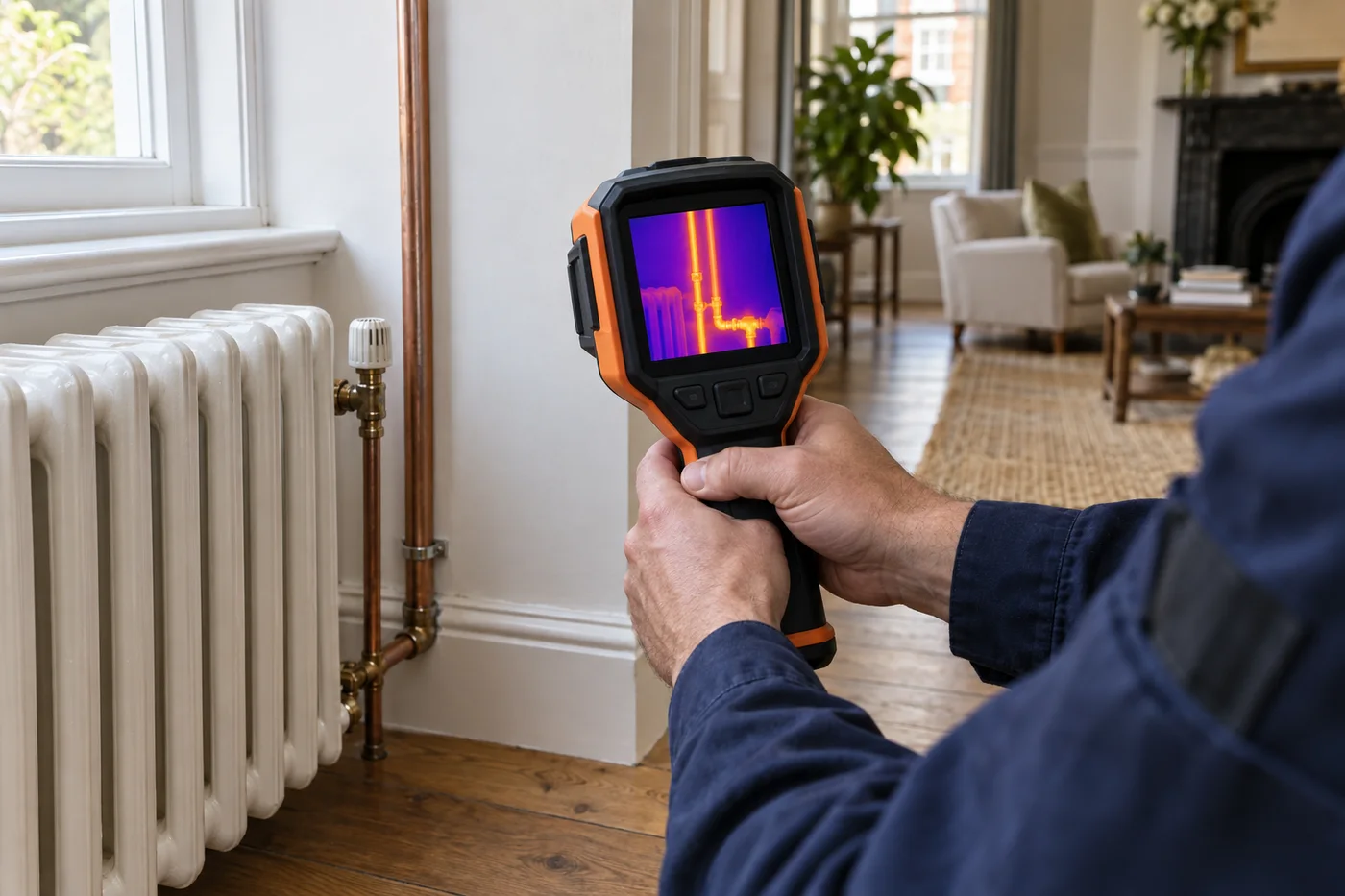
Do not demand a guarantee that a non-invasive technique will find every leak. Ask why the proposed methods suit the pipe material and access. A thermal image, acoustic survey or tracer-gas test has limitations. Those limitations should inform the scope and report rather than being discovered only when a reimbursement question arises.
Keep five different cost categories visible
When asking for a quotation or invoice, use separate descriptions for the work which actually took place. The headings are an organisational aid; they do not determine insurance coverage. A contractor cannot make an excluded repair claimable by moving it under a heading called “trace and access”.
- Investigation: inspection, testing and interpretation used to establish where water is escaping.
- Access: necessary opening to reach or establish the defect, with the location and extent recorded.
- Source repair: work to the failed pipe, joint, valve or fitting.
- Access reinstatement: restoring the parts opened for investigation or repair.
- Consequential damage work: drying and restoring damage caused by the water itself.
One visit can contain several categories, but the report should make the sequence understandable. If the ceiling was already damaged before attendance and another opening was made to reach the pipe, say which was which. Otherwise the later reader has to guess whether an invoice concerns existing water damage or damage created by access.
Retain time records and photographs where they are part of the job documentation. Do not manufacture a detailed hourly split after the event merely because it looks more persuasive. If the original records are limited, provide an honest explanation of the work and any reasonable breakdown the contractor can substantiate.
A real dispute shows why the booking conversation matters
In Financial Ombudsman decision DRN-4918538, an insurer had agreed that the customer could arrange a plumber for trace and access, while distinguishing plumbing repairs. A combined invoice led to a dispute. The Ombudsman examined the original call, amended invoice and the detail the insurer had actually requested, and required payment of the trace-and-access amount.
The practical lesson is to establish the scope and evidence expectations early. It is not that every invoice must have an identical format, that all high charges are reasonable, or that another customer's successful complaint guarantees yours. Keep the actual instructions, because what the insurer communicated can matter alongside the policy wording and work record.
Ask your contractor whether it can provide the requested information before you book. A firm which can carry out the work but cannot supply the relevant report may not meet your intended claims process. Clarifying that at quotation stage is easier than trying to reconstruct concealed work after the floor has been closed.
No visible damage is a question to resolve, not a fact to hide
If the only evidence is water consumption or a falling pressure gauge, tell the insurer. Do not imply that the building is damaged to make the proposed investigation sound more urgent. Some claims depend on particular damage requirements; others use different wording. The answer needs to come from the applicable policy.
The contrast is visible in two Ombudsman decisions. In DRN-4386665, the relevant wording linked trace-and-access cover to escape-of-water damage. In DRN-5404474, the Ombudsman noted that the policy's trace-and-access wording was separate and considered the correct classification of an already settled claim. These are examples of wording differences, not interchangeable rules.
Ask the handler to point to the clause it relies on. Then compare the requested investigation with that clause and the known facts. If you disagree, preserve the explanation and ask for review. Having a leak is a physical finding; whether a particular expense is insured is a separate question.
Understand who owes the contractor while the claim is assessed
Read the booking terms. If you appoint the firm yourself, do not assume that giving it the claim reference transfers your payment obligation to the insurer. Ask whether the insurer has agreed direct payment, whether the contractor accepts that arrangement and what happens if only part of the invoice is reimbursed.
Before paying a deposit or agreeing to extensive work, know what is due and when. If a proposed payment relies on an expected insurance settlement, discuss the timing openly. A report can be suitable for assessment without the insurer having accepted liability or agreed an amount.
Keep receipts and proof of payment with the corresponding invoice. If several contractors attend, label the stages and dates so the same cost is not submitted twice. If one contractor invoices another rather than you, ask how that arrangement will be documented in the claim rather than improvising a replacement invoice.
When the investigation changes, update the approval
An engineer may discover that the suspected central-heating leak is actually a valve discharging outside, or that water is entering from a different property. The initial investigation is still useful, but the next work may no longer be the work described in the approved quotation. Pause non-urgent expansion of the job and explain the new findings.
Send the insurer a short update: what was checked, what was established, what remains uncertain, and the proposed next stage with its cost basis. Include a photograph or test result where it helps. Avoid forwarding a long chain of messages without explaining the new decision required.
Where immediate action is needed to prevent further damage, record why the work could not reasonably wait and contact the insurer as soon as practical. Do not embellish the urgency afterwards. A clear record of an active leak and the minimum work undertaken is more useful than an unsupported statement that everything was an emergency.
If no leak is found, the report should say which areas or circuits were tested and the limitations. “No leak found during these tests” does not mean every pipe in the property has been proved sound. Ask what further evidence would justify another visit before repeating the same investigation at additional cost.
Use a factual approval-request message
You can adapt the following outline. It is a request for instructions, not a statement that the insurer has already agreed them. Remove questions that have been answered clearly, and do not include personal account information in messages sent outside the insurer's official channels.
I discovered [symptom] at [property] on [date]. The action taken so far is [facts]. Attached are [photographs/report/quotation]. Before I instruct the proposed investigation, please confirm which policy section applies, whether cover is accepted or being assessed, who may appoint the contractor, and what work and spending are authorised. Please also confirm the relevant excess, whether I must pay initially, what evidence the report and invoice should contain, and when further approval is needed.
When a response arrives, check whether it answers the questions or merely acknowledges receipt. If it says “send the report for consideration”, that may mean the decision is still pending. You can choose to commission work on that basis, but make that choice knowing the reimbursement remains uncertain.
Give the contractor the relevant instructions without sending unrelated policy or personal documents. The engineer usually needs the approved scope and report requirements, not your entire financial history. Keep the original insurer correspondence yourself in case later summaries omit an important qualification.
Book the physical work with a clear scope
If you need an investigation in London, send us the symptoms, existing findings and insurer's instructions. We can discuss what a first visit should establish, what access may be needed and how the findings will be documented. Our trace, access and reinstatement service connects the investigation with repair and making good where appropriate.
Leak Fix London charges £150 per hour. The rate is fixed before attendance; the total depends on how long the work takes. If we do not find the leak, you do not pay for the time we spent looking. See the pricing details and tell us about any insurer-approved limit before booking so the proposed work can be discussed against it.
We provide a factual leak detection report for the insurer to assess. We cannot approve your policy claim, promise reimbursement or describe unconfirmed damage as proven. If your insurer has already appointed a suitable contractor, coordinate with that arrangement before booking a duplicate investigation. The useful outcome is a supported diagnosis and an agreed next step, with a clear record of who authorised the work.