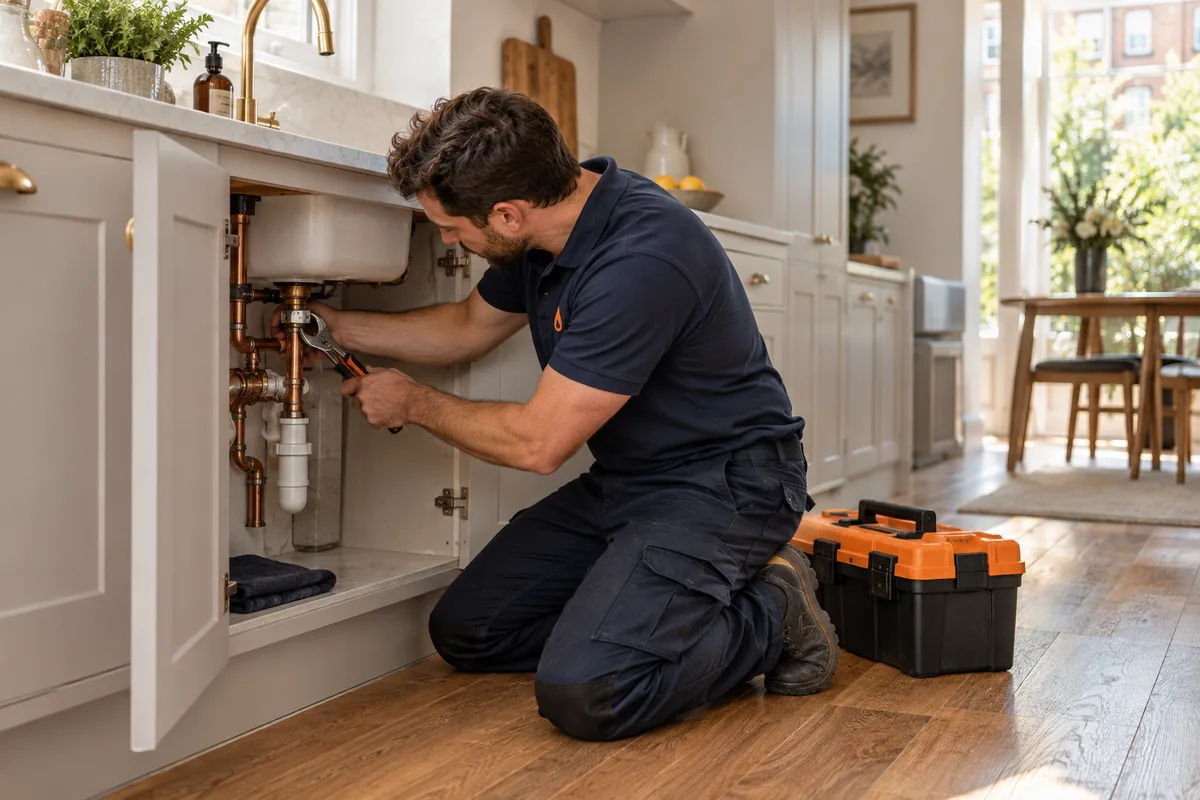
What the nut actually undid
A radiator tail joins the pipe with a compression fitting: a nut, and inside it a soft brass ring called an olive. Tightening the nut crushes the olive onto the pipe and it takes a permanent set. It is not a washer. It does not spring back.
On a joint that has sat untouched for fifteen years, the olive has bedded into one exact position and rotation, and the small imperfections in that seal have silted up with corrosion product carried by the system water. The joint is not dry because the olive is perfect. It is dry because the system sealed it for you.
Slackening the nut breaks that. Half a turn is enough to crack the deposit. Going back on, the olive has to seat against a surface it already deformed once, usually at a slightly different angle, because the tails have shifted a millimetre. Sometimes it reseals. Often it weeps.
Two habits make it worse. Overtightening, the instinctive reaction to a weep, distorts the olive further and can turn a joint that would have settled into one that never will. And a radiator refitted over fresh lining paper stands further off the wall, bending both tails.
Why it shows up on Thursday, not on Monday
Almost nobody finds this leak when it starts. The rate is tiny. Water runs down the outside of the tail, wicks along the pipe and soaks into underlay or the edge of a floorboard, reaching a surface you can see only once the material around it is saturated. That takes days.
Radiators also come off in warm weather. A joint that holds against a cold, static system starts moving the first time the pipe expands and the pump pushes water through it, and that first proper heating cycle can be weeks later.
| What you find | What it usually is |
|---|
| Damp carpet or a dark line at the skirting under one end | The tail joint at that end. Nearly always the reused olive. |
| A rust streak down the panel from the valve | Weeping spindle or gland, disturbed when the valve was turned hard shut. |
| Wet appearing only once the heating comes on for the season | Thermal movement opening a joint that was holding cold. |
| Pressure dropping with nothing visible anywhere | Trapped air still working out, or a leak on the pipe run under the floor. |
| Weeping from the radiator body, not a joint | Internal corrosion. Moving an old radiator can open a pinhole that sludge was plugging. |
The pressure one catches people out. After a refill, air comes out of solution for a week or two and every bleed drops the gauge, so a slow leak hides under that pattern. If you are still topping up after four weeks, it is not air.
The lockshield, and the turns nobody counted
A radiator has two valves. One end is the thermostatic or wheelhead valve you adjust. The other is the lockshield, under a cap, and that one is not a tap. It is the balancing valve, set once at commissioning, and it restricts flow so that radiator takes its share of the pump's output and no more.
Closing it to lift the radiator is correct. Reopening it fully afterwards is not. Wide open, that radiator becomes the easiest path through the circuit: it heats quickly, returns water to the boiler still hot, and starves whatever sits further along the run. One room is now too warm, a far room never gets there, and the high return temperature stops a condensing boiler condensing.
The fix is to count. Close the lockshield in quarter turns and write the number on masking tape stuck to the pipe. Reopen exactly that many. If nobody counted, the system needs rebalancing, a measured job with a pipe thermometer working out from the boiler.
And a thermostatic head turned down to zero is not a shut-off valve. The pin underneath can stick, and some heads pass regardless. The decorator's cap that came with the valve is the shut-off. If the cap is lost, drain the system rather than trust the head.
Fresh water is not free
The water in a sealed heating system is deliberately dead. Its dissolved oxygen was used up in the system's first weeks, and the inhibitor holds the pH and films the metal. Left alone it does very little damage.
Every refill undoes some of that. Fresh mains water is fully oxygenated and dilutes the inhibitor along with the volume it replaces. Oxygen plus steel radiators plus copper pipe produces magnetite, the black sludge that collects in radiators, in the pump and across the heat exchanger, and the corrosion making that sludge is the same corrosion that makes pinholes. A repeatedly drained system ages faster than one left alone.
So if the system was drained rather than one radiator isolated, the inhibitor needs replacing. And once the filling loop has done its job it must be disconnected: that is a backflow requirement under the water fittings regulations, and it is how systems quietly end up over-pressurised.
Taking one off without creating a job
- Fit the decorator's cap to the thermostatic end and turn it fully down.
- Close the lockshield in quarter turns. Count them. Write the number down where it cannot get painted over.
- Tray, old towels and a jug. Hold the valve body with a second spanner while you slacken the tail nut, so the pipe is not twisted. The water is black and stains permanently.
- Open the bleed screw to drain it properly, then close it before you lift.
- Lift with two people. A drained double panel still holds water inside.
- Bag or cap both ends and protect the open valve tails.
If a valve will not hold when you test it, stop there. How to drain a radiator covers testing the seal first and what to do when a lockshield or thermostatic valve will not close.
Putting it back
- Fit new olives if the tails will take them. A reused olive is the single most common reason this joint weeps.
- A smear of jointing compound helps the olive take up small misalignment, but it will not rescue a crooked joint.
- Tighten to firm, then a fraction more, and stop. If it weeps, one more quarter turn. If it still weeps, change the olive rather than keep pulling on it.
- Open the lockshield to the counted number, then open the thermostatic end.
- Refill slowly with the bleed screw open until water appears. Slow filling leaves less air behind.
- Bring a sealed system back to 1.0 to 1.5 bar cold, and add inhibitor if it was drained.
- Dry every joint with kitchen roll and check at twenty minutes, the next morning, and again after the first full heating cycle of the autumn. That last check is the one everybody skips, and the one that finds this leak.
When the wet patch is not at the radiator
Pipes under floorboards get stood on and levered while a radiator is wrestled out. A soldered elbow two metres away can crack; a push-fit connector can be shifted off its stop. You then get a damp patch at the skirting several feet from the radiator, or a stain on the ceiling below, and the entry point is rarely above it because water runs along a joist first.
That is the point to stop lifting boards at random. A pressure test confirms the loss and sizes it; thermal imaging on a warm circuit follows the pipe run so one board comes up instead of six. If the wet patch is at the valve, a leaking radiator valve is usually a short job. Anywhere else needs finding first, which is what radiator and valve leak repair covers.
Decorator, plumber, owner: how the argument usually runs
It runs the same way most times. The decorator says the radiator was dry when they left, and it was. The plumber called afterwards says the joint was disturbed and the olive reused, and it was. You have a soaked floor and two trades with reasonable accounts of their own part.
Whether anyone owes anything depends on what was agreed beforehand and what was actually done. We do not give a view on that, and be wary of any trade who does while standing in your hallway.
What is worth doing, in order: stop the water, then keep the evidence. Dated photographs before anything is lifted or dried. A note of who took the radiator off and when. Any message where taking it off was agreed. And a written description from whoever repairs it of what they found at the joint, rather than an invoice reading "repaired leak". If water has reached a flat below, the same evidence is what the claim rests on.
The repair is usually well under an hour. The argument routinely costs more than the repair.
What it costs to have it dealt with
We work at £150 per hour, agreed before we attend, with no call-out fee. A weeping tail joint or a valve gland is normally inside the first hour, including refilling, bleeding and putting the balance back. Tracing a leak is the same rate and it is no find, no fee: if we do not locate it, you do not pay for the looking time. Detection visits come with a written report to support a trace and access claim, though what the policy pays is the insurer's decision. If a floor or ceiling has to come up, our own handymen and builders put it back. Rates are on the pricing page.
One case where you should not call us: if the radiator is cold at the bottom or noisy and nothing is wet, that is air or sludge, not a leak. Bleed it and run the heating for a week. If it stays cold after refitting, check the valves were reopened; radiator not heating up goes through it in order.