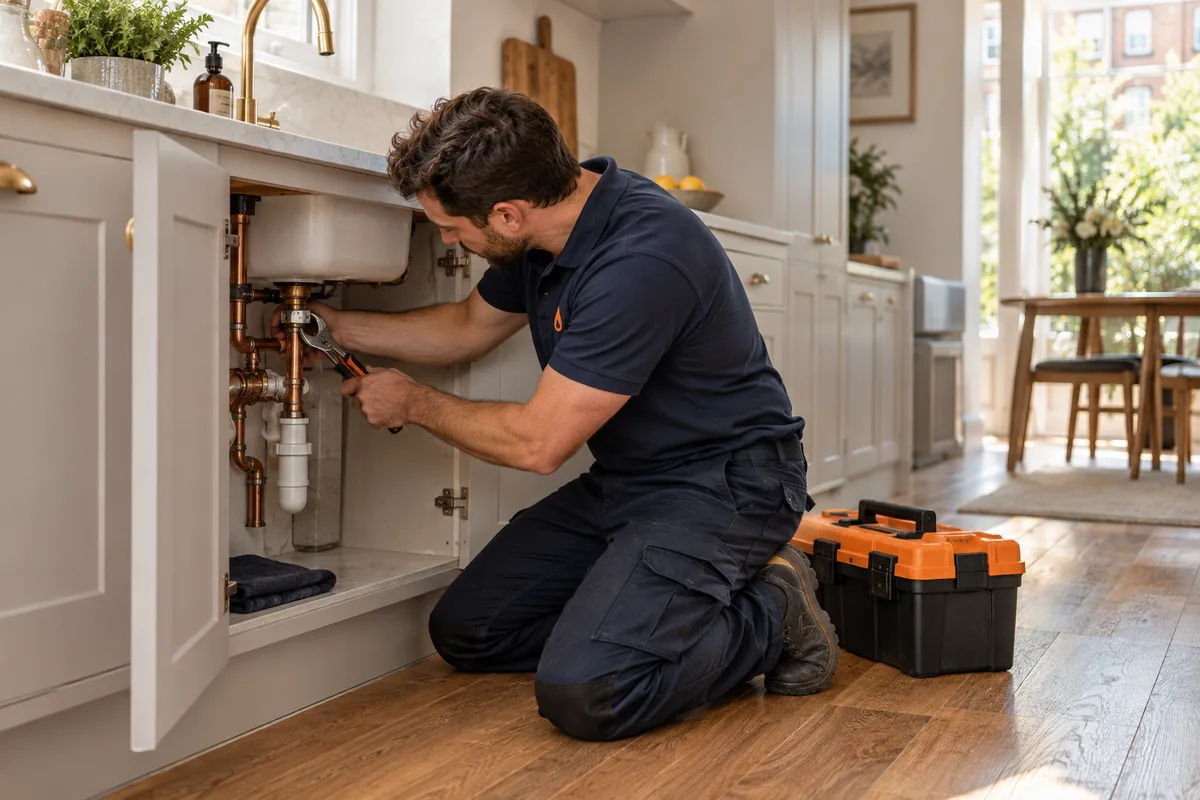
Get the heating back on
Low pressure is not dangerous. The boiler has usually stopped because a pressure switch told it to, and the fix is to put water back in.
- Switch the boiler off and let the system cool, so the reading is honest.
- Find the filling loop: a braided silver hose with a valve at each end under most combis, or a built-in key or lever behind the front panel on some Worcester and Ideal models.
- Open both valves slowly and watch the gauge, not the clock.
- Close both valves fully at 1.0-1.5 bar cold. Ideal warn that levers left partly open let the pressure keep climbing.
- Restart. Most boilers clear the fault themselves, some want the reset button held.
Step by step, with the awkward filling loop variants, is on how to repressurise a boiler. If you overshoot, bleed a radiator briefly to drop back into the band. If the boiler is showing a code rather than just a low gauge, check what it means for your make first: on an Ideal, F1 is the low pressure code, while the same code on some other makes means something else entirely.
How low is actually too low
Below 1.0 bar cold is worth topping up. Worcester Bosch treat below 0.5 bar as water having escaped the system rather than as a setting that drifted, and most boilers lock out somewhere in that region rather than fire against a falling pressure. Vaillant describe safe operation as staying inside a 0.7 to 2.5 bar envelope.
A boiler in low-pressure lockout takes the hot water with it on a combi, which is usually how people notice in the first place. On a system that still fires, the first sign is often the top-floor radiators going cold; radiator not heating up sorts that from a valve or air fault.
Why it fell, read from how often
This is the only question worth answering, because the top-up is trivial and the cause is not.
| When it dropped | Most likely explanation | What to do |
|---|
| Right after you bled radiators | Expected. Bleeding removes water, and Worcester Bosch tell you to top up afterwards | Refill and forget it |
| Right after a service or a radiator was changed | The system was drained or partly drained | Refill, then watch for a fortnight |
| Once or twice a year | Normal by Worcester Bosch's own guidance | Nothing |
| Every month or two | A weeping joint or valve, a corroding panel, or an expansion vessel losing its charge | Inspect, then test |
| Weekly | An active leak, usually hidden | Have it traced |
| Daily, or it will not hold at all | A significant leak, or the pressure relief valve passing to the outside discharge pipe | Have it traced |
| Only when the heating is running | A circuit that only pressurises under the pump, or a failed expansion vessel | Pressure test, not guesswork |
The causes, in the order they turn up
Ideal list six between them, and in practice they cluster into four things you can check and two you cannot.
You can check these
- Radiator valves. Run a dry tissue around every spindle and around the nut where each valve meets the pipe tail. A weep that evaporates on a hot pipe leaves a white or green crust rather than a puddle.
- Towel rails. Bathroom rails corrode at the welds and drip into a room that is tiled, so it dries and nobody sees it.
- The discharge pipe outside. A small copper pipe through the wall near the boiler. If it drips after the boiler fires, the pressure relief valve is passing or the expansion vessel has failed, and you are watching your system pressure run down the outside wall.
- Under and behind the boiler. Look, do not open the casing. Vaillant are explicit that you should not remove the boiler casing yourself.
You cannot check these
- The expansion vessel. A burst diaphragm lets water fill the air side. The signature is a large swing between cold and hot pressure, and Worcester Bosch put the threshold at a rise of more than 1 bar once up to temperature. This is a recharge or a replacement, not a detection job, and it is worth ruling out before anybody lifts a floor.
- Buried pipework. Under screed, under boards, in a wall chase. A pinhole here can move the gauge weekly and show nothing for months.
The test that separates them
Top up to a known figure, write it and the date on a piece of tape stuck by the boiler, and read the gauge cold each morning for a week. A system losing pressure only when the heating runs behaves differently from one losing it steadily around the clock, and the two point at different faults. Doing that week of readings before anyone attends saves time on the visit, and time is what you pay for. How to run the overnight version of that test properly, and what each result means, is in why a system loses pressure overnight.
Also worth ruling out: the filling loop left slightly open, which makes the pressure climb rather than fall and is the opposite problem with the same cause, someone topping up in a hurry.
When topping up stops being the fix
The specific symptom: you refill correctly, cold, into the band, and within a week the gauge is under 1 bar again with no wet radiator valve, no damp under the boiler and a dry discharge pipe. Everything visible is dry and the water is still going somewhere. That is a leak under a floor, behind a wall, or inside the boiler case.
Carrying on topping up makes it worse rather than holding it steady. Each refill puts fresh oxygenated mains water into the pipework and dilutes the inhibitor, which Ideal note accelerates corrosion, which produces more pinholes. Meanwhile the water that left is sitting in a floor void or a ceiling. Where heating circuits usually fail, by pipe type and age, is set out in central heating leaks, and the pattern of a gauge that falls again every few days is covered in boiler pressure keeps dropping.
What a detection visit does that guessing does not: isolate and pressure-test the system to confirm the loss and size it, then trace the run with thermal imaging and, on a drained circuit, tracer gas, so the opening is made at one point. It is charged at our hourly rate, agreed before we attend, and under no find, no fee you do not pay for the time spent looking if we do not find it. See boiler and heating leak repair, or pressure dropping with no visible leak for the diagnostic on its own.