What each method did
These counts come from 25 investigations in our own job records, each with a written finding. A method is counted as "used" only where the report records it being deployed, and as having "located" the leak only where the report attributes the find to it.
| Method | Used in | Located the leak | Returned a clear negative | Inconclusive |
|---|
| Visual inspection, including running the fixture and watching | All 25 | 8 | — | — |
| Pressure testing | 11 | 0 | 4 | 0 |
| Tracer gas | 8 | 4 | 3 | 1 |
| Inspection or endoscopic camera | 4 | 1 | 3 | 0 |
| Meter observation and stopcock isolation | 4 | 2 | 0 | 0 |
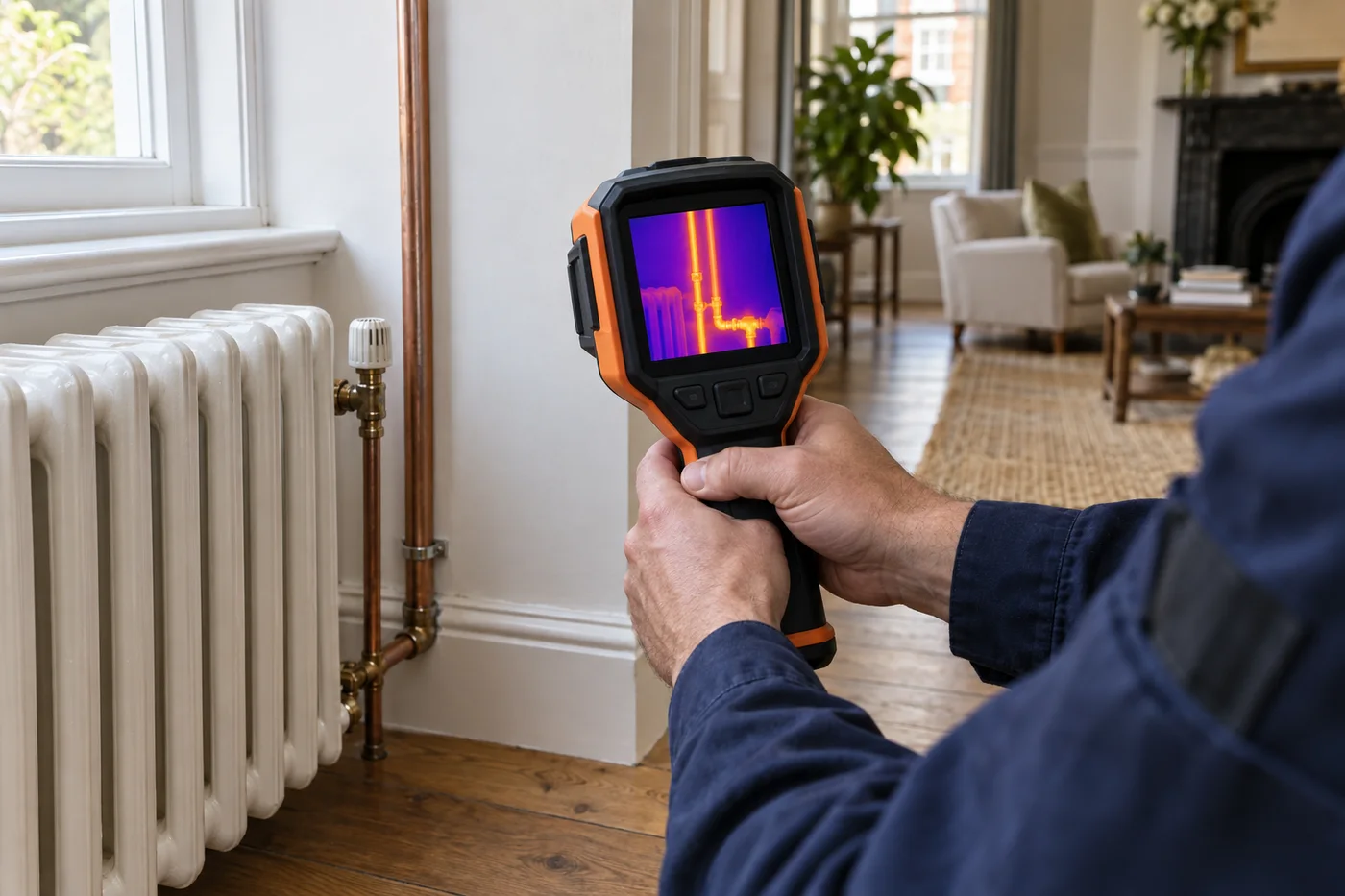
| Thermal imaging | 2 | 0 | 2 | 0 |
| Acoustic detection | 0 recorded | — | — | — |
Read that table the wrong way and you will conclude that thermal imaging is useless and looking is brilliant. Neither follows, and the reason is in the next section.
Why a hit rate is not a quality score
An engineer chooses a method after seeing the property. That choice is not random, so the hit rate of each method reflects the difficulty of the jobs it was pointed at as much as anything about the method.
Visual inspection "wins" eight of twenty-five because visual inspection is what you do first, and eight of these faults were visible once someone ran the right fixture and watched the right place. Tracer gas is deployed precisely when everything simpler has failed, so a hit rate of four in eight is a good result on the hardest subset, not a poor one.
Thermal imaging appears twice and found nothing twice, and both properties turned out to have no active supply leak. Two uses tells you nothing about the technique. What it does tell you is that we did not lean on it, and there is a physical reason for that: thermal imaging shows a temperature difference at a surface. It is strong on warm water under a floor and weak on a cold pinhole behind plaster in an unheated wall. The physics and its limits are set out here.
Acoustic detection appears in none of the 25 as the deciding method. Engineers do listen, and in one job the sound of escaping water under a staircase helped narrow the search. But no report attributes a find to acoustic equipment, and if it had done the work, the reports would say so.
Pressure testing found nothing, and it was still the most valuable step
Pressure testing was recorded in 11 of the 25 and it located nothing in any of them, because that is not what it does. It answers two questions that everything after depends on: is there actually a leak, and on which circuit.
Three examples from the set:
- A flat with ingress into the unit below. The cold system was isolated, pressurised and monitored for 30 minutes with no drop. The hot system dropped immediately and significantly. That single test halved the search area and turned an open-ended investigation into a tracer gas job on one circuit.
- A bathroom with a raised floorboard and damp in a cupboard. The cold circuit dropped within two to three minutes, which confirmed an active loss before anyone touched the structure. An inspection camera then found water escaping beneath the toilet pan connector, and one access board came off rather than a floor.
- A property with damp reported for years and previous engineers unable to find anything. Hot, cold and heating were each isolated and pressure tested, and each held. Then tracer gas was run into all three in turn, and nothing escaped. That is a negative result, and it was the correct answer.
Four of the eleven pressure tests produced a clear negative on the circuit tested. In a property where damp is real and the pipework is sound, that negative is what redirects the owner towards a damp surveyor or the building fabric instead of another year of lifting floors.
Tracer gas: four finds, three negatives, one it could not do
Tracer gas was used in eight of the 25. It located the leak in four, returned a negative that ruled out a concealed pipe leak in three, and could not produce a usable result in one.
The four finds were a 22mm heating pipe under a floor, a lead supply pipe under a floor, a joint on old underground pipework below a hall floor, and a faint reading between a bath and a toilet that matched a very small pinhole in concealed pipework. All four were under something.
The one that did not work is the most instructive. A large non-domestic building was losing roughly 2,000 litres a day. Isolating every internal stopcock in turn left the external meter still running, which proved the loss was in the buried incoming supply, about a metre below a hard surface. Tracer gas was introduced and the route walked with detection equipment, and nothing surfaced. At that depth, gas and water disperse into the ground before they reach the surface. The investigation narrowed the loss to a stretch of buried pipe and stopped there, with the honest recommendation being to find the original pipe route and excavate to it.
Two practical points follow. Tracer gas needs the circuit drained, so it is not a five-minute add-on. And it gives you an area, not a cross. What it is and how it is run is covered here.
The job where the first opening was in the wrong place
One case in this set is worth setting out in full, because it is the honest version of what tracer gas does.
A property was losing about seven litres a minute. A dripping kitchen tap was found immediately and recorded as far too small to account for it. The system was drained, tracer gas introduced, the outside checked first with nothing found, and then the inside surveyed. A strong, consistent reading came up in a reception room near a doorway, and the floor in that area had visibly sunk compared with the rest.
A section of floorboards was cut and lifted there. There was no pipework beneath it. A telescopic camera was put into the void and still found no pipework.
So the gas was introduced again and the property surveyed a second time. This run led towards the void beneath a staircase, where escaping water could also be heard. A screwed-down panel came up, and a lead supply pipe with a hole in it was there. Reaching it properly needed two further sections of flooring cut out in the hall. Heating and water pipes ran directly above the failed lead pipe, and removing them would have meant substantially more damage, so a repair clamp was fitted over the hole instead. The meter then showed no usage, a pressure test held, and the flooring went back.
That is one opening in the wrong place, one in the right place, and a repair chosen for how little else it destroyed. Anyone who tells you tracer gas puts a cross on the floorboard has not run it on a suspended timber floor.
What this means for what you should ask for
- Do not book a method. Book an investigation and let the sequence run. Two bookings in this set specified tracer gas and neither needed it; one was an external drain and one a blocked gully.
- Expect pressure testing first on anything concealed. If a firm proposes lifting a floor before anyone has established that a circuit is losing pressure, ask why.
- Accept that a negative is a result. Three tracer gas runs and four pressure tests in this set produced negatives, and in each case that changed what the owner should do next.
- Ask what happens if they do not find it. Ours is charged at £150 per hour, agreed before we attend, and under no find, no fee you do not pay for the time spent looking if the leak is not found.
Limits of this count
Twenty-five investigations over nine weeks, from one firm's caseload in London, classified by hand from the written reports. The counts for individual methods are smaller still: two for thermal imaging and four for cameras are too few to support any general claim about those techniques, and we are not making one. The full method and exclusions are in the dataset post. Where a report does not mention a method, we have counted it as not used, which will understate anything an engineer did without writing it down.