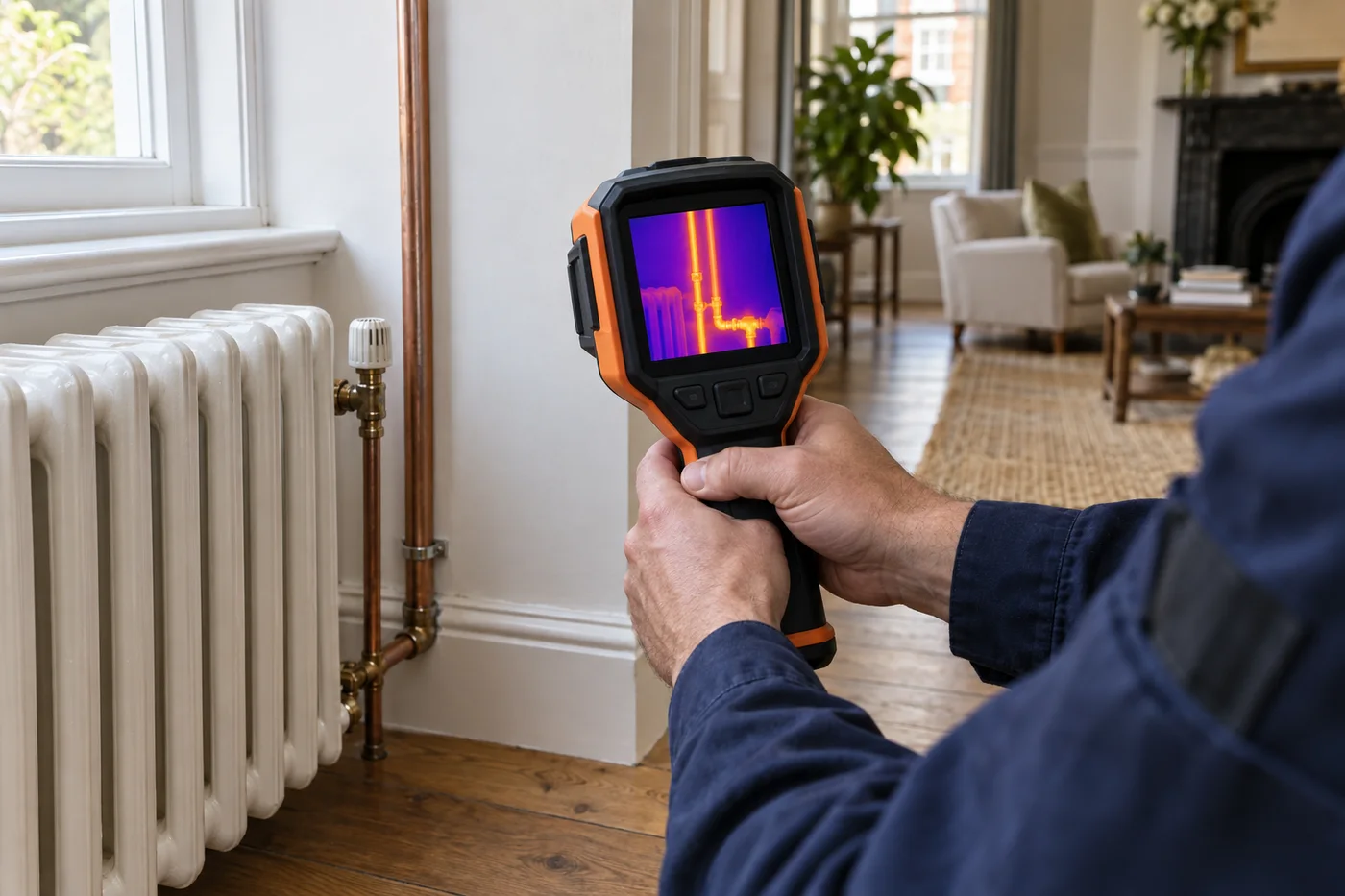
The sentence that should be on every thermal report
Teledyne FLIR, who build most of the cameras in use on UK leak work, say it plainly: a thermal imaging camera cannot see moisture in walls, but it can detect subtle temperature differences and patterns that reveal the existence of water. And then the qualifier that matters more: identifying a pattern that looks like moisture does not guarantee the presence of water. Their own advice is that you should always use a moisture meter to confirm what the thermal camera has detected.
That is the whole discipline. A thermal image is a hypothesis. This post is about the eight hypotheses that are usually wrong, and what separates them from the one that is right. The method itself, what it is good at and where it produces false negatives, is covered in the thermal imaging guide and not repeated here.
Three questions before you believe anything
Is this surface telling the truth? Emissivity is how efficiently a surface radiates. FLIR give the working values: highly polished metals such as copper or aluminium are usually below 0.10, most flat-finish paints are around 0.90, and skin and water are around 0.98. Below 0.5 you are unlikely to get an accurate temperature measurement at all, because a low-emissivity surface behaves like a mirror and the camera reads what is reflecting off it rather than the object.
Does the anomaly move when I do? This is the single most useful field check and it takes four seconds. Change your angle and look again. A reflection travels across the surface as you move. A genuine subsurface thermal pattern stays exactly where it was.
Does a second instrument agree? A moisture meter on the spot, and ideally a pressure test on the suspect circuit. A thermal pattern plus a wet reading plus a proven pressure loss is a finding. Any one of the three alone is not.
One: the warm flue
A chimney breast serving a live gas flue, or a flat where someone else's flue passes through your stack, produces a vertical warm band up a wall that follows the masonry and can look uncannily like water tracking down from above. Two tells: the pattern is oriented to the structure rather than to gravity, and it changes with the boiler's firing cycle. Come back an hour after the heating has been off and see whether it has faded.
Two: underfloor heating doing exactly what it should
On a floor with underfloor heating, the pipe runs image as clean regular parallel lines. That is the system working. The mistake is reading the serpentine as a fault, or, more often, missing a genuine leak because the whole slab is warm and a warm plume has nothing to stand out against. On a live underfloor circuit, thermal is looking for the blob that spoils an otherwise regular pattern, not for warmth in general. Where the pattern is regular and the pressure is still dropping, the answer is to drain and switch to tracer gas.
Three: the sun
Solar gain through a window puts a bright warm rectangle on a floor or a wall, and it does not disappear the moment you draw the curtain, because the material holds the heat. The same applies to a south-facing external wall surveyed in the afternoon. The tell is geometry: solar patterns have straight edges and corners matching the window, which nothing behind a wall ever does. The fix is to survey that elevation early in the morning, or to shade it and come back.
Four: the cold bridge
A concrete lintel, a joist end built into masonry, a steel, or a wall-to-floor junction conducts heat out of the building faster than the fabric around it, so it reads cold from inside. Damp reads cold too, through evaporative cooling, which is precisely why this one gets called wrong. The tell is that a cold bridge is linear and structural: it runs the full width of an opening, or repeats at regular joist centres. Damp is irregular and it has a gradient. A meter settles it in a minute, because a cold bridge is dry.
Five: missing or slumped insulation
Insulation that has slipped between studs, been cut short around a socket, or settled in a cavity gives a cold patch with an oddly rectangular or triangular shape. Again the shape is the giveaway: it follows the framing. This is a real defect and worth reporting, but it is a heat loss defect, not a leak, and treating it as one means opening a wall for nothing.
Six: air leakage
A draught through a service penetration, a loft hatch, a recessed downlight or a gap behind a skirting cools the surface around it in a plume. FLIR list drafts among the conditions that affect the evaporation, capacitance and conduction processes thermal imaging relies on. The tell is that it responds to pressure: close the windows, shut the internal doors, and see whether the plume weakens. It also tends to be sharper and more comet-shaped than a moisture pattern, which spreads.
Seven: the reflection
Gloss paint, ceramic tile, a polished stone floor, stainless splashbacks, foil-backed plasterboard and glass all reflect. FLIR describe reflected temperature as thermal radiation originating from other objects that reflects off the target, and warn that an object can appear much warmer than it is when a nearby heat source reflects off its surface. The commonest domestic false positive of the whole set is a radiator reflecting in a gloss floor, or the surveyor's own body heat reflecting off tile.
Use the movement test. If you are still not sure on a low-emissivity surface, FLIR's own workaround is to apply a high-emissivity surface such as electrical tape and read that instead.
Eight: thermal mass and lag
Materials of different density change temperature at different rates. A dense lintel, a granite worktop, a tiled hearth, a concrete pad under a screed patch, or a section of wall that was rebuilt in a different material all warm and cool at a different rate from what surrounds them. In the morning they read cold, in the evening they read warm, and at some point in between they read the same as everything else. That crossing point is the test: a leak does not disappear for an hour a day.
What a defensible thermal finding looks like
Not a pretty picture. A finding that survives scrutiny has four parts: an image with the emissivity and reflected temperature parameters set rather than left at default, a stated reason why the anomaly is not one of the eight above, a moisture reading at the anomaly and a reference reading on the same construction known to be dry, and a pressure test proving a real loss on a named circuit.
That combination is also what a loss adjuster is looking for. A single thermal image showing a warm patch is a finding, not a proof of source, which matters when the claim turns on trace and access. The moisture side of the evidence is covered in what a moisture meter is actually measuring.
When a thermal survey is the wrong thing to book
Do not pay for one on a cold water leak in an unheated property in winter. There is no temperature difference for the camera to find, and an empty, cold flat is the classic false negative. Heat the place for a day first, or use a different method.
Do not book one to answer "is my wall wet", because that is a moisture meter and it costs nothing like as much. And do not book one when you already know where the leak is and simply want it fixed; that is a repair.
Where it earns its place is narrowing. It turns a whole ground floor into a square metre in about ten minutes with nothing drained and nothing opened, which is why it goes on early. Detection is £150 per hour, fixed before we attend, with no find, no fee, and if the camera finds it in the first twenty minutes you pay for twenty minutes.