Two different searches, same four words
People type this phrase meaning one of two things, and the answers are not related. Work out which one you are before reading further.
- "Will Thames Water come out and find my leak?" Partly. They detect leaks on their own network continuously, and that work sometimes identifies a loss on a customer supply pipe. What they will not do is trace a leak under your kitchen floor. The rest of this page is where that line falls.
- "Thames Water have written to me saying I have a leak." That is a different problem with a four-week clock attached to it, and it has its own page: what to do when Thames Water say you have a leak. Read that one instead.
What their detection work actually is
Thames Water describe most leakage as invisible: their own figure is that over 95% of leaks are never seen by customers, because they are small, deep and underground. The ones that break the surface are bigger but lose less water overall. Field teams work around the clock to find them.
That is network detection, and it is a different discipline from domestic work. They listen across whole metered zones — comparing flow into an area overnight against what it should be using, then narrowing street by street. It finds a leak somewhere in a few hundred metres of main. It is not designed to put a cross on a floor in one house.
When they find something, Thames Water say they prioritise the repair on four things: how much water is being lost, the effect on customers' supply, complexity, and location. They also coordinate with the council, highways and other utilities before opening a road, which is why a reported street leak can sit visible for weeks.
The pipe they stop at
Thames Water own the mains and the communication pipe that links your supply pipe to the main. From the boundary — the outside stop valve — into your house, the supply pipe is yours, along with everything past the internal stop tap. The awkward London cases are covered separately: where their pipe ends and yours begins.
The short version here: water in the road or pavement is theirs to find and fix, free, and you should report it rather than pay anyone. Water inside your boundary is yours.
What happens when the leak is at your property
Two routes lead here. Either their area detection work picks up continuous flow on your connection, or you spot it yourself and ring them. Thames Water's leakage code of practice gives a 24-hour line, 0800 316 9800, for a suspected supply pipe leak.
What follows is advice and a deadline rather than an engineer with a correlator. They confirm the leak, tell you it is yours to arrange, and start the four weeks. Before that, expect to be asked for the meter test they publish. It costs nothing and takes half an hour:
- Turn every water-using appliance off and make sure no cistern is refilling.
- Close the internal stop valve, usually under the kitchen sink.
- Read the meter and write the number down.
- Wait thirty minutes without using water.
- Read it again.
Identical readings mean nothing is escaping between the meter and that closed valve. A higher second reading means water is moving through the supply pipe with the house shut off, which is a leak outside. On a smart meter the same evidence shows up as an overnight baseline that never drops to zero.
Where their engineer stops and your plumber starts
Their own guidance is unusually blunt here. Thames Water tell customers that for a visible leak indoors — a dripping tap, a leaky loo — a WaterSafe approved plumber is the right call, and warn that "a plumber may not be able to trace a leak" that is outside the house. For a leak outside but still on your property, or one indoors you can neither see nor hear, their advice is to get a leak detection specialist.
They also set out what that referral is not. The contract is between you and the contractor, not with Thames Water. They do not guarantee availability or workmanship and will not step into a dispute between you and whoever you hired. They recommend getting at least one quote, asking upfront whether the quote itself is chargeable, and taking a certificate of water regulations compliance at the end. If you use a plumber who is not approved, they may come out to check the work and charge you for further repairs they think are needed.
So the sequence is: they detect at network level, they tell you, they point at a category of specialist, and the money is yours from that moment.
When they will fix your pipe anyway
There is discretionary help, and it is narrower than most people assume. Thames Water's code of practice says they will help fix a leak on a customer supply pipe at their discretion for people in their Priority Services Register categories, or on WaterHelp or WaterSure, and that they will step in anyway where there is a risk to life or to their supply network. CCW's advice matches: ask your company whether it offers one-off assistance with locating and repairing a leak, because conditions differ company to company.
Where they do the work, the published limits are worth knowing before you count on it:
| Their stated position | What it means on the ground |
|---|
| They repair the supply pipe up to where it enters the building, but not pipework beneath a building | In a converted flat, that is the point the pipe enters the block. The run to your door is still yours. |
| They will try to replace the pipe, but may repair it instead where replacement is impractical or the rest of the run is sound | You may get a mended pipe rather than a new one |
| Surfaces made safe, but no specialist reinstatement such as relaying block or crazy paving | Your resin drive, York stone path or tiled front step is your cost |
| Repairs guaranteed for two years under normal use; no guarantee on the condition of the existing pipe either side | On an old lead or galvanised run, the next hole is not covered |
| The supply pipe stays your responsibility throughout, even after they repair or replace it | Their work does not transfer ownership |
None of that is a promise that Thames Water will pay for your leak. It is a discretionary scheme with conditions, and the only way to know whether it applies to you is to ask them before you book anybody.
The point it becomes your bill
You are paying from the moment the loss is confirmed inside your boundary and you do not qualify for help. If a formal notice has been served, the clock is the one in the section 75 explainer — and if it runs out, Thames Water can do the work themselves and recover the cost from you, which is the most expensive option on this page.
Check insurance first. Thames Water themselves say to look at home buildings cover and any home emergency policy before arranging a repair. Trace and access cover — the money to open a floor and put it back — is often present even in policies that exclude the pipe itself.
What a private detection visit does that theirs does not
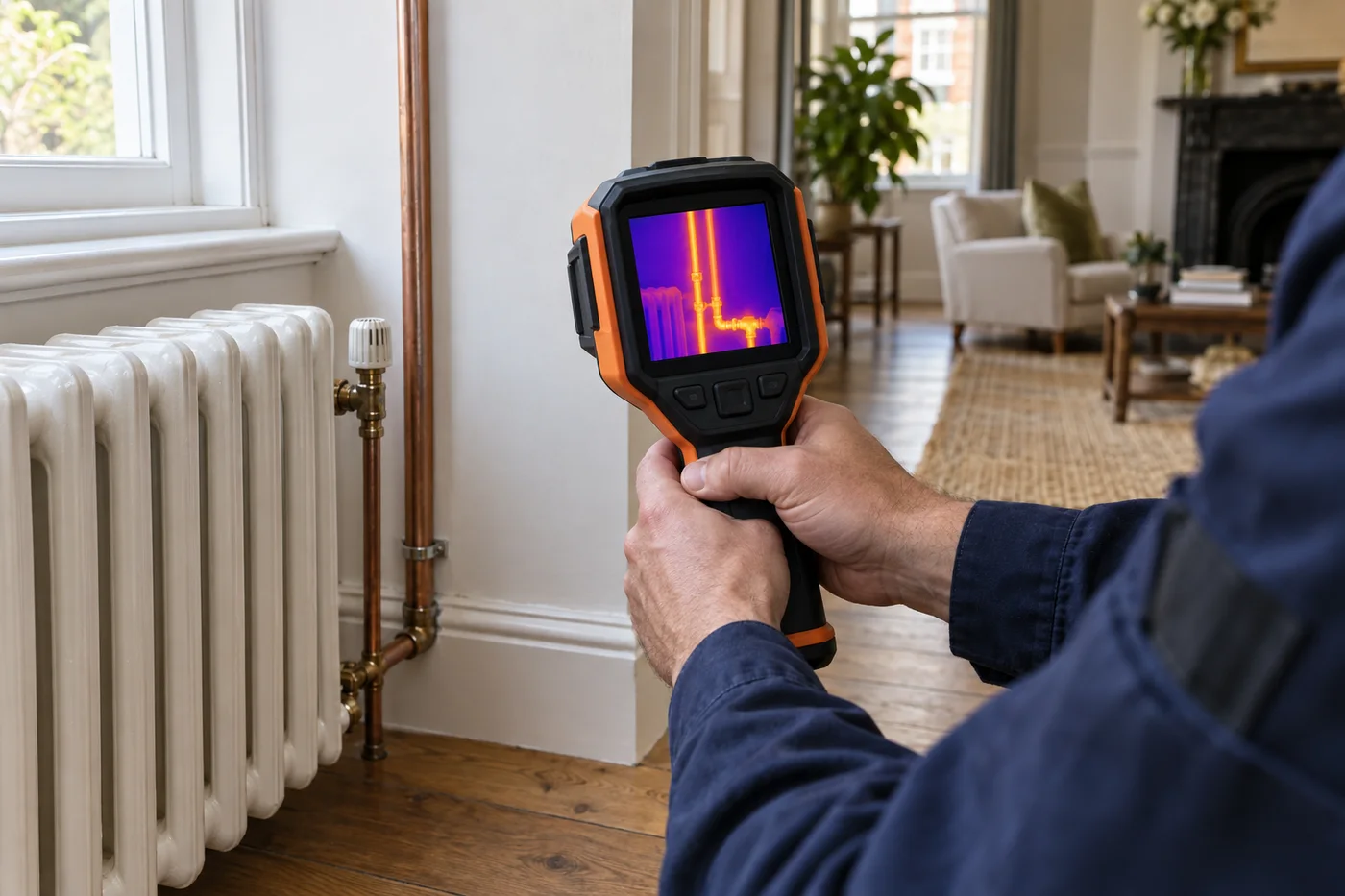
Ours is single-property work, and the point is to stop guessing. On a pressurised supply pipe we correlate acoustically between two contact points, narrowing the position by the arrival time of the leak noise. On a drained line we push tracer gas through and pick it up at the surface, which works on plastic pipe and deep runs where acoustic does not. Thermal imaging follows a warm run under screed and tile. The output is a mark and a depth, so one hole goes in the right place instead of four in hopeful ones.
The visit includes a written report prepared to support a trace-and-access insurance claim. The insurer decides what the policy covers; the report gives them something to decide on. We charge £150 per hour, agreed before we attend, no call-out fee, and if we do not find the leak you do not pay for the time we spent looking. Our own handymen and builders put floors, plaster, ceilings and tiling back, so the firm that opened it closes it. Supply pipe work and what it costs are both set out plainly.
When not to call us
- Water in the road or pavement. Report it to Thames Water. It is free and it is theirs.
- You rent. Tell the landlord or agent in writing and keep a copy. The repair is theirs to arrange.
- The meter does not move with the internal valve shut. Nothing is escaping outside. Look inside: a leaky loo passing into the pan is the usual culprit, and Thames Water put the average one at around 400 litres a day. Dry toilet paper left on the back of the pan for a few hours will tell you.
- You are on the Priority Services Register, WaterHelp or WaterSure. Ask Thames Water about their discretionary assistance first.
- The leak is a visible weep at an accessible joint. Any competent plumber can remake that. You do not need detection to find something you can point at.
Call us for the case their process leaves on the table: a confirmed loss inside your boundary, no visible source, and something solid on top of it that somebody has to put back.