The three things only the freeholder or agent can do
When a leak crosses between flats, most of the delay comes from leaseholders trying to solve something they have no power over. Three things sit with the freeholder or the managing agent and nowhere else.
- Access to another flat. The Leasehold Advisory Service notes that where a neighbour is not cooperating, the landlord or managing agent "will usually have a power under the lease to get access to a flat to investigate a problem, although the lease may say that you need to cover their costs". They can also "legally require your neighbour to do repairs", and they hold the owners' and tenants' contact details.
- The buildings insurance claim. The freeholder arranges the block policy, so the claim goes through them. LEASE: your landlord is responsible for arranging buildings insurance and "you'll need to ask them if they can make a claim".
- Instructing work on communal elements. Nobody else can commit the block to opening a riser or a communal ceiling void.
Which means that when a leaseholder is stuck, the productive next step is a written request to the agent, not another conversation with the neighbour.
What the freeholder is usually responsible for
LEASE's general division is that the landlord is usually responsible for "communal pipes, water tanks or boilers that serve more than one flat" and for leaks caused by a problem with the structure of the building, "such as a leaking roof or damage to an external wall", while each leaseholder takes the pipes serving their own flat, even where part of the run is outside it, and their own appliances. And then the qualifier that governs everything: leases vary, so the lease has to be read.
Two complications turn up constantly in managed London blocks.
- A pipe in a communal void is not automatically communal. If it serves one flat, it is usually that leaseholder's, wherever it physically sits. Agents and leaseholders both get this backwards.
- Where a flat is sublet, section 11 bites on the intermediate landlord too. Section 11(1A) of the Landlord and Tenant Act 1985 extends a landlord's repairing obligation to installations that "directly or indirectly, serve the dwelling-house" and that either form part of a building in which the landlord has an estate or interest, or are "owned by the lessor or under his control". So a buy-to-let leaseholder can owe their tenant a duty in respect of pipework the leaseholder does not own and cannot repair, which is precisely why those landlords chase the agent hardest.
Who pays: service charge, insurance, or the individual
| Cost | Usually funded by |
|---|
| Repair to communal pipework, tank or riser | Freeholder, recovered from leaseholders through the service charge |
| Repair to a pipe serving one flat | That leaseholder |
| Damage to the fabric of affected flats | Block buildings insurance |
| Residents’ furniture and belongings | Their own contents policies |
| The policy excess | Recoverable from whoever was responsible, or shared through the service charge — the lease decides |
| Investigating the cause | Trace and access cover if the policy includes it; otherwise the service charge or the instructing party |
The excess is the flashpoint. LEASE: it "might be recoverable from the person who was responsible for the leak, or it might be shared by all leaseholders through the service charge. This will depend on what the lease says." And on blocks with a claims history, LEASE warns the policy "might no longer cover leaks, or there might be a very high excess", in which case the landlord "might expect you to cover the cost of any repairs yourself or by negotiating with your neighbour". For an agent, a block that has reached that point needs a different approach to leaks entirely, because there is no longer an insurer absorbing the mistakes.
Why an independent finding moves it faster than another visit
The pattern in a stalled block claim is familiar. Flat 3 says the water comes from Flat 5. Flat 5's plumber attended, found nothing, and says it is the roof. The agent has two contradictory opinions, no measurements, and a resident escalating weekly.
What breaks it is data rather than another opinion. On a block leak that means:
- Isolate and pressure test each flat's services separately, and the communal risers separately again. A circuit that holds at test pressure over a recorded hold is out of the argument. A circuit that drops is in it, with a figure attached.
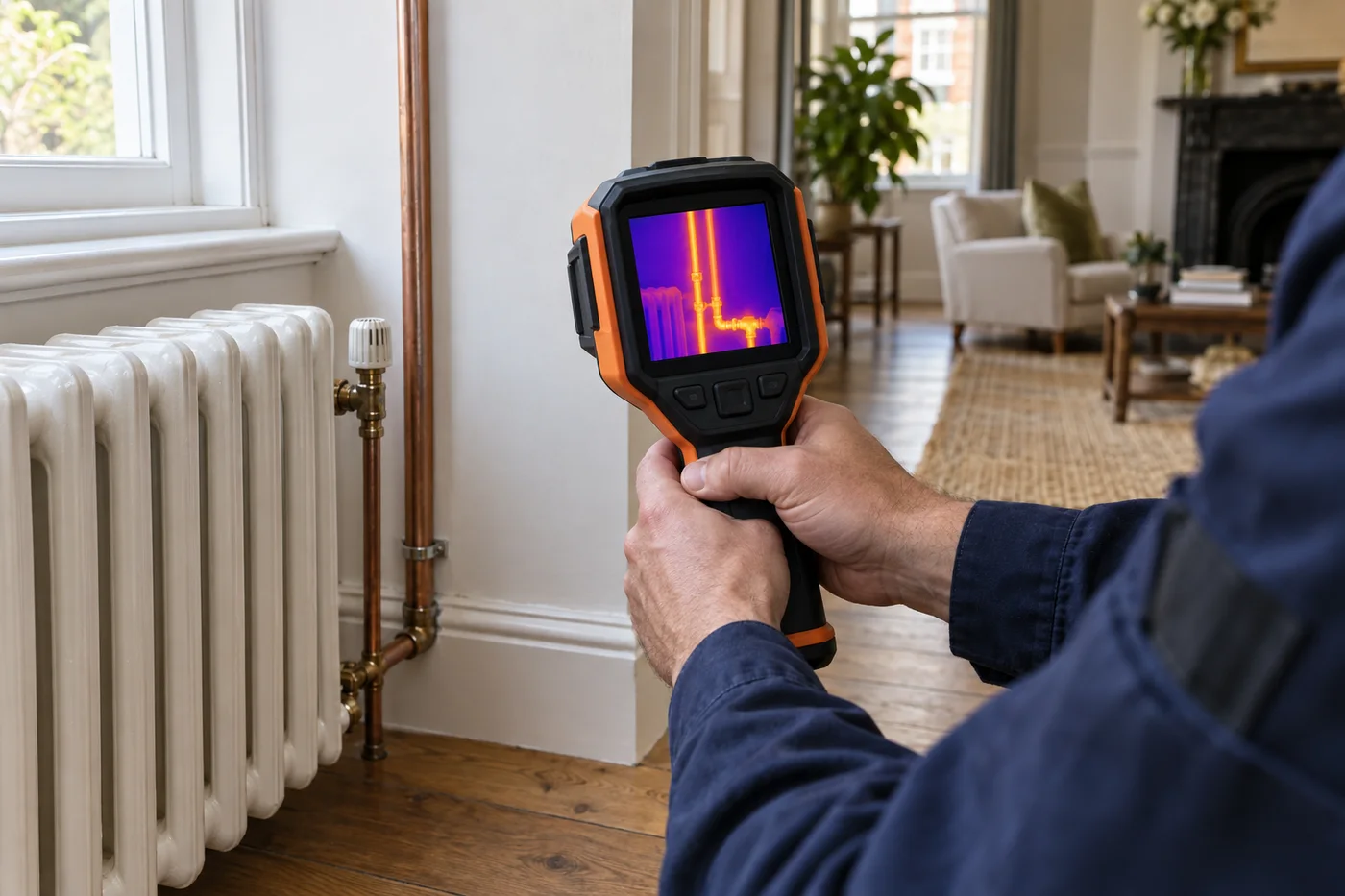
- Thermal imaging through floors and ceilings to follow the warm runs and find where water is moving through cold structure.
- Moisture mapping across the affected areas with dry reference readings, which gives the shape of the wetting and usually its direction of travel.
- Acoustic on live pressurised pipework and communal risers.
- Tracer gas on a drained circuit where the others cannot reach, which is non-invasive and tends to be the finding that ends the disagreement.
The output is a single written document naming which service is losing water and what has to be opened to reach it. For the agent, that is the thing that lets them allocate the cost under the lease, instruct the right party, and give the insurer something they can act on. The Financial Ombudsman, on how insurers should handle these claims, says it gives "greatest weight to reports from an independent expert". What the report contains sets out the full structure.
What the agent should get in writing before instructing anyone
- Who is instructing, and against which budget or claim.
- Whether the block policy includes trace and access, and its limit.
- Which flats need access, and on what notice. Where a flat is tenanted, the tenant gets the statutory notice, not just the leaseholder.
- Whether the same contractor carries out the repair and the reinstatement, or whether the block will be coordinating trades itself.
- What happens if nothing is found. Our terms are no find, no fee on the detection time.
The reinstatement question is worth pressing. A detection-only instruction on a block leak ends with an open ceiling, a closed corridor and three more contractors to appoint. Trace, access and reinstatement keeps the detection, the repair and the making good under one instruction, which on a managed block is usually the difference between a two-week job and a two-month one.
When it is not a block problem at all
Not every ceiling leak in a flat is somebody else's. Condensation in a poorly ventilated bathroom, a failed shower seal in the flat's own bathroom, a slow waste leak on the resident's own basin and historic staining that dried out years ago all present the same way and are none of the freeholder's business. A survey that says so, with readings, saves the block a claim and the excess that goes with it. Detection is charged at our hourly rate, agreed before attendance. See leaseholder responsibility for where the demise line usually falls, or book an engineer.