It is not a price, it is a share of an allowance
Most people read a water bill as the cost of the water. It is not. Thames Water's Statement of Significant Change for 2026/27 says it plainly: "For 2026/27, our allowed revenue has been set by Ofwat as part of our PR24 FD. This fixes the amount of revenue we can collect from our customers."
What follows from that is the whole shape of the bill. The regulator's 2024 price review determined how much the company may collect. That figure is then adjusted for inflation — a CPIH figure of 3.5% for this year, from the Office for National Statistics release of 17 December 2025 — for an in-period determination published on 13 November 2025 reflecting performance payments for 2024/25, and for a Blind Year Adjustment correcting a revenue over-recovery in 2024/25. The company also collects a Thames Tideway Tunnel infrastructure provider charge from wastewater customers on behalf of Bazalgette Tunnel Limited, which is money passing through rather than money earned. What lands on your bill is that total, divided across customers by tariff.
Which is why a metered bill can rise when you used less. You are not buying a commodity at a unit price; you are paying a share of a determined revenue, expressed as a unit price.
The parts of the charge
For a metered household in 2026-27 the charge has two halves. The volumetric part is £2.7346 per cubic metre for clean water and £1.4721 per cubic metre for wastewater from 1 April 2026. The fixed part is £66.87 for water and £128.13 for wastewater, or £80.43 where the surface water drainage rebate applies, and Thames Water describe those as covering "our essential costs, such as pipe maintenance and bill and payment processing".
They also publish where every pound goes: 55p on infrastructure, 37p on day-to-day services such as energy, government rates and salaries, and 8p on financing borrowing, with no dividends paid to shareholders since 2017.
Where that money stops
All of it buys the network. Reservoirs, treatment works, trunk mains, the distribution main under your street, and the communication pipe that runs from that main to the outside stop valve at your boundary. Not one penny of it maintains the supply pipe from that valve into your house.
That division is not a policy choice Thames Water made; it is how the industry is built, and it catches people out precisely because the rest of the chain is invisible and paid for. The boundary, drawn properly covers the legal position, including the awkward cases where your pipe crosses somebody else's land. What follows here is the money.
The four bills a leak actually generates
People arrive expecting one invoice. There are four, and they are paid by different parties.
| Cost | Who normally carries it |
|---|
| The water that escaped | You, at the metered rate, less any allowance the company grants |
| Finding the leak | You, or your insurer under trace and access cover |
| Repairing the pipe | You, or in limited cases the water company at its discretion |
| Putting the building back | Your insurer for damage; frequently nobody for the access opening |
The fourth row is where the money goes missing, and it is worth walking through.
Row by row
The water
Metered, so it is priced at £4.2067 per cubic metre combined and it accrues every hour. An allowance may cover the lost water once the repair is done, on conditions that include repairing within four weeks and claiming within three months. Unmetered, the water costs you nothing directly, which is why unmetered leaks run for years.
The finding
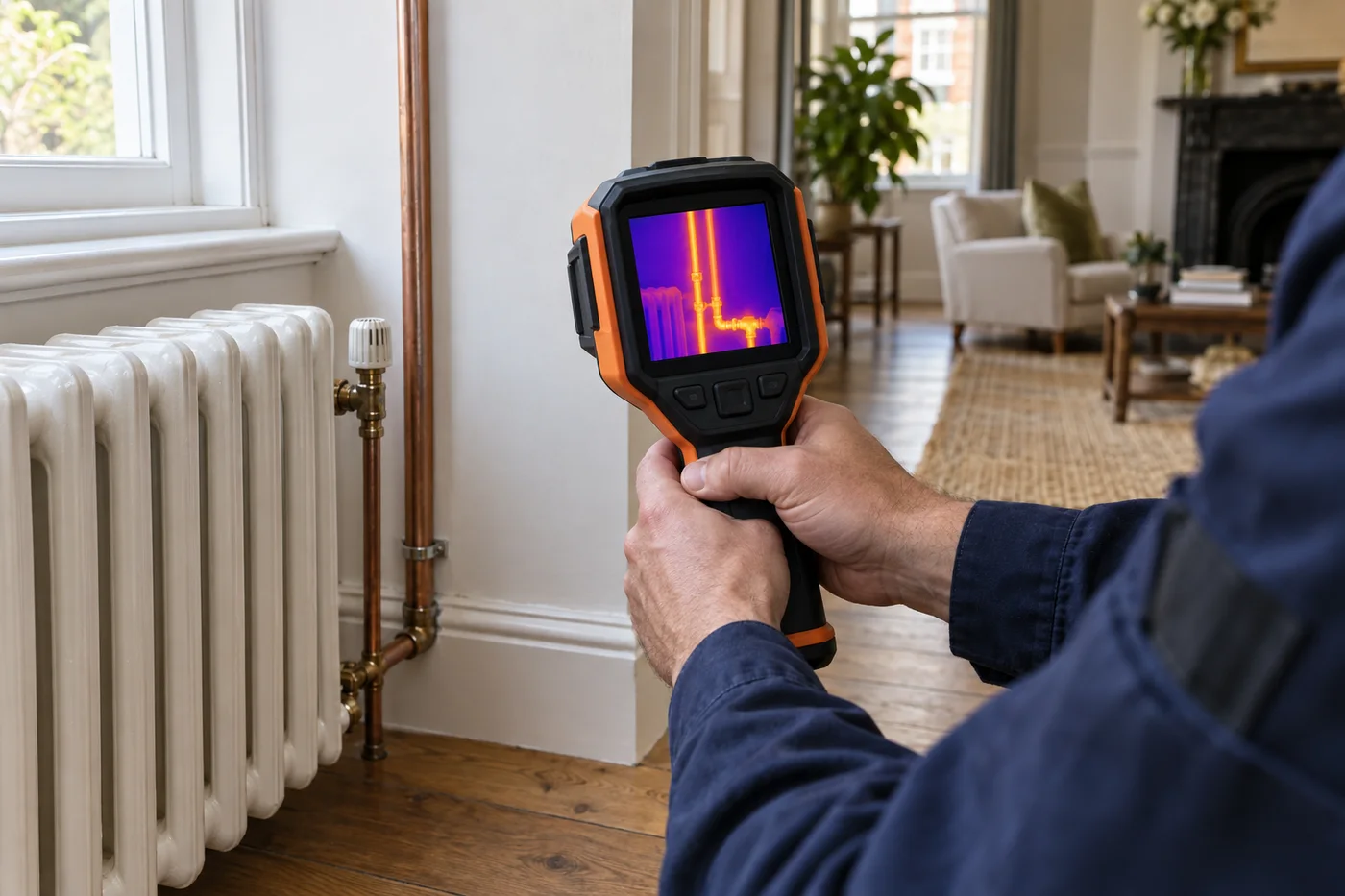
Detection is labour. There is no way to make it anything else: someone attends with acoustic, thermal, moisture and tracer gas equipment and works the site until the loss has a position. Many buildings policies fund exactly this under trace and access cover, which pays for the work of locating a leak and getting at it. What trace and access cover is explains the mechanism, and it is often present even where the supply pipe itself is excluded.
The repair
Yours, on your side of the valve. Thames Water's household customer side leakage code of practice describes discretionary help for customers in their Priority Services Register categories or on WaterHelp or WaterSure, and where there is a risk to life or to the supply network — and where they do repair, they work up to where the pipe enters the building and not to pipework underneath a building.
The making good
Here is the gap. Where Thames Water dig on a footpath or driveway they say they will restore the surface so it is safe, but cannot undertake specialist work such as relaying block or crazy paving, and if you arrange that yourself you carry the cost. A detection firm finds the leak and leaves. A plumber repairs the pipe and leaves. An insurer pays for damage caused by the escape of water, which is not the same thing as the hole somebody cut to reach it. Between those four positions sits a lifted Victorian tiled path, a cut screed, a ceiling with a metre square missing, and no one funded to close it.
Who pays for what, end to end
| Asset or task | Paid for by |
|---|
| Reservoirs, treatment, trunk and distribution mains | All customers, through the regulated revenue |
| Communication pipe, main to the outside stop valve | The water company |
| The outside stop valve itself | Company apparatus, but it marks your boundary, not their reach |
| Supply pipe, stop valve to the house | You, including where it crosses other land |
| Internal plumbing and heating | You |
| Thames Tideway Tunnel | Wastewater customers, via a charge collected for Bazalgette Tunnel Limited |
| Locating a hidden leak | You, or your insurer under trace and access |
| Damage caused by the escape of water | Your insurer, subject to excess and exclusions |
| Reinstating what was opened to reach the pipe | Usually unfunded unless you contract for it |
The question to ask before anyone attends
Not "what is your hourly rate", though you should ask that too. Ask who puts the floor, the path or the ceiling back, and get the answer before the work rather than after. A firm that answers "you will need a builder for that" has told you the truth about its scope, and you can then price the builder before you commit rather than discovering the second invoice from a hole in your hallway.
Our answer is the reason this company exists. We work at £150 per hour, agreed before we attend, and if we do not find the leak you do not pay for the time we spent looking. We repair the pipe and then the flooring, screed, plaster, ceiling, tiling and decoration go back, by our own people. Trace, access and reinstatement is the whole sequence in one contract, and pricing is one page that does not move.
When not to call us
If the water is in the road or the pavement, it is on the company's side and reporting it is free. If you rent, the repair is your landlord's. If your bill has risen and your usage explains it, there is nothing to find — the water bills hub works through that diagnosis in order. And if you are struggling to pay, ask Thames Water about WaterSure, WaterHelp and their Extra Support Scheme before you spend money proving anything.