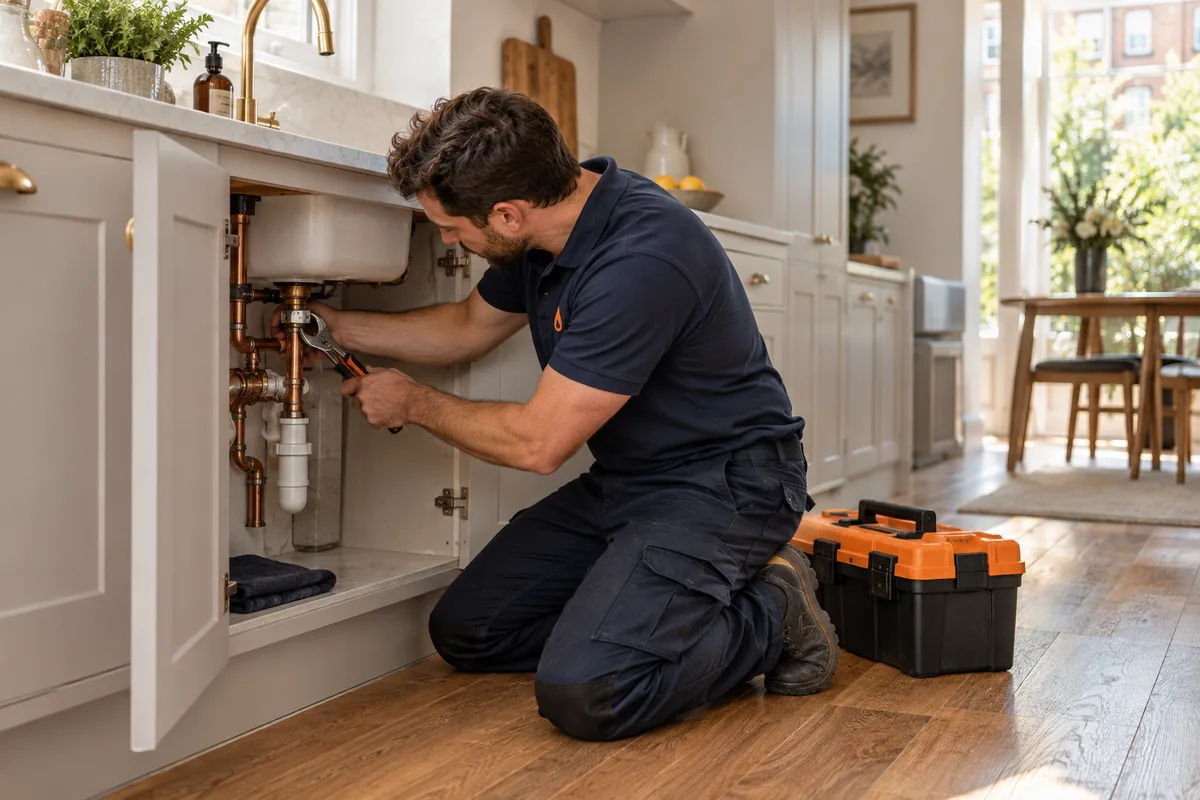
The first ten minutes
A cylinder leak is fed. It does not stop on its own, because something keeps refilling the vessel — a cistern in the loft, or the mains. Cut that feed first.
- Switch the immersion heater off at the fused spur, not at the cylinder thermostat. If the water level drops below the element it will burn out, and you have water running down a case with a 3kW element bolted into it. If the switch or the flex is wet, leave it and turn the circuit off at the consumer unit instead.
- Turn the boiler off if the cylinder is heated by the boiler rather than by immersion alone. No reason to keep pushing heat into a vessel that is emptying.
- Close the cold feed. On a vented cylinder that is the gate valve on the cold feed pipe at the base, or the ball valve in the cold water storage cistern in the loft — tie the float up to the batten if there is no valve. On an unvented cylinder it is the isolating valve on the inlet control group, the cluster of brass valves where the mains enters.
- Drop the level. Open a hot tap. Once the water falls below the leak point it stops. Only with the immersion already off.
- Protect what is underneath. Most London cylinders sit in a first-floor airing cupboard, on boards, over someone's ceiling.
What not to do: keep topping it up and carry on. A cylinder weeping at a seam under 3 bar of mains pressure does not hold, and the damage is almost always to the floor and ceiling rather than to the cylinder.
Check it is the cylinder before you condemn it
Three things get blamed on cylinders and are not cylinder failures.
Condensation
An airing cupboard is warm and often unventilated. The cold feed pipe and the lower third of a recently refilled cylinder are cold, so moisture forms on them and runs down. Condensation spreads evenly across a cold surface in a thin film rather than running from one point, and if you wipe it dry it takes an hour or more to come back. A leak returns in minutes and always has a source you can put a finger on.
Something above it
Airing cupboards are where the pipework bundle goes, and they are frequently under a bathroom. A wet crown means the water is coming from above: a joint on the hot draw-off, a valve overhead, or a bathroom floor upstairs. Dry top, dry sides and water only at the base points at the cylinder or its base connections. That one observation saves more unnecessary replacements than anything else here.
Water from the tundish is not a leak
On an unvented cylinder, a small plastic funnel called a tundish sits in a pipe near the top of the vessel and discharges to a drain or outside. Water running through it means the expansion relief valve or the temperature and pressure relief valve has opened — the safety chain working. The usual cause is a failed expansion vessel or a lost air bubble, so heated water has nowhere to expand to and the valve dumps the excess. It is a fault and it needs fixing, but the cylinder is not leaking, and nobody should be quoting you for a new one on the strength of it. Discharge that never stops, or discharge that is hot, wants attention the same day.
The four places a cylinder actually leaks
1. The immersion heater boss
The commonest of the four, and the most repairable. The immersion element screws into a threaded boss on the shell, sealed by a fibre or rubber washer. The washer perishes with age and heat cycling, the element corrodes where it passes through the boss, or it was overtightened on the last change. Water appears at the immersion plate and tracks straight down, so the jacket is dry above the boss and soaked below it. A new element and washer fixes it — unless the boss itself has corroded or distorted, in which case the seal will not take and the cylinder is finished.
2. The connections
The cold feed at the base, the hot draw-off at the crown, the secondary return tapping, the drain cock and the thermostat pocket. All joints, and joints weep. A weeping compression nut or a failed drain cock is a twenty-minute repair. A weep where the tapping itself meets the shell is not, because that joint — soldered on copper, welded on stainless — cannot be remade in situ.
3. The coil, which leaks internally
An indirect cylinder has a coil inside it carrying heating water from the boiler. The two circuits never mix. When the coil perforates they do, and the tell is not a puddle but a pressure that makes no sense:
- Unvented cylinder, sealed heating system: the mains side is at higher pressure than the heating side, so hot water is forced into the heating circuit. The boiler gauge climbs, the pressure relief pipe outside drips after every firing, and topping the system down does not hold.
- Vented cylinder, open-vented heating: the stored water pushes into the primary circuit and the small feed and expansion tank in the loft rises and overflows continuously.
- Either: discoloured, grey or black hot water at the taps, because inhibited heating water is now in the domestic supply. That water should not be drunk or bathed in.
A perforated coil cannot be repaired; the cylinder is replaced. Get it diagnosed properly first, because a failed expansion vessel produces some of the same pressure behaviour with no coil failure at all, and the two are separated by isolating and pressure-testing each side, not by looking.
4. The vessel itself
The dome weld, the longitudinal seam, or a pinhole in the shell. On an older copper cylinder this is usually corrosion, often accelerated where the sacrificial anode has been consumed. On a stainless unvented vessel it is more often a weld defect or chloride attack. The foam insulation is what makes this one hard to catch early: it holds the water, hides where it started, and can soak for weeks before anything surfaces where you can see it. There is no in-situ repair. A pressure vessel with a hole in it is replaced.