London-wide leak specialists
ResidentialCommercial
Get in touch
Book an engineer

Banging, Hissing and Whistling: Which Pipe Noise Means a Leak

Banging happens at the instant a tap or valve closes and is water hammer or an unclipped pipe, not a leak. The noise that matters is a steady hiss, whoosh or trickle that continues when every tap, cistern and appliance in the property is off.

Leak Fix LondonLast updated

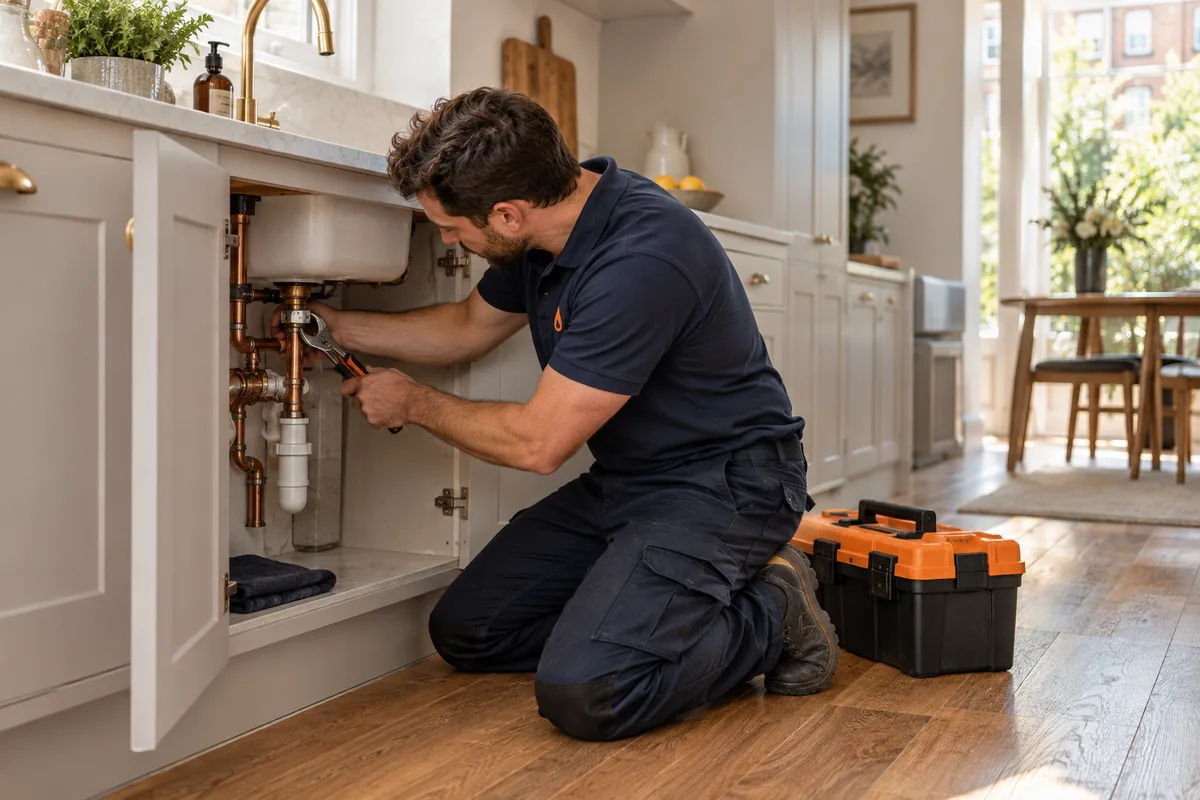
A Leak Fix London engineer working on pipework in a London home

The noise table

Work out when the noise happens before you work out what it is. Timing separates six of these seven cases on its own.

NoiseWhenUsual causeA leak?
Single loud bang or knockThe moment a tap, washing machine or dishwasher valve shutsWater hammer: a pressure surge with nowhere to goNo
Rattling or repeated knockingWhile water is runningA pipe not clipped, moving against a joist or wallNo
Steady hiss or whooshContinuous, with everything offWater escaping through a small opening under pressureYes
Trickling or running waterContinuous, with everything offWater moving where there should be none, or a passing valveUsually
Whistle or squealOnly while one outlet runsA restriction: limescaled aerator, worn washer, partly closed valveNo
GurglingAfter a sink, bath or WC emptiesDrainage venting, often a failing air admittance valveNo, but see below
Ticking or creakingAs the heating comes on and goes offPipework expanding through a joist notchNo

One clarification on gurgling. It is a drainage noise, not a supply leak, so it is not our job as a detection call. It does sometimes travel with a smell and a damp ceiling below, and that combination is worth reading about in why a bathroom smells of drains.

Banging: what is actually happening

WaterSafe, the UK register of approved plumbing businesses, lists the causes of banging pipework directly. Faulty ball valves can generate noise. If pipes are not clipped correctly, they may move and hit against walls or flooring. If air is trapped at the stop tap, this can cause the pipes to vibrate and produce a hammering or banging sound. Loose fitting washers, or jumpers, in stop taps do the same.

Underneath all four is the same physics. Water in a pipe has momentum. Close a valve quickly and that momentum has to go somewhere, so it becomes a pressure spike that travels back down the pipe and shakes anything not firmly held. Modern solenoid valves in washing machines and dishwashers close far faster than a hand-turned tap, which is why the problem often appears the week a new appliance is installed and nothing else has changed.

The plumbing regulations treat this as a design requirement rather than a nuisance. Schedule 2 of the Water Supply (Water Fittings) Regulations 1999 requires at paragraph 3(b) that fittings be constructed of materials of such strength and thickness as to resist damage from any external load, vibration, stress or settlement, pressure surges, or temperature fluctuation, and at paragraph 4(d) that water fittings be adequately supported. A pipe that bangs is a pipe that is not adequately supported, or a system with surges it was never designed to absorb.

What you can do about banging yourself

  1. Identify the trigger. Run each tap and each appliance in turn and note which one produces the bang. If it is one appliance, the fix is at that appliance.
  2. Check the cistern. Lift the lid on the WC and watch it refill. A ball valve that chatters or slams as it closes is the classic cause of a bang heard all over the house. A replacement float valve is a cheap part.
  3. Open the stop tap fully, then close it a quarter turn. A partly open stop tap creates turbulence and a loose jumper inside it rattles.
  4. Clip what you can reach. Pipes under a bath, in an airing cupboard or under floorboards you can lift should be held every metre or so on horizontal runs. WaterSafe's advice is to ensure pipes are properly secured with brackets or clips.
  5. Pad where pipes pass through timber. A pipe sitting hard in a joist notch transmits every surge into the floor. Felt or foam in the notch removes most of it.
  6. Consider a pressure reducing valve. WaterSafe suggests one to regulate the flow and protect the plumbing system from stress, and it is the right answer where incoming pressure is genuinely high.

None of that is a job for a leak specialist, and we would rather tell you so than attend. If the banging persists after the cistern and the clipping have been dealt with, it is an hour of a general plumber's time.

The hiss, and how to listen for it properly

A hiss is water forcing itself through an opening smaller than the pipe. With everything genuinely off, there is only one way for that to happen.

Listen at night, when the street is quiet and nobody upstairs is running anything. Turn off every tap, make sure no cistern is refilling, switch off the washing machine and dishwasher at the wall, and stand still for a minute before deciding you can hear nothing. Then put your ear against the incoming pipe at the stop tap. The handle of a long screwdriver held against the pipe, with your ear on the other end, transmits sound far better than air does and costs nothing.

If you can hear it at the stop tap, close the stop tap. If the noise stops, the loss is downstream inside the property. If the noise continues with the stop tap closed, it is upstream on the supply pipe or the main, and that is a supply-side investigation. Either way, confirm it with the meter: note the reading, use nothing for an hour, and read it again. A meter that has moved has settled the question, and a meter turning with everything off explains how to read the leak indicator dial.

Airlocks, which sound alarming and are not

An airlock produces spluttering, a juddering tap and sometimes a knock, and it is often mistaken for a serious fault. It is air trapped at a high point in the pipework, usually after the supply has been off for a repair or after a system has been drained and refilled. The standard remedy is to connect a hose between the affected hot and cold taps and use mains pressure on the cold side to push the air out through the hot. It is a twenty-minute job with a hose and two jubilee clips and it needs no engineer.

What separates it from a leak is that an airlock is loud only while water is moving. A leak is loud when nothing is moving. If in doubt, the meter answers it.

When the noise is the only symptom

A surprising number of jobs start with someone hearing running water in a wall and nothing else: no damp, no stain, no pressure change, no visible anything. That usually means a pipe leaking into a void that drains somewhere, under a suspended floor, into a cavity, or down the outside of a soil stack. It will show eventually. It is considerably cheaper to find before it does.

The method is acoustic. A ground microphone or a contact microphone picks up the frequency signature of water escaping under pressure, which is distinct from flow noise and from building noise, and the loudest point along the run is the leak. On a buried supply pipe with two accessible contact points, a correlator times the noise arriving at each end and calculates the distance between them. Where the system can be isolated and drained, tracer gas is introduced instead and detected at the surface, which works through screed, tile and plaster.

What none of that requires is guessing, and none of it requires lifting a floor to have a look. That is the whole point of water leak repair done in the right order: locate, then open at one point, then repair, then make good.

What it costs

Detection is £150 per hour, agreed before we attend, and if we do not find the leak you do not pay for the time spent looking. A noise with no other symptom is usually a short visit, because the property can be isolated section by section quickly. See pricing.

Frequently asked

Are banging pipes dangerous?
Repeated pressure surges are not a safety risk in the way a gas fault is, but they do work joints loose over time, which is how a banging pipe eventually becomes a leaking one. The regulations require fittings to resist pressure surges and to be adequately supported, so persistent hammering is worth correcting rather than living with.
Why do my pipes only bang when the washing machine fills?
Appliance solenoid valves close in a fraction of a second, far faster than a tap, so they generate the sharpest surge in the system. Fitting a slow-closing valve, adding an arrestor at the appliance, or reducing incoming pressure with a pressure reducing valve all address it.
I can hear running water but there is no damp anywhere. Is that possible?
Yes, and it is common. Water leaking into a suspended floor void, a cavity, or alongside a drain runs away instead of collecting, so nothing shows. The meter test settles it: if the meter moves with everything off, the water is going somewhere.
Can you find a leak from the sound alone?
Often, on pressurised pipework. Acoustic detection identifies the loudest point along a run, and on a buried supply pipe a correlator can calculate the position between two contact points. On a drained or unpressurised system there is no noise to hear, and we switch to tracer gas or thermal imaging.

Sources

No find, no fee · £150 per hour. The rate is fixed before we attend and does not rise for a difficult property, an awkward access or an evening visit. The total depends on how long the job takes; the rate cannot change.