Where Dyno-Rod is very hard to beat
Dyno-Rod has been trading since 1963, was a founding member of the British Franchise Association in 1977, and has been inside the Centrica group since 2004. On 19 September 2026 its Trustpilot profile stood at 4.8 out of 5 from 50,318 reviews, with 90% of them at five stars. Fifty thousand reviews at 4.8 is not a number anyone should wave away, and we are not going to.
For a blocked drain, a collapsed sewer, jetting or a CCTV survey, Dyno-Rod is the default for good reason: the national network means somebody with the right vehicle is usually close, the drains capability is the original business, and there is no call-out charge. If your problem is a drain, stop reading and call them.
The reason this page exists is that "leak detection" and "drainage" get treated as the same purchase, and they are not.
What Dyno-Rod publishes about leak detection
Dyno-Rod does market leak detection, and at considerable scale: 764 templated location pages under /services/dyno-leak-detection-, covering Mayfair, Belgravia, Bloomsbury, Covent Garden, Soho, Paddington, Maida Vale, Fitzrovia, Belsize Park and hundreds more.
Three things are true about those pages, and all three are checkable in a minute.
- No detection method is named on any of them. The strongest published statement is that professionals "will deploy the latest and most sophisticated technology to identify exactly what your issue is". Thermal imaging, acoustic, tracer gas, tracer dye and camera inspection appear nowhere.
- No price or price range appears. The pages carry a no-call-out-charge line and a three-month workmanship guarantee, and nothing numeric.
- Leak detection is not in the main navigation or the plumbing menu, which lists emergency plumbing, outside plumbing, bathroom plumbing and kitchen plumbing only.
State that carefully, because it is a statement about pages and not about people. It does not mean a Dyno-Rod engineer cannot find your leak. Plenty will. It means that before anyone arrives, you cannot find out from their website what equipment is coming, what the search costs, or what happens if the search does not work. For a blocked drain none of that matters much, because the outcome is visible within the hour. For a leak under a screed floor, it is the whole question.
What we publish instead
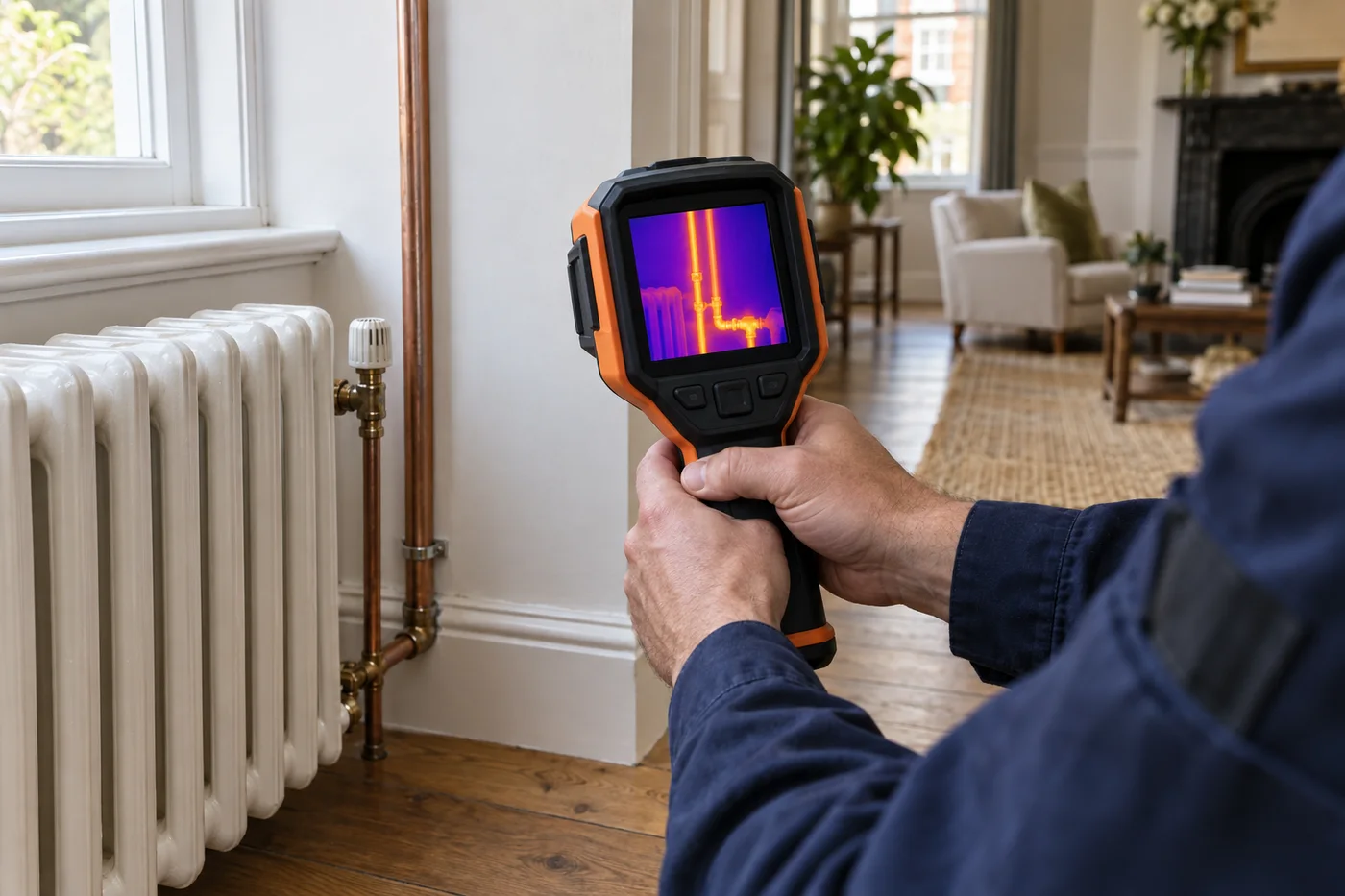
We charge £150 per hour, fixed before we attend. We name our five methods: acoustic, thermal imaging, moisture mapping, pressure testing and non-invasive gas tracer. We work no find, no fee, so if the leak is not located you do not pay for the time we spent looking. Our pricing page carries the whole of it in one place.
Then we repair the pipe, in copper, MDPE, push-fit or lead, and our own handymen and builders put back what had to come up: floor, screed, plaster, ceiling, tiling, decoration. Dyno-Rod's plumbing menu lists no making-good or reinstatement service, which means that on a job where a floor has to be lifted, the lifting and the relaying are your problem to solve with someone else. That is not unusual. Almost every leak firm in London works that way, which is precisely why we do not.
Fixed-price quote versus hourly rate: which is actually better for you
Their model and ours are genuinely different, and neither is automatically the better one.
Dyno-Rod's published promise is a fixed price quoted on arrival, before any work begins, with no call-out fee. The strength of that is obvious: you hear one number and you decide. The limitation on a hidden leak is that a fixed price can only be quoted once someone knows the scope, and on a leak nobody has located, the scope is the unknown. A quote given on the doorstep for a search of unknown length has to price that uncertainty somewhere.
Our model puts the uncertainty the other way round. You know the rate before we set off, it cannot rise for an awkward property or an evening visit, and if the search fails you pay nothing for it. What you do not get is the total in advance, and we will not pretend otherwise: a fixed hourly rate is not a fixed price. If knowing the exact number before anyone starts matters more to you than knowing the method and capping your downside, their structure suits you better than ours. That is a real preference and it is fine to hold it.
The franchise structure, stated plainly
Dyno-Rod describes itself in its own words as "a franchise business offering full national coverage from highly trained local engineers". It publishes "over 50 franchisees" on its prices page and "over 45 franchisee businesses" on its About page, both live on the same day, alongside "over 1,200 engineers and support staff". Its own leak-detection pages attribute equipment access to that structure: being a multi-national franchise, it says, is what lets it access the best technology.
Two practical consequences follow from the structure itself, and neither is an accusation.
The first is that the business you deal with in London is a local franchise operating under a national brand, so experience can differ between territories in a way it cannot inside a single company. You can see the structure in the accreditations: the Which? Trusted Traders endorsement is held franchise by franchise rather than centrally, and on 19 September 2026 the Central London profile carried 3.0 from two published reviews while the North West London profile carried none. Two reviews prove nothing about service quality and we are not claiming they do. They do demonstrate that the endorsement, and the review history attached to it, is territorial rather than national.
The second is that in a national network taking calls on one number, the person who books the job, the person who quotes it and the person who attends are three different people. With us they are the same person, and on a leak that has already survived one or two visits from somebody else, that continuity is most of what you are paying for.
When Dyno-Rod is the better call
- The problem is a drain: blocked, slow, smelling, backing up, or needing a CCTV survey.
- You are outside London. Their coverage is national and ours is not.
- You want one number quoted on the doorstep before anything starts, and you are willing to trade method transparency for it.
- The job is straightforward plumbing and the three-month guarantee is what you want.
- You are a landlord or managing agent already inside a British Gas or Centrica arrangement and want the invoicing in one place.
When to call us instead
- Water is appearing and nobody has established where it is coming from.
- Somebody has already attended and either failed to find it or found the wrong thing.
- Your boiler pressure keeps dropping with no visible leak anywhere.
- A floor, screed or ceiling has to be opened and you want the same firm to open it, repair the pipe and put it back.
- You are making a trace and access claim and need a report written to be accepted by an insurer.
And when to call nobody: if the damp patch appears only after a shower and dries within a day, that is usually a failed seal or grout, and it is a tube of sealant rather than a detection visit. If your stopcock is weeping, a plumber sorts it in under an hour. Detection is for water you cannot trace to a source, and if you can see the source you should not be paying anyone to look for it.